Calibration, empirical chronology, interacting matter, reciprocal dynamics, release and reserved predictions. Each result retains its stated physical scope.
Ordinary calibration and unidentified field response
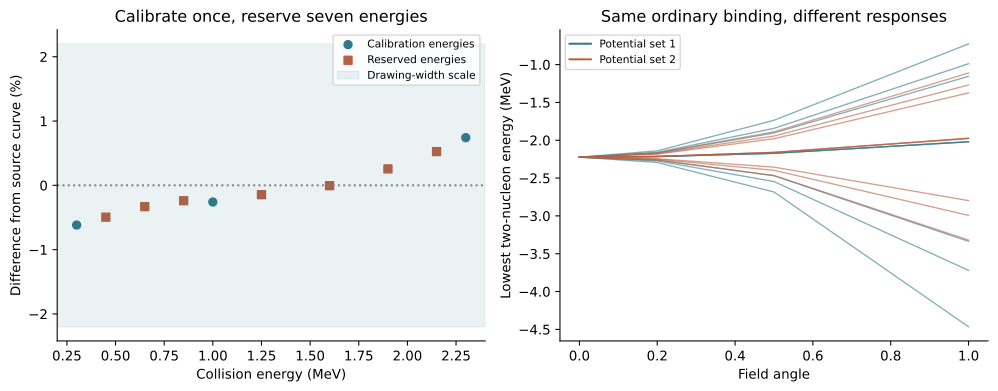
Three capture energies calibrate one E1 counterterm; seven other source-curve energies are reserved. The shaded drawing-width scale is not measured experimental covariance. Explicit OBE fits agree on ordinary deuteron binding but diverge under independent contact-response scenarios and predict an unwanted bound singlet. These fits do not resolve the printed source convention. Provenance · Data · PNG
Empirically calibrated alpha–alpha continuum
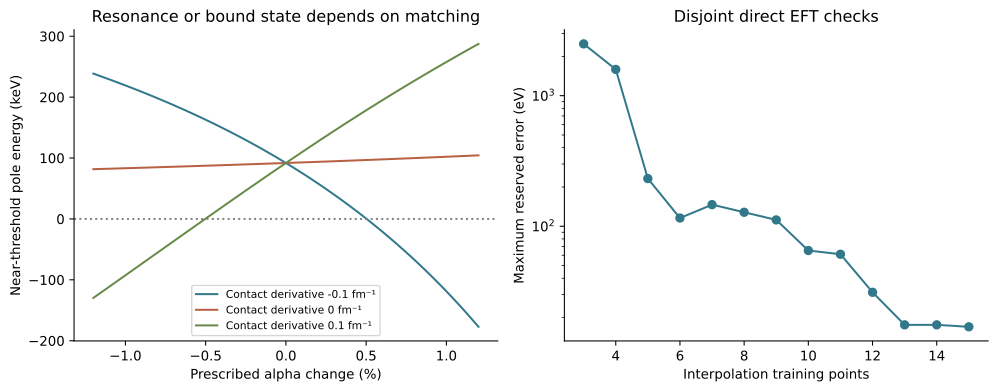
A separate Coulomb-resummed cluster EFT matches the empirical 91.84 keV, 5.57 eV Be-8 pole. Complex outgoing poles replace the real-axis approximation above 10 keV; widths below that scale are negligible at the stated precision. Short-range derivatives are scenarios, not measured inputs. Greedy interpolation uses 64 disjoint direct EFT checks; its accuracy is neither lattice accuracy nor an EFT-theory error estimate. Provenance · Data · PNG
Measured chronology in a joint history likelihood
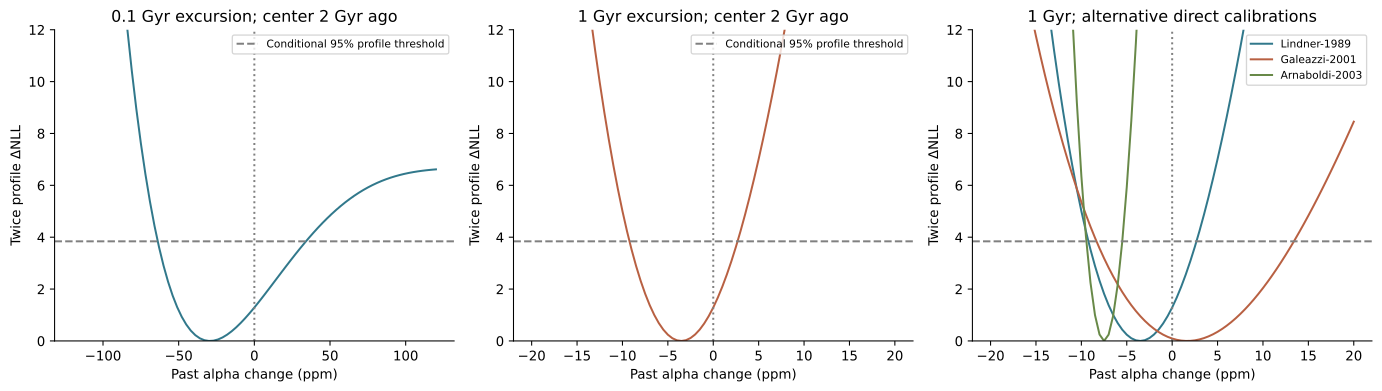
Real Re/Os and corrected W observations are combined with an affected compressed Pb/Pb anchor. The left two panels use the historical Lindner direct half-life. The right panel substitutes the later Galeazzi and Arnaboldi measurements, treating their quoted statistical/systematic errors as independent Gaussian terms. These alternatives are not combined into a consensus. Unknown x/y correlation, additional common W error and W-to-Re closure delay are zero in this display; the full results scan alternatives. A calibration-dependent displacement is not a detection of changing constants. Provenance · Data · PNG
Dense candidate versus a gas confined by the box
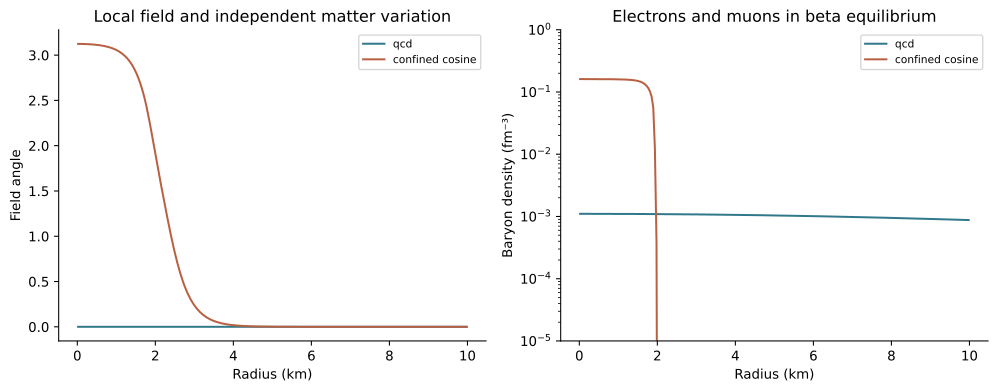
Both actions use the same ordinary saturation anchors, fixed baryon number and weak shell gravity. The cosine candidate passes radial energy-curvature and outer-box tests; the QCD gas radius follows the box. Muons are included after the electron-only audit identified their threshold. A local minimum of this phenomenological cold functional is not a matched astrophysical object. Provenance · Data · PNG
Formation and removal within the same cold benchmark
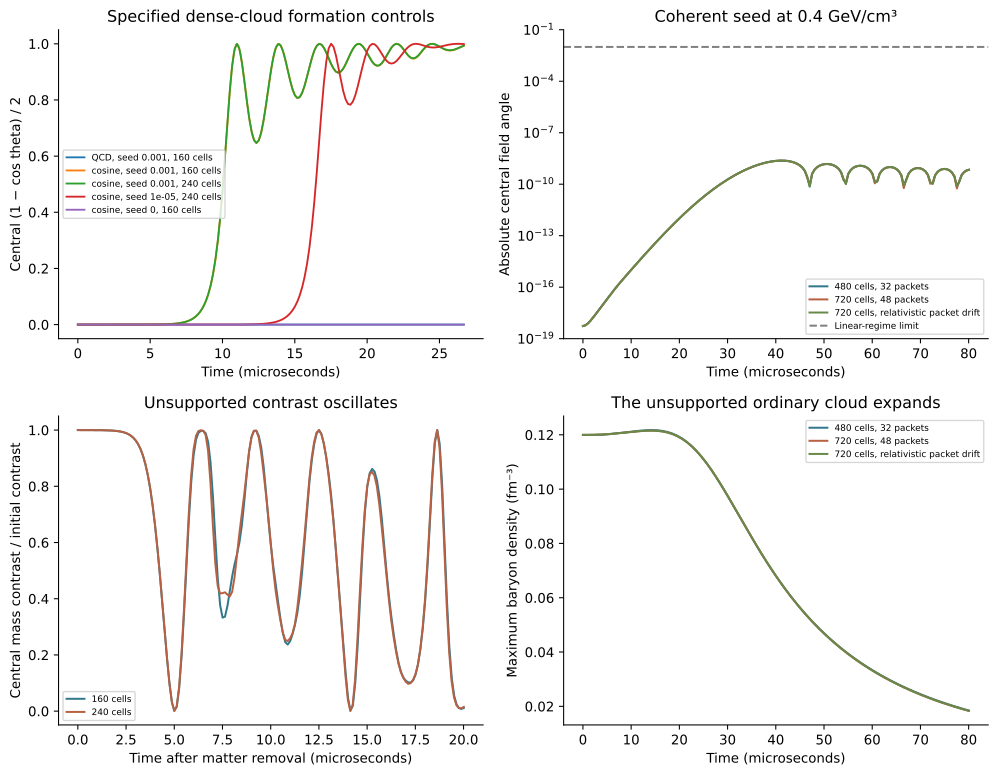
Large specified seeds form contrast in smooth spherical matter at n≈0.12 fm⁻³, f_a=10¹⁶ GeV. A coherent seed normalized to the stated reference density instead remains tiny through 80 microseconds as the ordinary cloud expands. That linear response uses reciprocal zero-seed matter trajectories in a larger box with two grid/packet resolutions. The reference density is a design assumption. Matter removal is a separate intervention; its subsequent periodic contrast oscillates. These controls supply neither a stellar lifetime nor an astrophysical occurrence rate. Provenance · Data · PNG
Release, transport and genuinely reserved element ratios
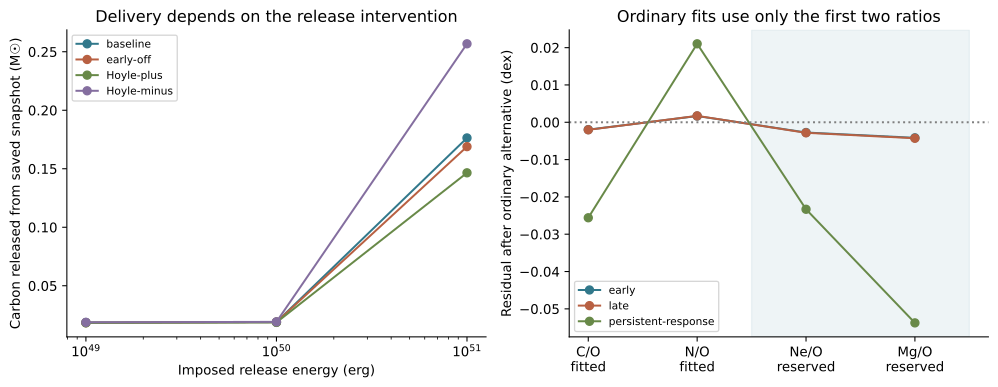
Contiguous exterior shells are released from actual helium-exhaustion profiles under an explicit binding budget and 1.4 M☉ retained-mass floor. This is not terminal ejecta or a compact-remnant identity. Released species and winds enter conservative delayed recycling. Ordinary energy and burst fraction are fit to C/O and N/O, with the family selected on those channels alone; Ne/O and Mg/O remain reserved. All displayed rate histories are imposed conditional cases. Provenance · Data · PNG
Transported patterns drive thermal and gravitational response
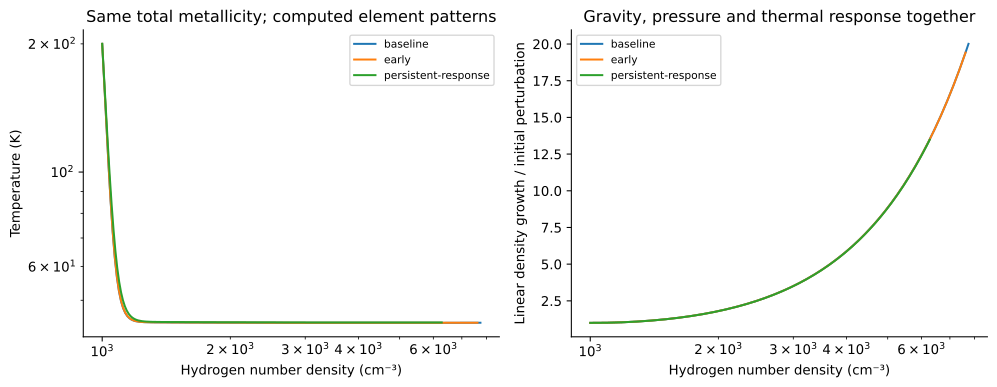
At Z=10⁻⁴ and one initial Jeans wavelength, the displayed trajectories stop at optical depth unity. Other runs stop at the linear-perturbation limit. Different final amplitudes can refer to different stop densities and must not be compared as fragment counts. Atomic C/O cooling, molecular/dust omissions and specified free-fall backgrounds delimit this calculation; no IMF is predicted. Provenance · Data · PNG