Public inputs: expanded experiments
Executed calculations, physical assumptions and unresolved matching.
Findings · Coverage · Original protocols
Propagating a released nuclear posterior
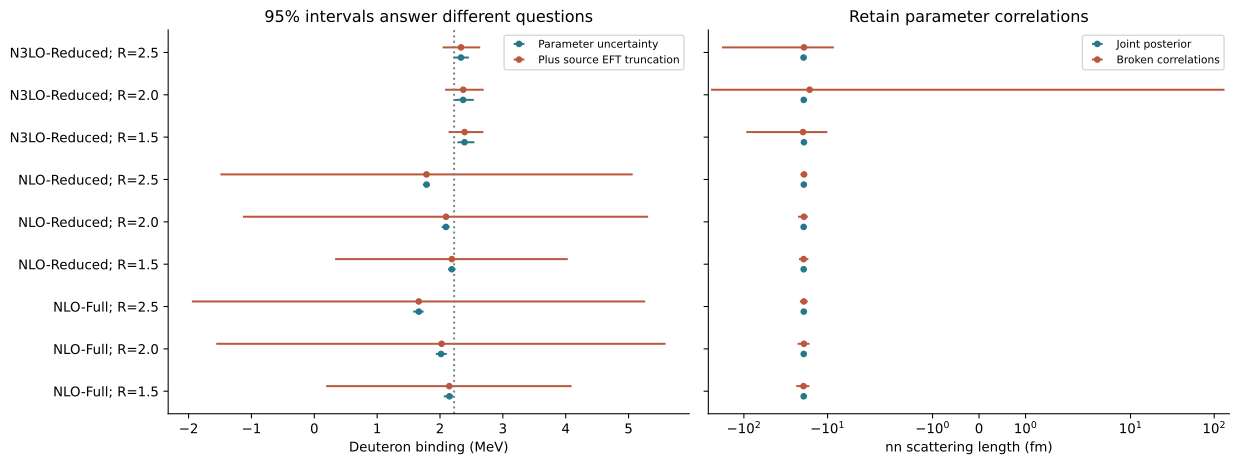
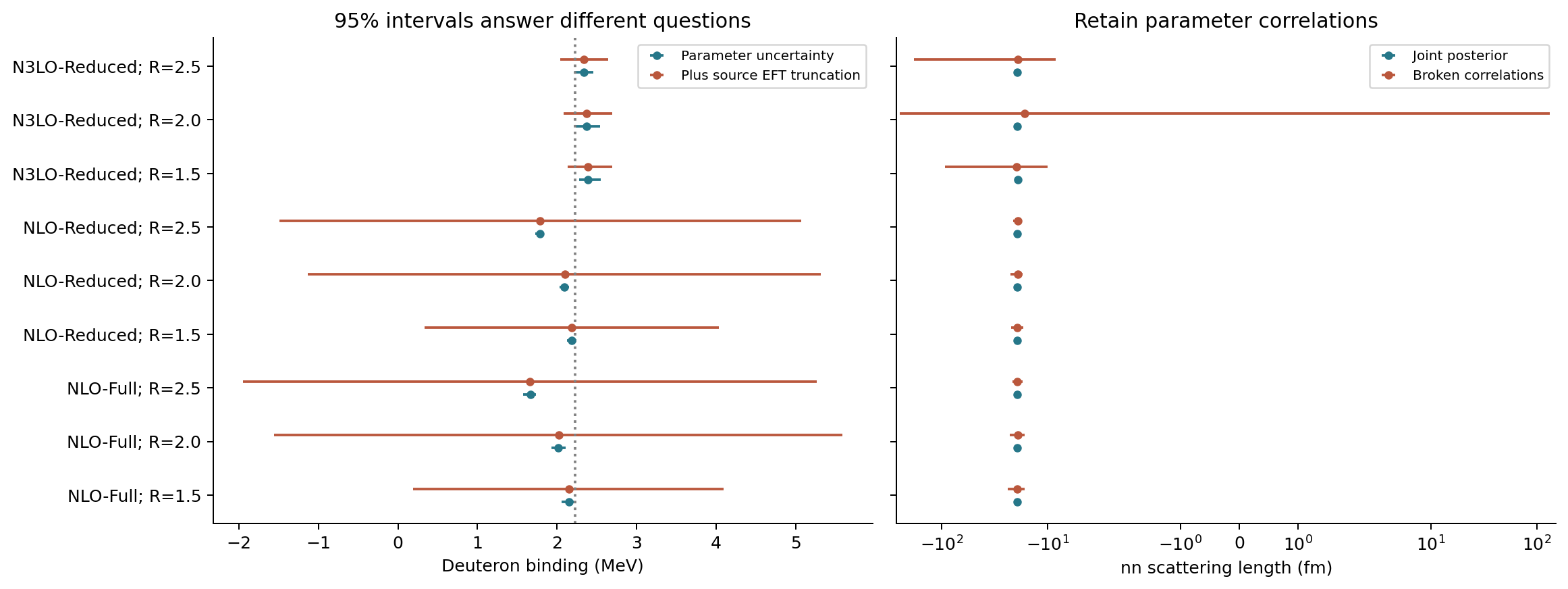
Nine source model/regulator combinations supply 225,000 singlet samples and 1,728 coupled deuteron solves. Binding and nn scattering were included in source calibration. Orange binding intervals marginalize the conditional Gaussian truncation model over the same joint LEC/hyperparameter draws; its negative draws are not probabilities of an alternative phase. Independently shuffling parameter columns is an intentionally invalid control that shows why covariance matters.
Data · Provenance · PNG · SVG
The public Bonn tensor benchmark
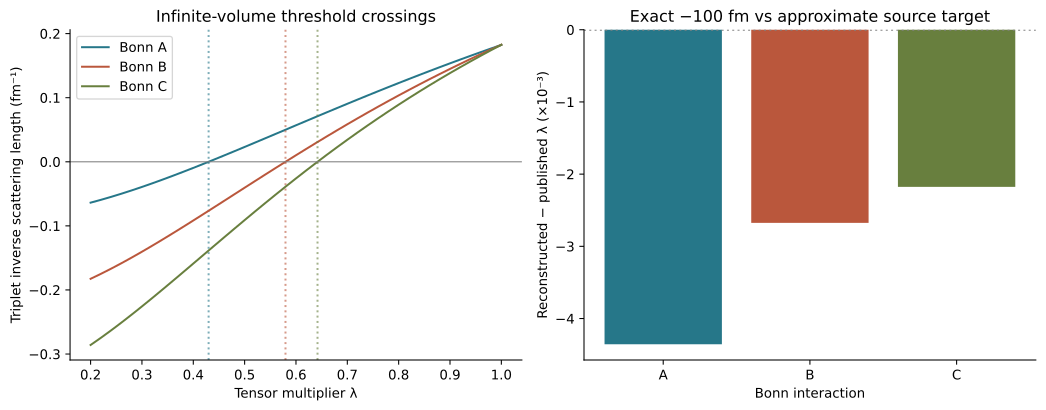
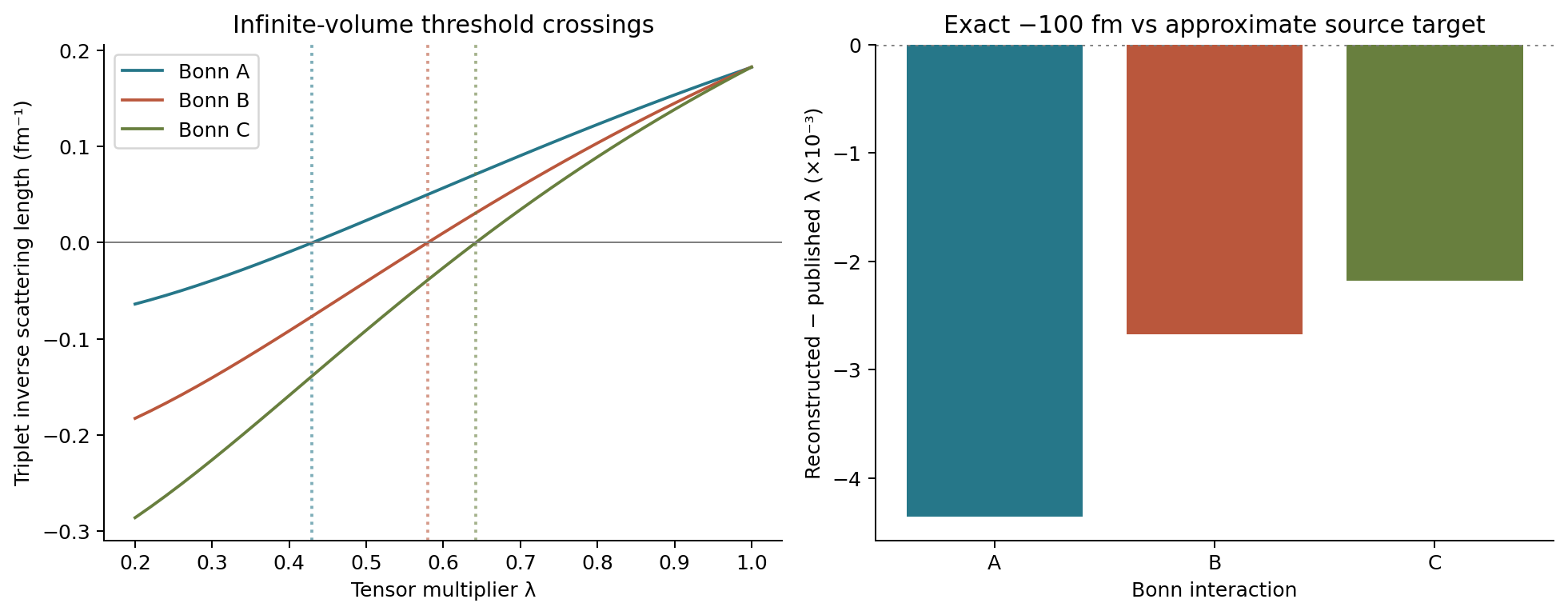
The original potential core and published A/B/C parameters reproduce ordinary binding within several eV. The tensor operator is independently projected with a checked LSJ phase. Unitarity and finite negative scattering length are different targets. The right panel compares our exact a=−100 fm points with source multipliers described only as approximately −100 fm, without a precision budget. At those quoted multipliers our values are about −116 fm. The plotted difference does not by itself establish a discrepancy with a precision source datum. These are Hamiltonian perturbations, not field predictions.
Data · Provenance · PNG · SVG
Three-body predictions and formation rates
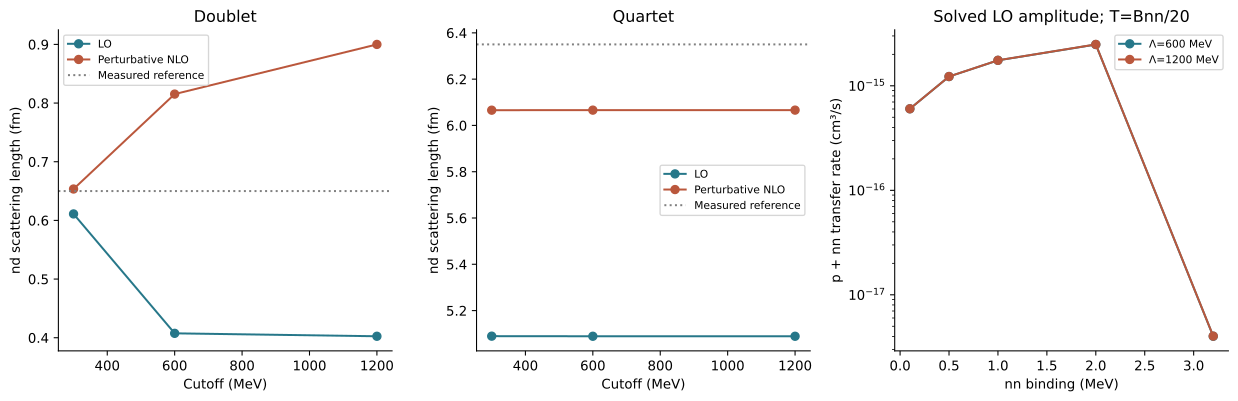
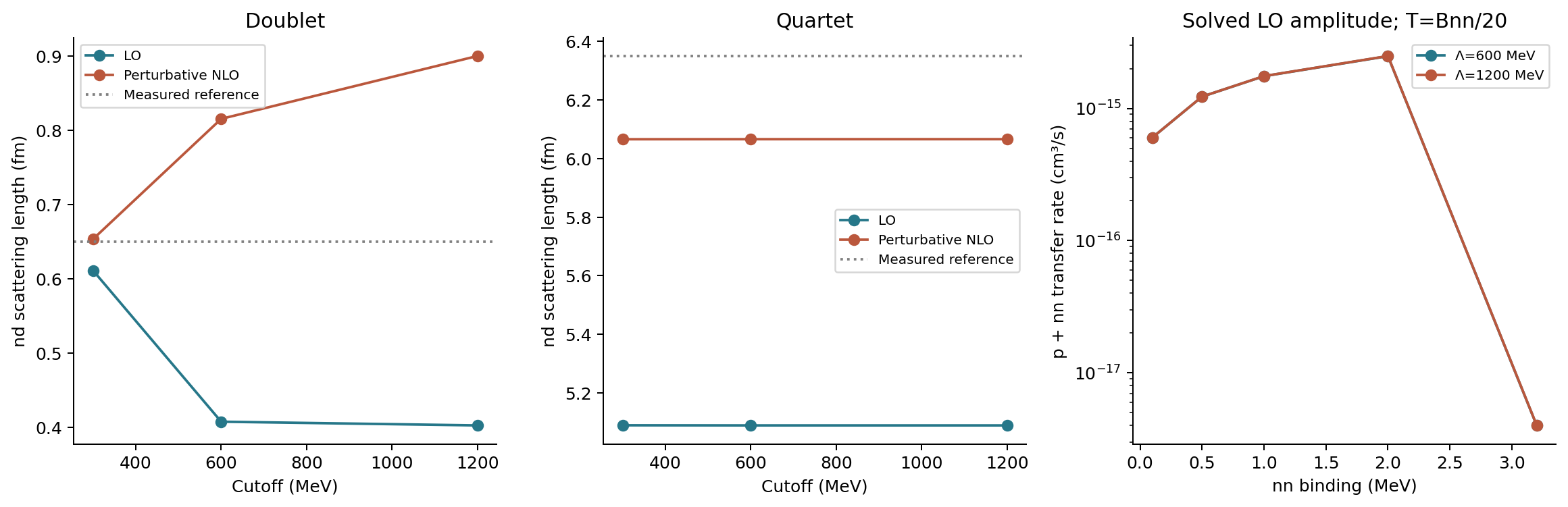
The three-body force and its NLO correction are fitted to triton binding, not nd scattering. The remaining errors against measured doublet/quartet values are visible and are not numerical convergence successes. The transfer panel uses solved neutral LO amplitudes; above-breakup S-wave tails are bounded below 0.3% for these temperatures. Larger partial waves and a field-dependent three-body force are absent.
Data · Provenance · PNG · SVG
Weak conversion and strong-rate controls
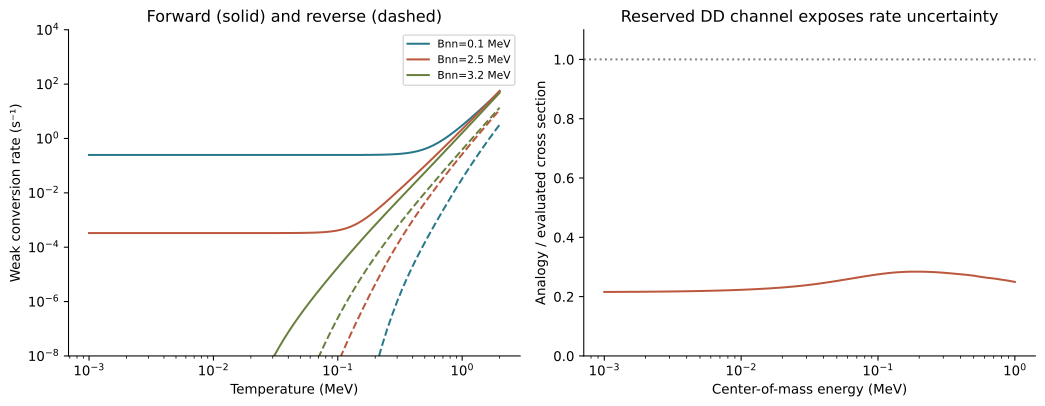
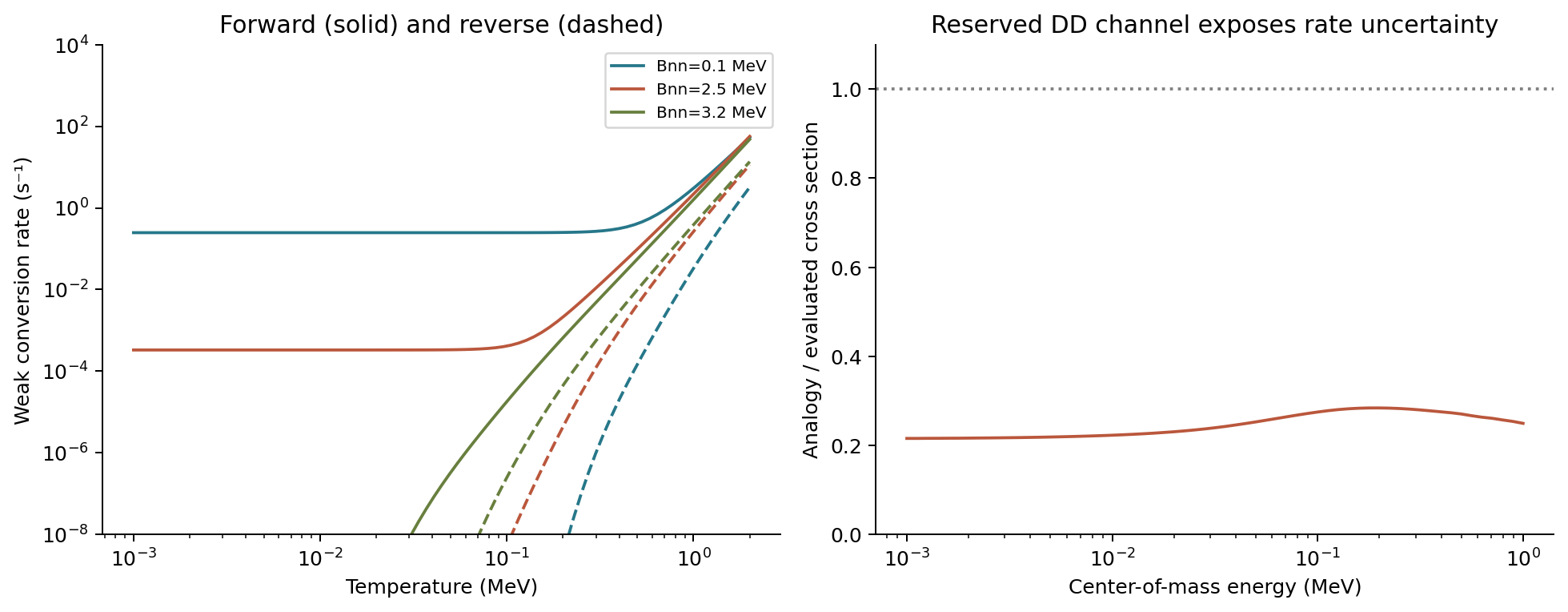
The four crossed weak processes include electron mass, Fermi factors, neutrino occupations and Pauli blocking in the heavy-nucleus allowed approximation. Equal temperatures satisfy detailed balance including the spin factor. A closed vacuum beta channel can still convert thermally. The historical strong-rate analogy underpredicts an independently evaluated DD comparison by roughly fourfold; it has no precision status for a hypothetical reaction.
Data · Provenance · PNG · SVG
Abundance histories depend on reaction amplitudes
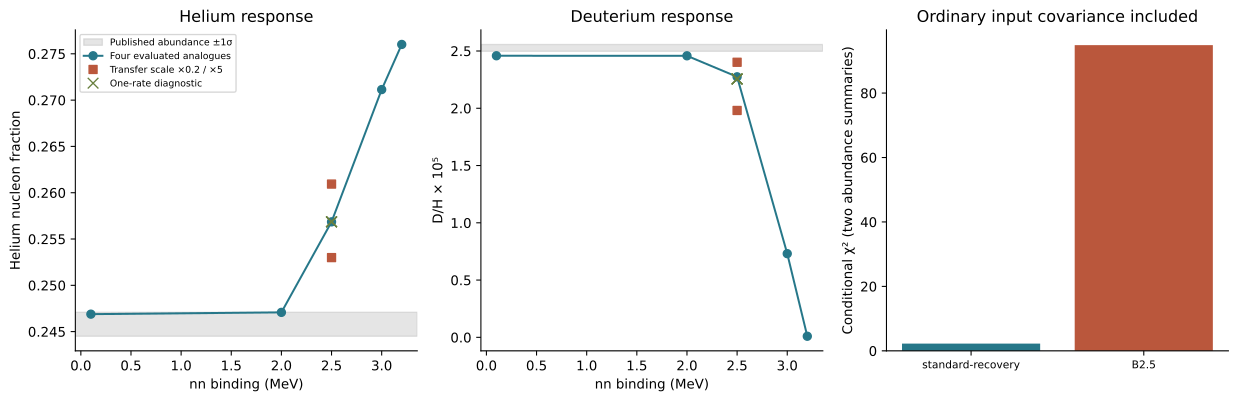
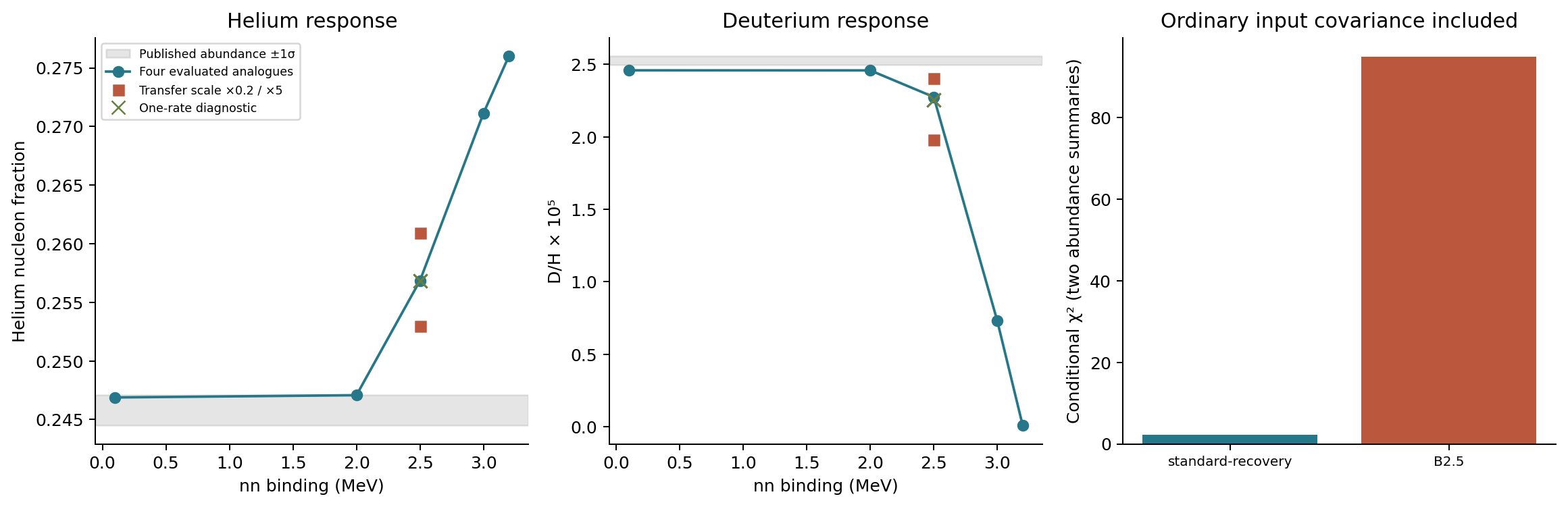
Actual PRyMordial integrations retain fixed ordinary masses except Bnn. New transfer rates are explicit closures. Replacing one analogy by a solved LO amplitude has cutoff/refinement and above-breakup S-wave tail controls, but is a sensitivity test: that same force also shifts tritium binding, which this network leaves fixed. It is not a matched nuclear Hamiltonian. The likelihood uses LBT 2026 He4/H and Cooke 2018 log(D/H), with ordinary-rate, neutron-lifetime and stated baryon-prior covariance recomputed for ordinary BBN and the fixed-binding analogue model. Connected binding points are a guide, not an interpolated exclusion limit. Hypothetical-amplitude uncertainty is not included in those covariance bars.
Data · Provenance · PNG · SVG
Stellar evolution without nuclear heating
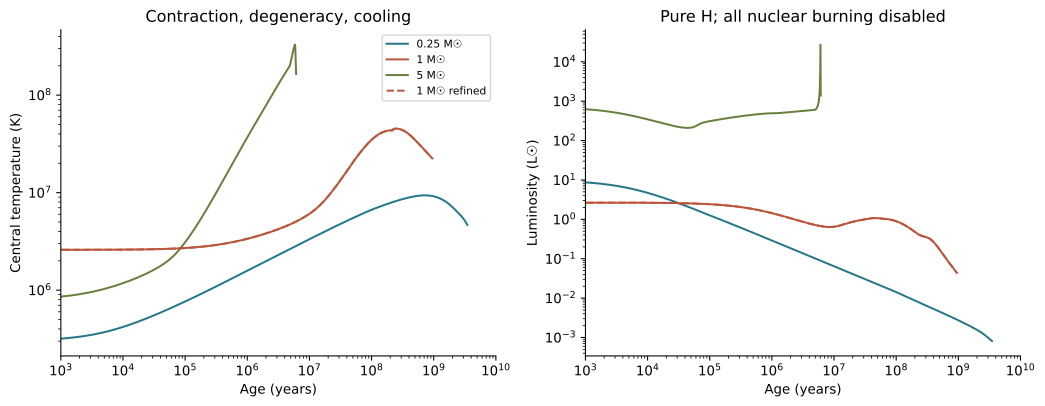
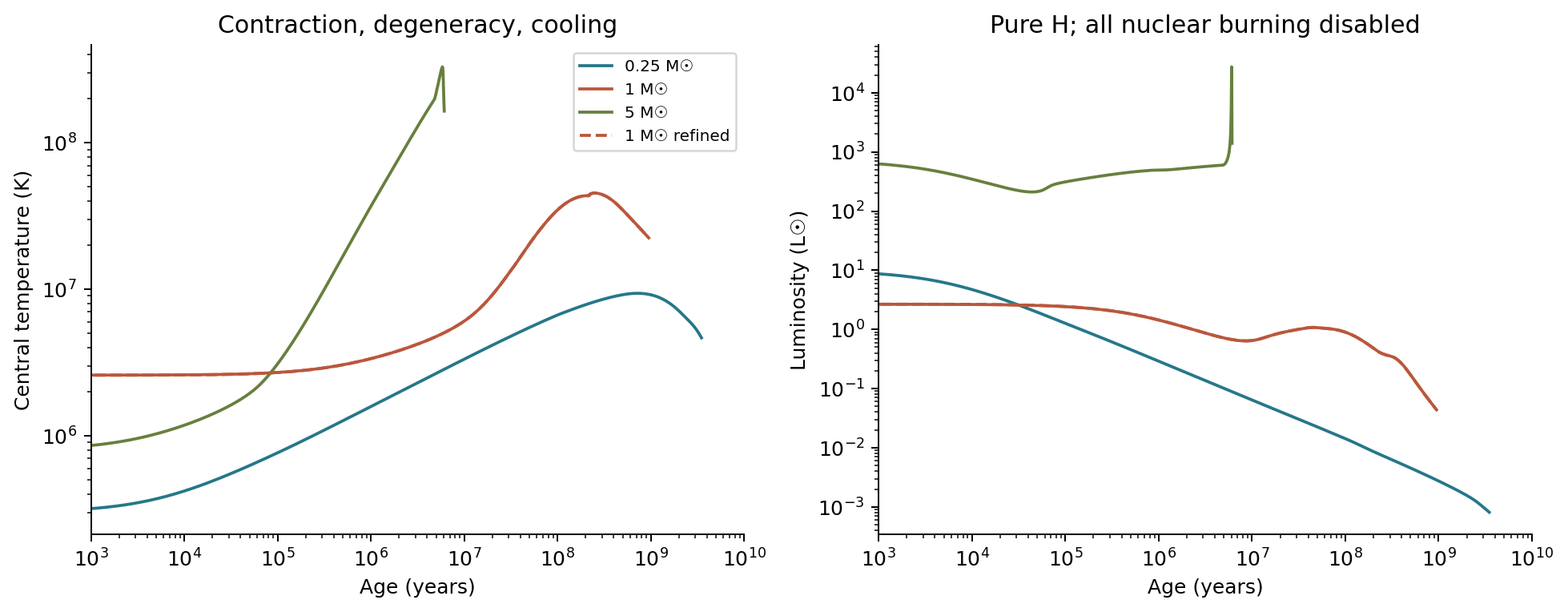
MESA uses its full ordinary EOS and opacity with pure hydrogen, zero seed metals and no nuclear reactions or nuclear heating. The display starts at 1,000 years; the data file retains the full histories. Models reach a declared cooling endpoint after central temperature falls below half its peak and electrons are degenerate. The one-solar-mass refinement changes peak temperature by 0.061% and endpoint age by 1.5%. These are the public contraction-only limiting experiment, not fully matched unbound-deuteron stars or estimates of habitability.
Data · Provenance · PNG · SVG
What the real dineutron search constrains
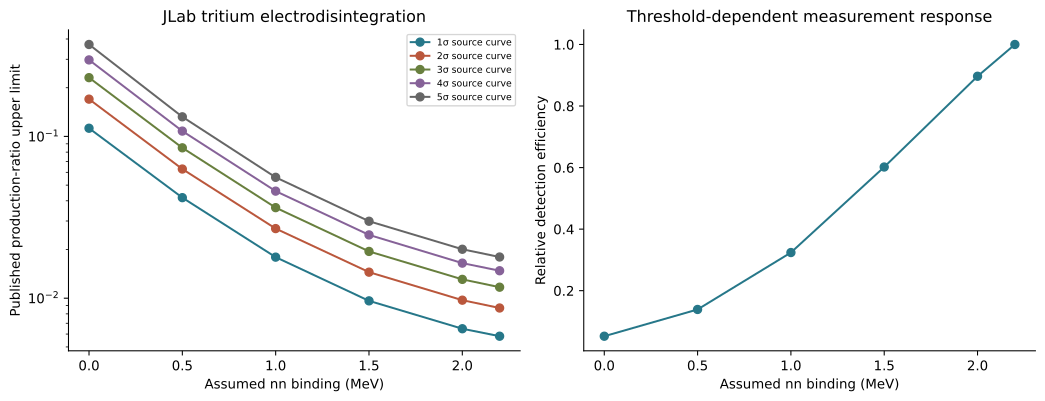
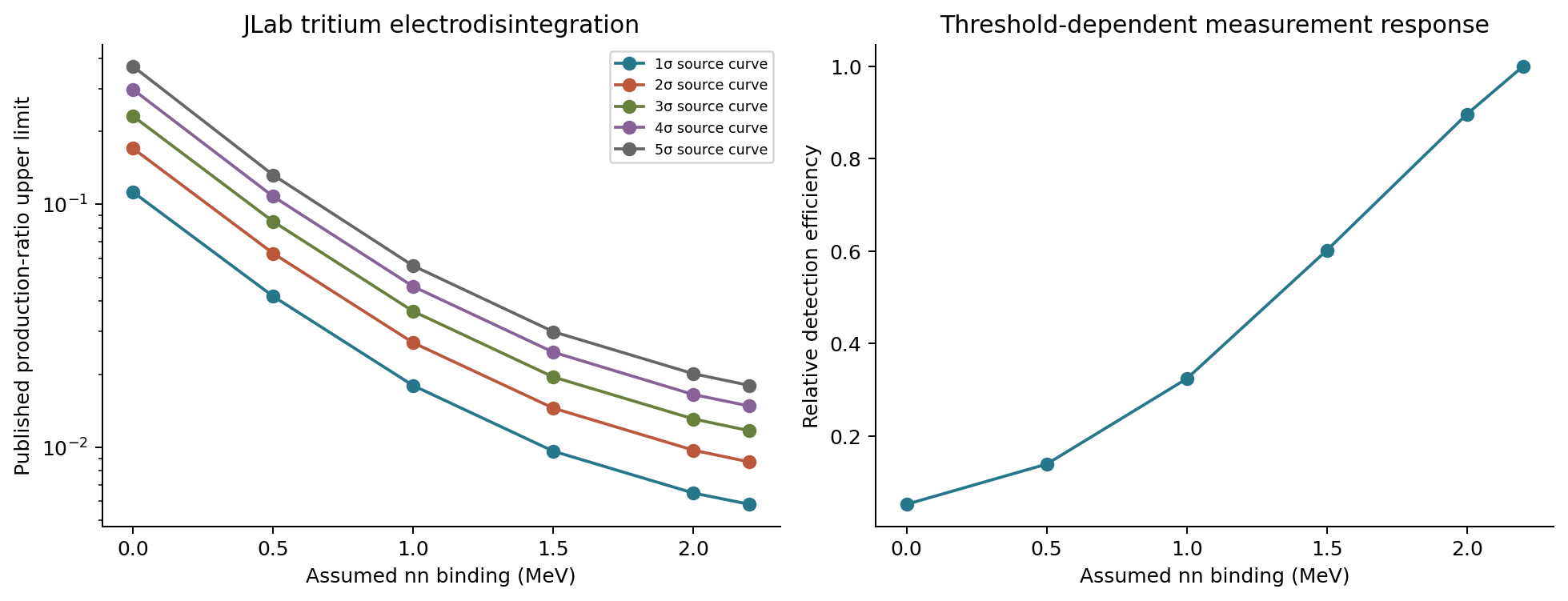
These are public measured-data exclusion curves extracted from native PDF vectors, with an axis-calibration and digitization audit. The two-sigma production-ratio limit near 2.2 MeV is about 0.0087, consistent with the source rounded 0.009. It is a production-process limit, not a model-independent exclusion of binding. Without released event data and response covariance, no independent event likelihood is claimed.
Data · Provenance · PNG · SVG
A measured isomer gives a different sensitivity
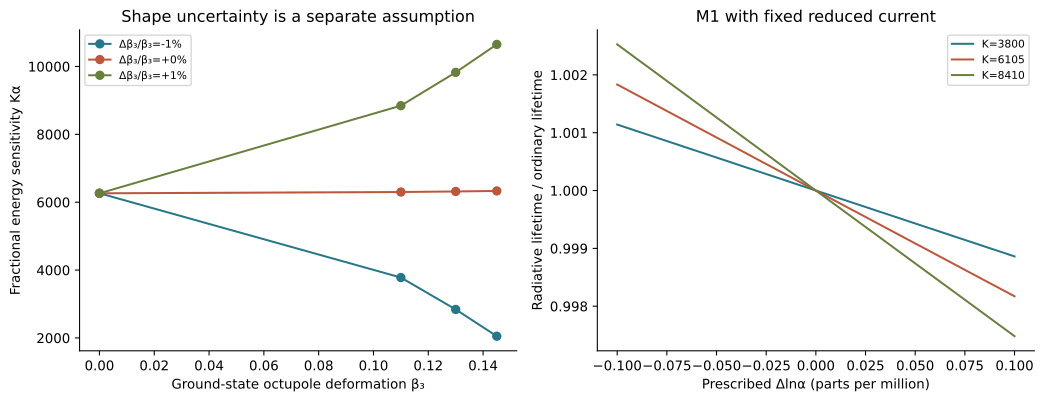
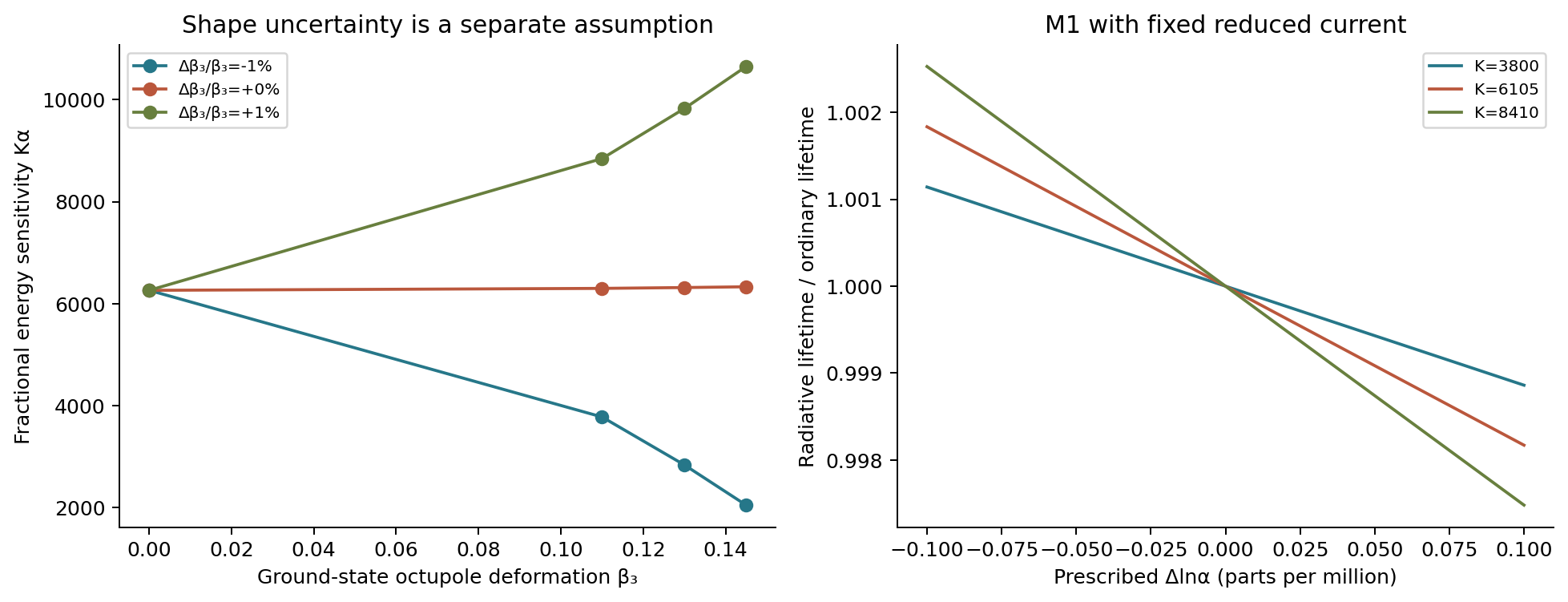
Measured Th229 charge-radius and quadrupole changes enter an independently integrated spheroidal Coulomb model. Input uncertainty gives Kα≈6105±2305; unknown shape response is separate. The radiative model includes both Eγ³ and explicit electromagnetic-coupling dependence, while holding the reduced M1 current fixed. It does not predict internal conversion, microscopic-current changes or a viable scalar history.
Data · Provenance · PNG · SVG
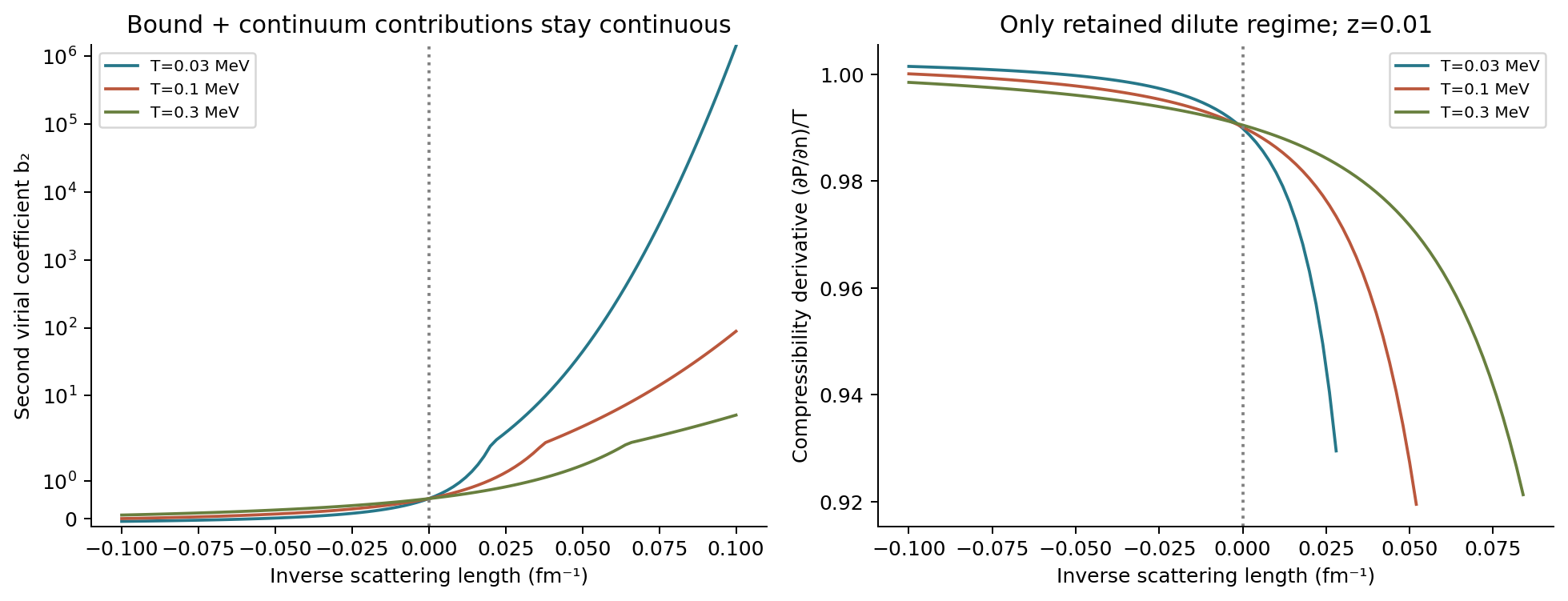
A binding threshold does not force a dilute-gas phase jump
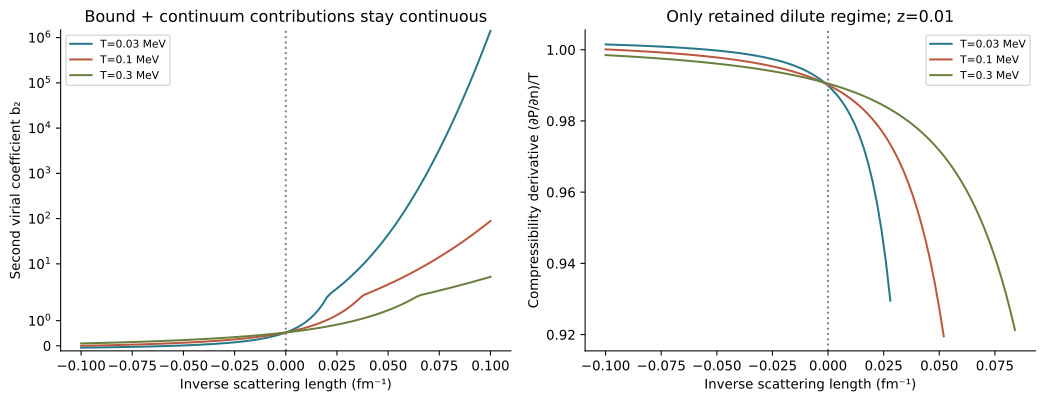
Beth–Uhlenbeck includes the physical shallow bound pole and scattering continuum, with an explicit half-bound threshold limit. The zero-range analytic result and energy-cutoff controls agree. The displayed EOS keeps only rows satisfying the stated small-second-virial correction criterion; that criterion is not a measured third-virial error. Positive compressibility in this dilute domain is not a dense alpha-gas/liquid calculation or a statement about nucleation.
Data · Provenance · PNG · SVG
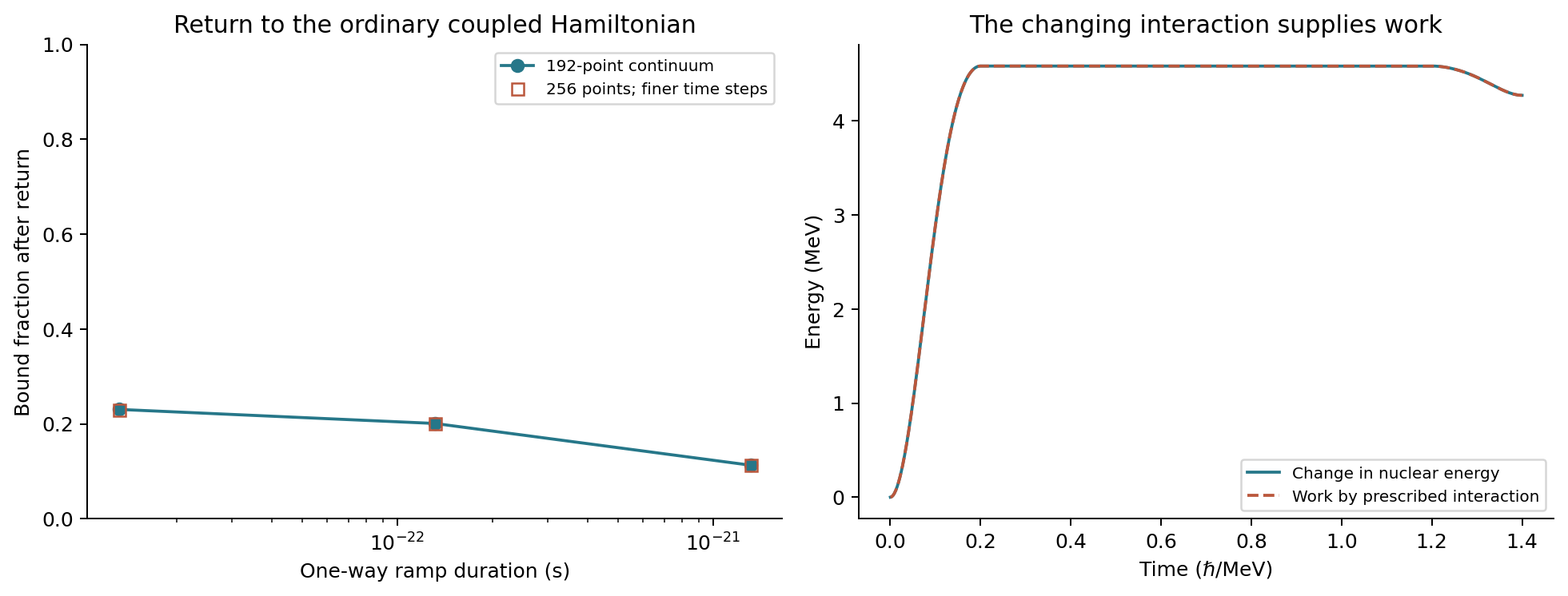
A source nuclear Hamiltonian crossing its threshold
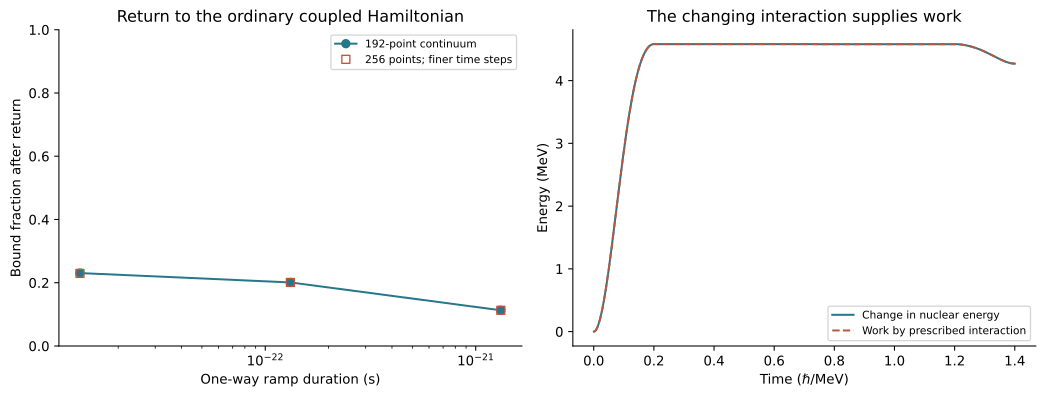
Bonn B follows a prescribed smooth excursion from tensor multiplier 1 to 0.4 and back, holding for ℏ/MeV between ramps. The minimum lies below its verified infinite-volume binding threshold. The complete S/D Hamiltonian and its quadrature continuum are propagated, with time, momentum-grid, sudden-limit and independent ODE controls. Nuclear energy change is checked against the supplied work. The final projector measures returned binding; intermediate overlap with the original deuteron is not an instantaneous bound fraction. Passage times are diagnostic, not derived from a viable field. No irreversibility, hysteresis or thermal capture rate is claimed.
Data · Provenance · PNG · SVG
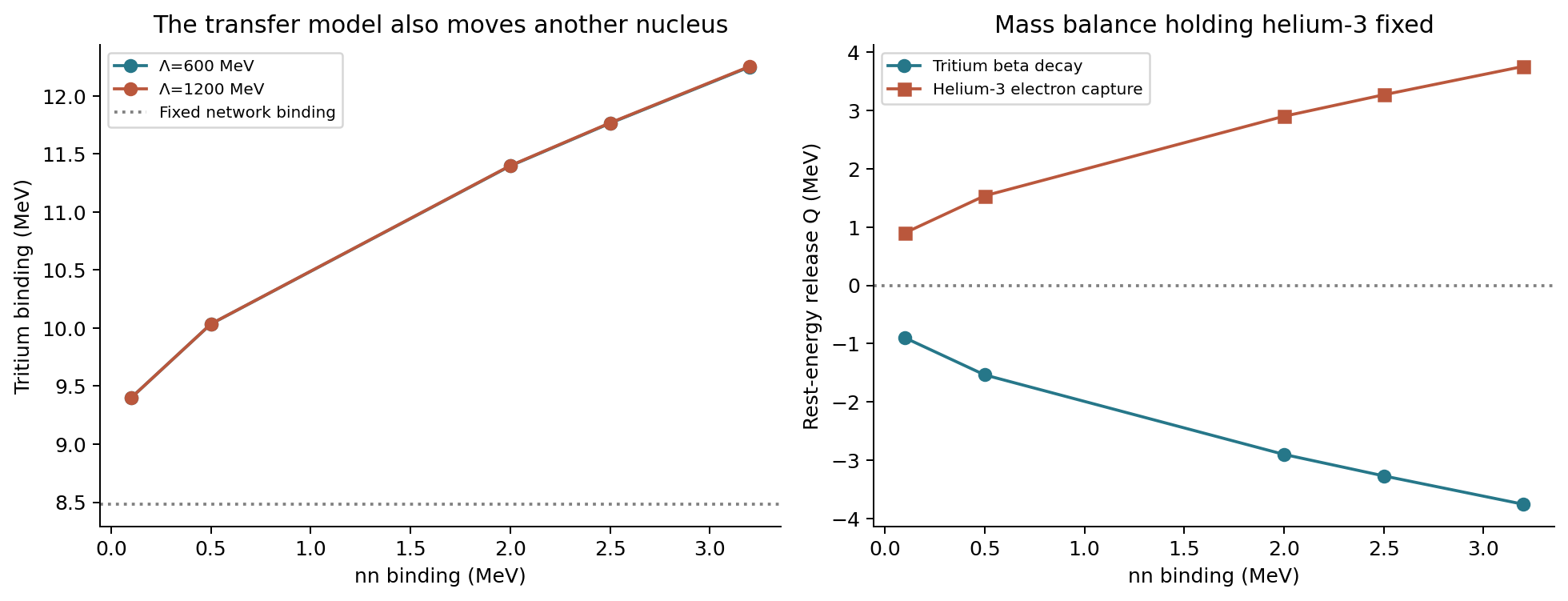
One rate does not define a consistent nuclear network
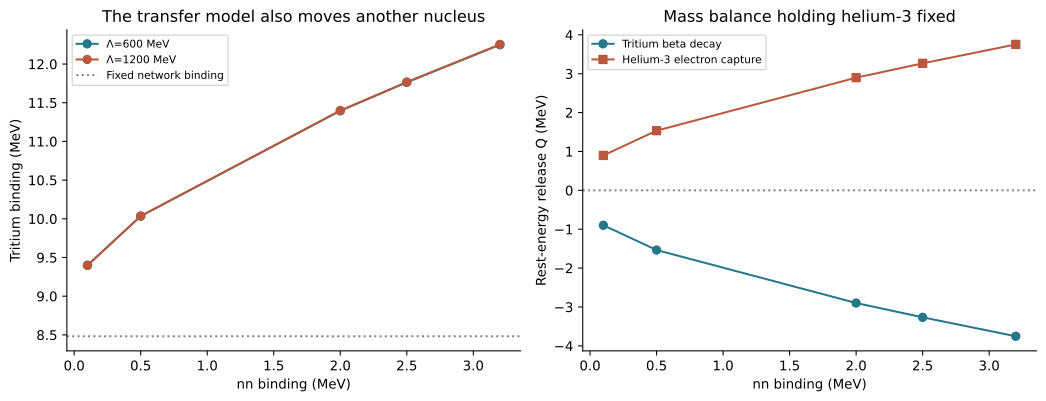
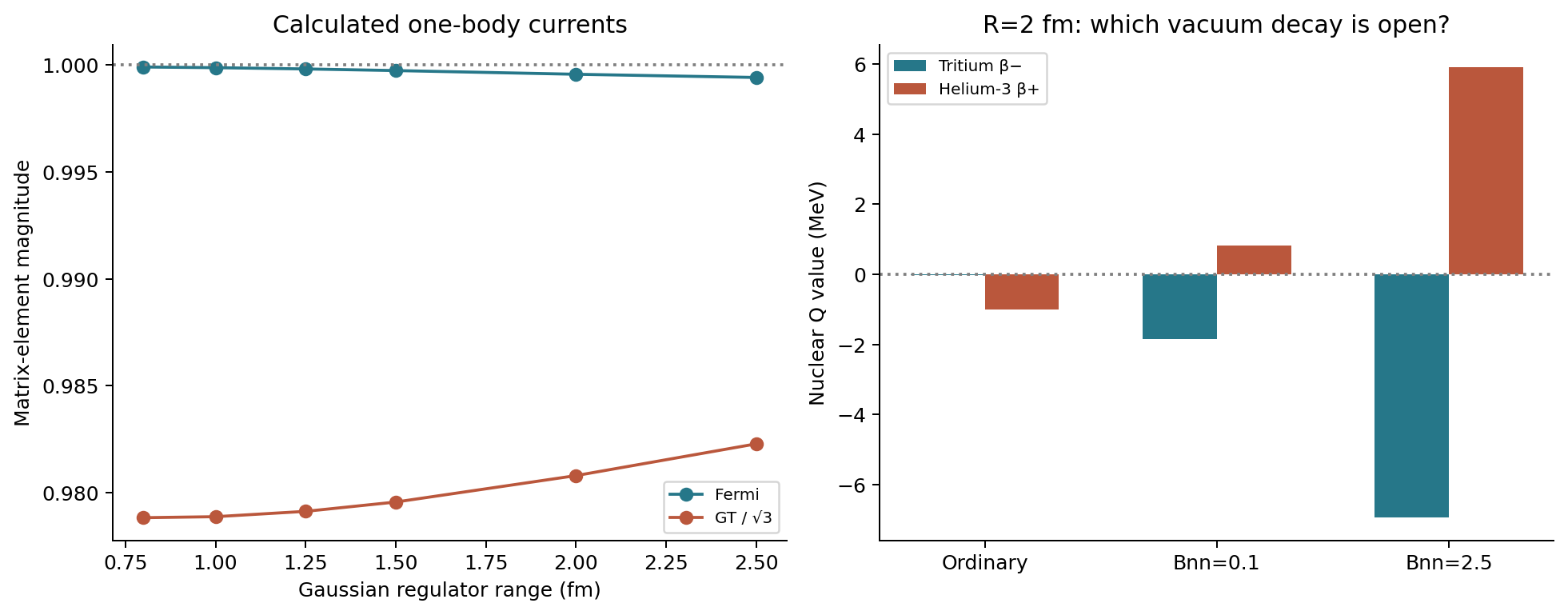
The same neutral LO force used in the solved transfer amplitude is fitted only to ordinary tritium. Keeping that force fixed as nn becomes bound shifts the triton pole; the BBN rate-substitution experiment instead retains ordinary tritium. At Bnn=2.5 MeV the mismatch is about 3.285 MeV, much larger than the cutoff and quadrature differences. Those differences do not measure omitted EFT orders. The right-hand panel holds helium-3 binding and particle masses fixed solely to display weak Q values. It does not calculate a charged three-body response or any lifetime. No phase-dependent counterterm is refitted to conceal the mismatch.
Data · Provenance · PNG · SVG
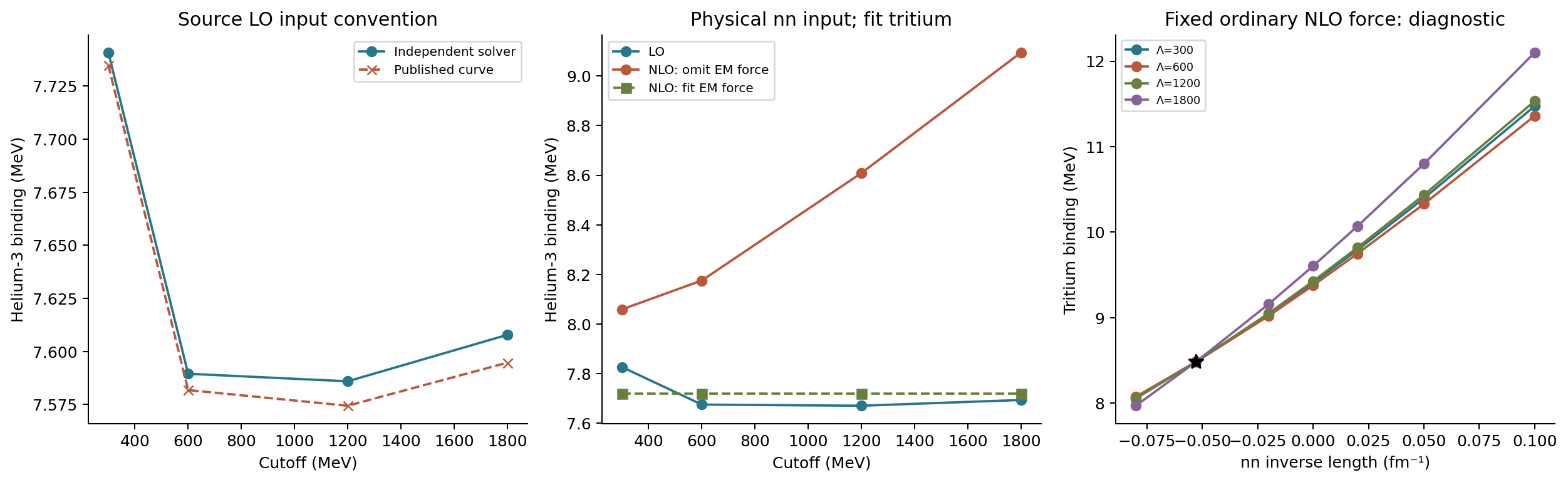
Charged bound states and the extra NLO input
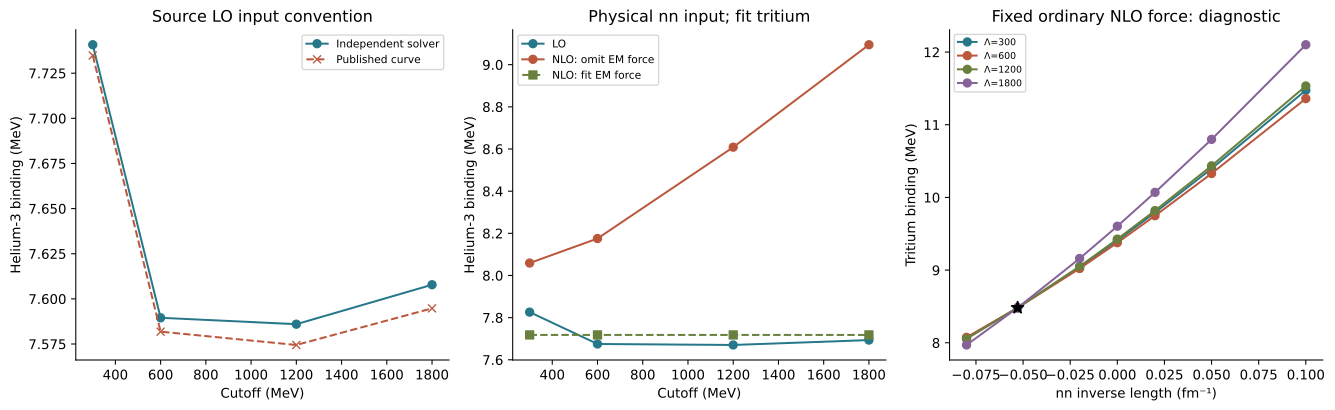
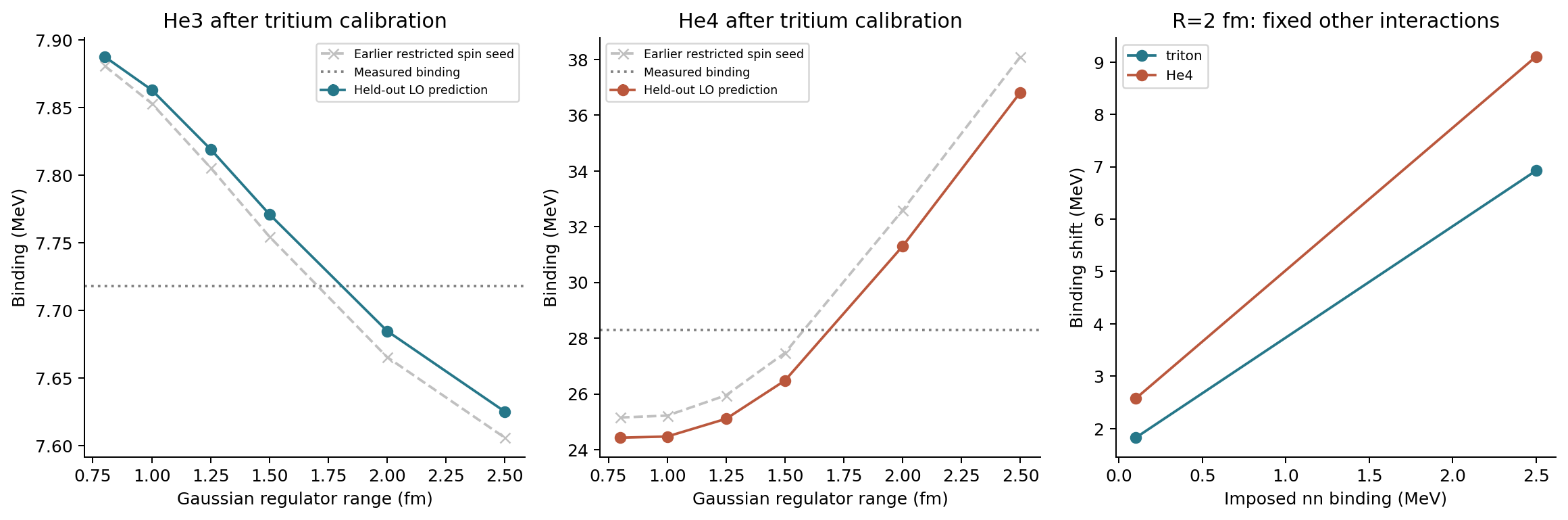
All O(alpha) three-body Coulomb kernels are iterated; the pp propagator resums Coulomb ladders. The logarithmic singularity is integrated at zero photon mass. The source curve comparison uses its isospin-symmetric convention and retains a 6–13-keV graphical/convention residual. The second panel instead uses the physical nn input. Fitting an NLO electromagnetic three-body term restores ordinary He3 binding by construction; it is not a prediction. The last panel holds the ordinary NLO strong term fixed in an nn-only variation and exposes unresolved cutoff dependence away from its calibration point. It is not a renormalized field response.
Data · Provenance · PNG · SVG
Charged continuum phases with regulator controls
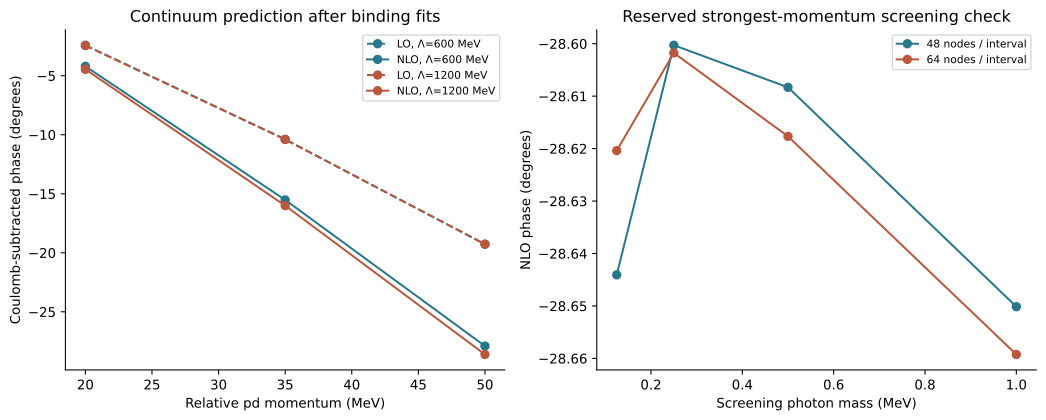
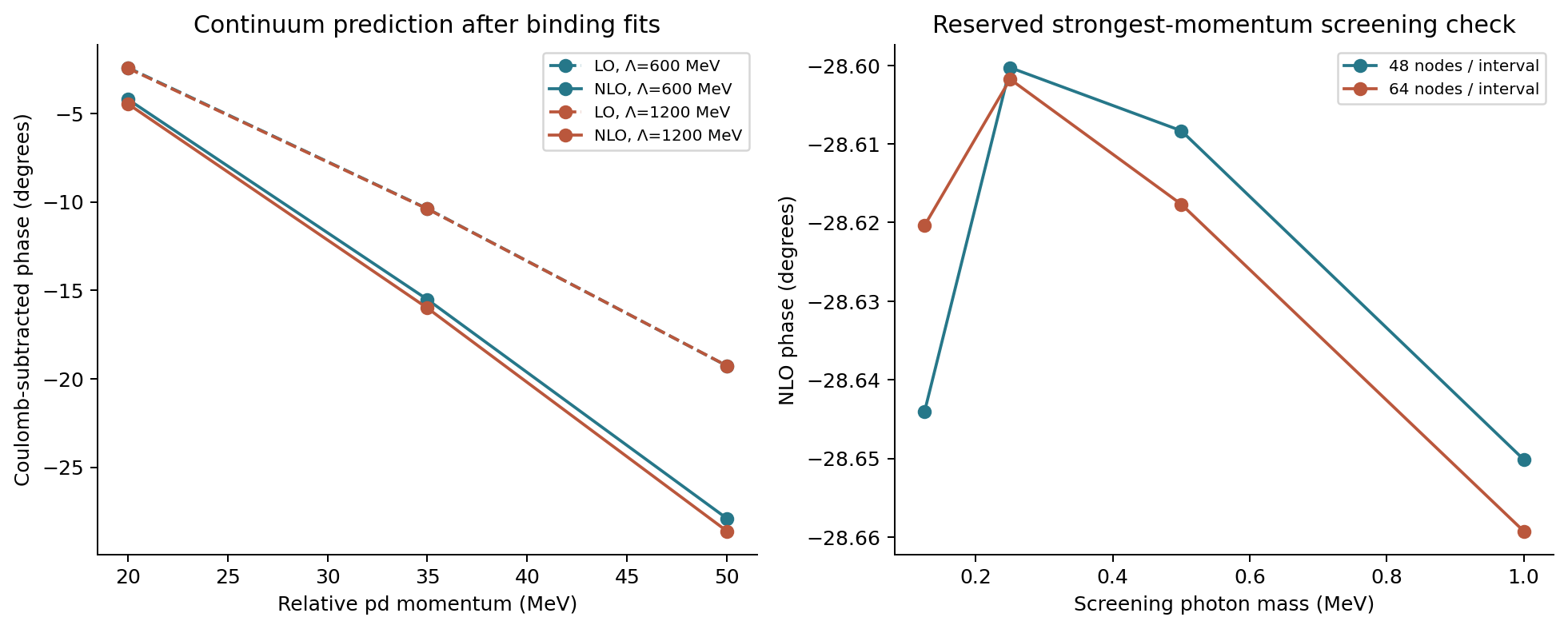
No continuum datum is fitted: strong and electromagnetic three-body terms come from the separate ordinary binding calibration. All calculations lie below three-body breakup. A separately solved composite-deuteron Coulomb phase is subtracted, following the source convention. Grid and screening-window differences are at most about 0.040 and 0.016 degrees in the selected runs; the 600-to-1200-MeV NLO cutoff difference is larger. Those numerical differences are not a physical uncertainty distribution, and charged breakup, higher partial waves and changed-field amplitudes are absent from this S-wave component. The E31 figure reports the subsequent doublet P/D/F extension.
Data · Provenance · PNG · SVG
Four-body predictions expose model dependence
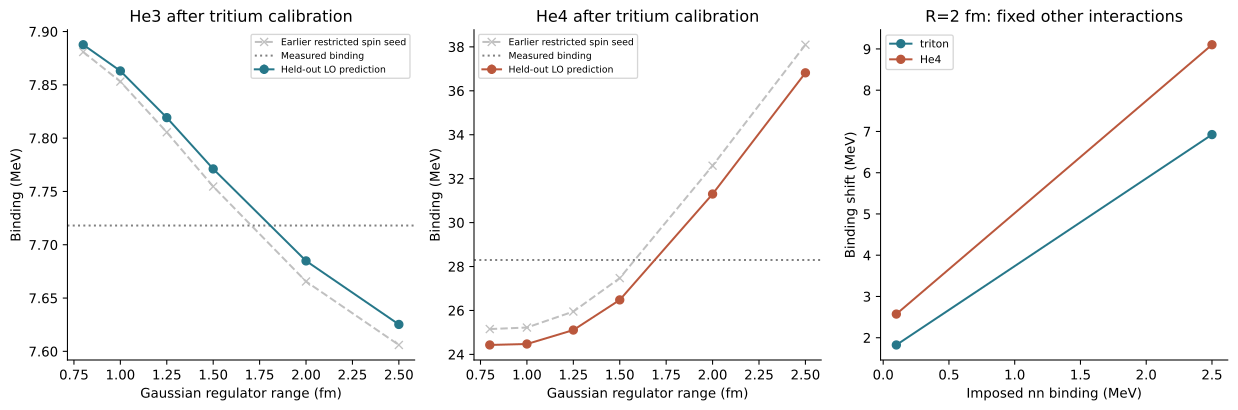
Antisymmetrized correlated Gaussians span the complete fixed-charge S=1/2 or S=0 internal space of a separate local LO Hamiltonian, with channel projectors and pp Coulomb. The earlier fixed-spin-seed results are shown as restricted controls; ordinary tritium is recalibrated in each space. Two-body observables and ordinary tritium are fitted; neither helium binding is fitted. Error bars show only the last basis change, not physical uncertainty. The source Volkov and independent radial controls are supplemented by off-diagonal spin tests and exact nesting of the restricted space. In the last panel only the nn interaction changes; its input is calibrated to the infinite-volume pole, and the three-body force is not refitted. This is not the STM regulator convention, a field prediction or a four-body reaction calculation.
Data · Provenance · PNG · SVG
Binding energies and weak currents must agree
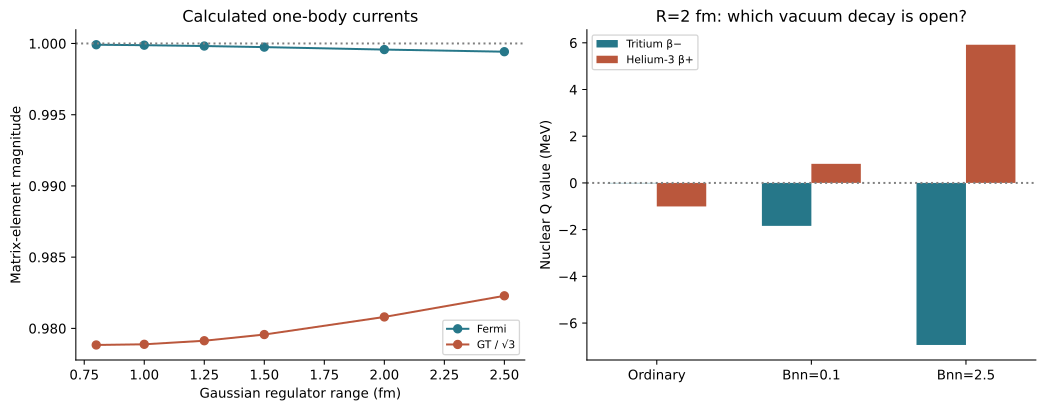
Fermi and Gamow–Teller operators act on the independently solved antisymmetric trinucleon states; no weak observable is fitted. The exact SU(4) limit and basis refinements are checked. Rates use neutron normalization and an allowed point-Coulomb phase-space integral, including positron repulsion. Ordinary binding errors can exceed the measured 19-keV tritium Q value, so a calculation with the empirical Q is stored separately as a current check. The right panel uses the model’s own masses. Higher-order axial currents, atomic corrections and plasma electron capture remain outside this impulse approximation.
Data · Provenance · PNG · SVG
Reconstructing the compact-alpha force
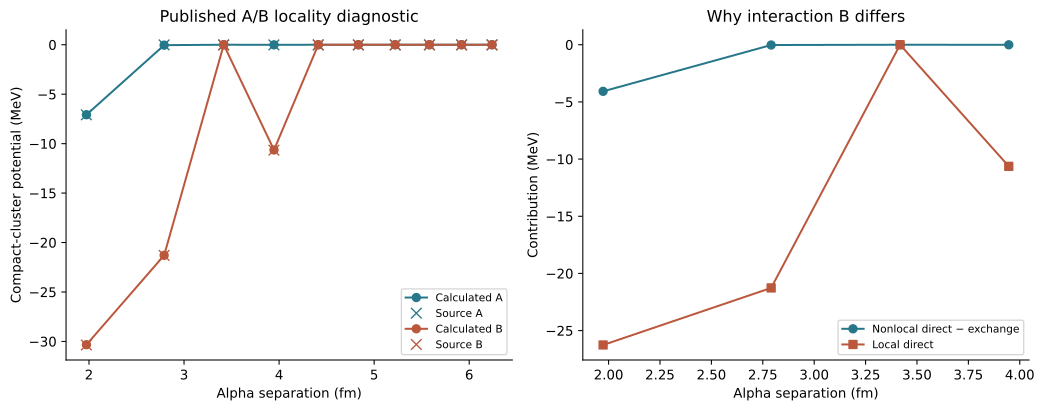
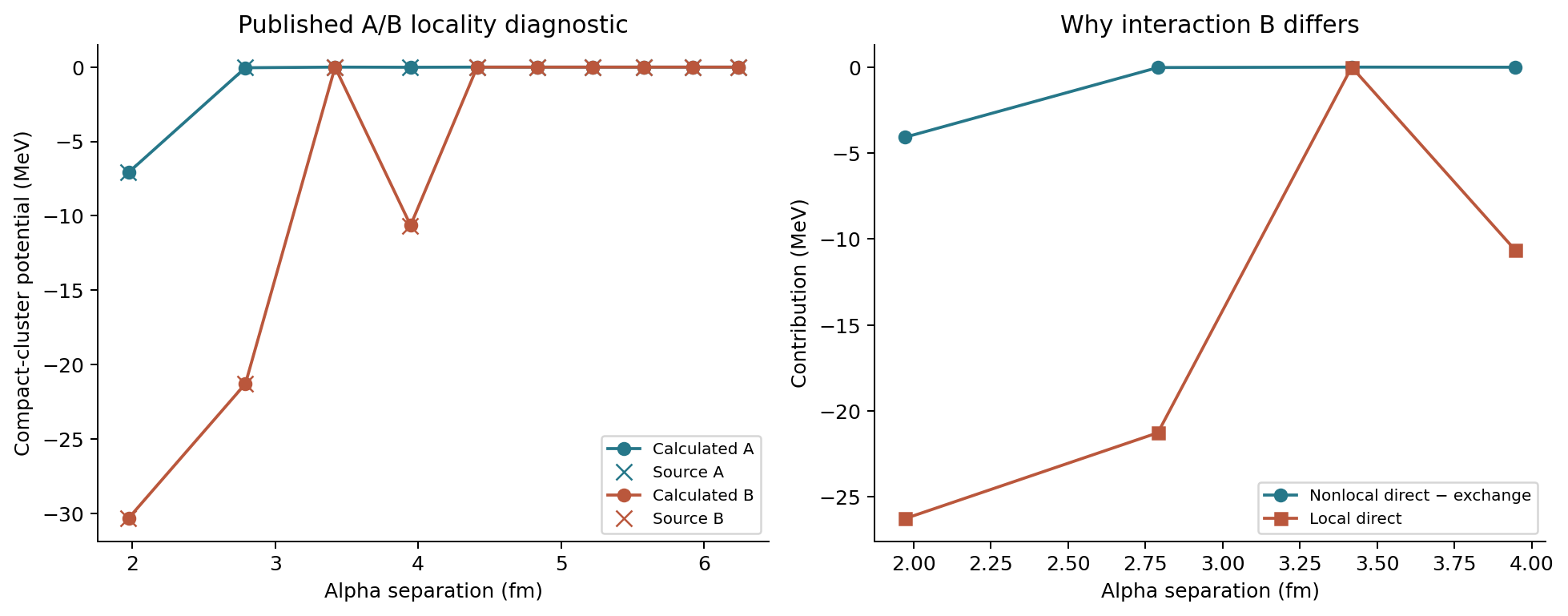
The published source parameters are used without refitting. Explicit internal spin/isospin traces and a real-space convolution reproduce the source A/B compact-alpha potential; an independent Fourier construction checks the nonlocal kernel. Published SVG marker positions supply all twenty comparison points, with coordinate precision recorded. The origin is outside this compact-cluster approximation and is not filled with an invented core. These kernels explain a locality sensitivity but do not supply alpha deformation, a complete scattering Hamiltonian or dense many-body phase ensembles.
Data · Provenance · PNG · SVG
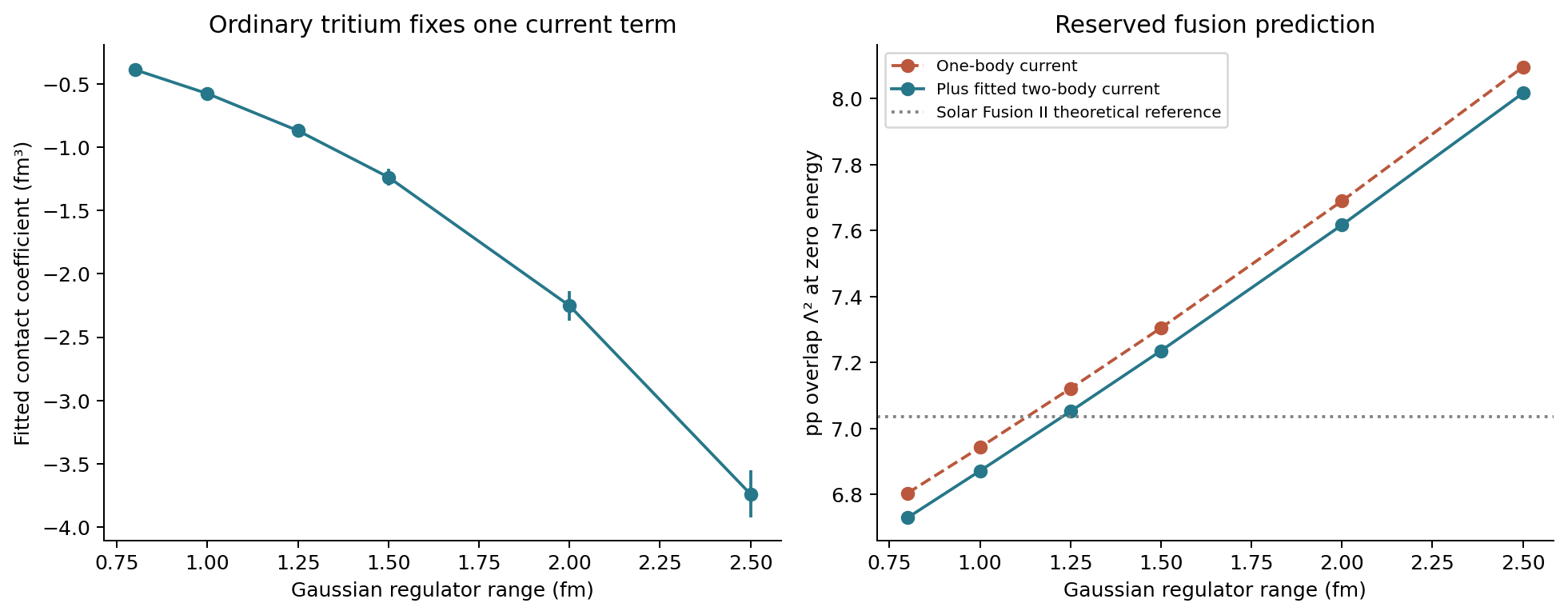
Does a fitted weak current transfer to fusion?
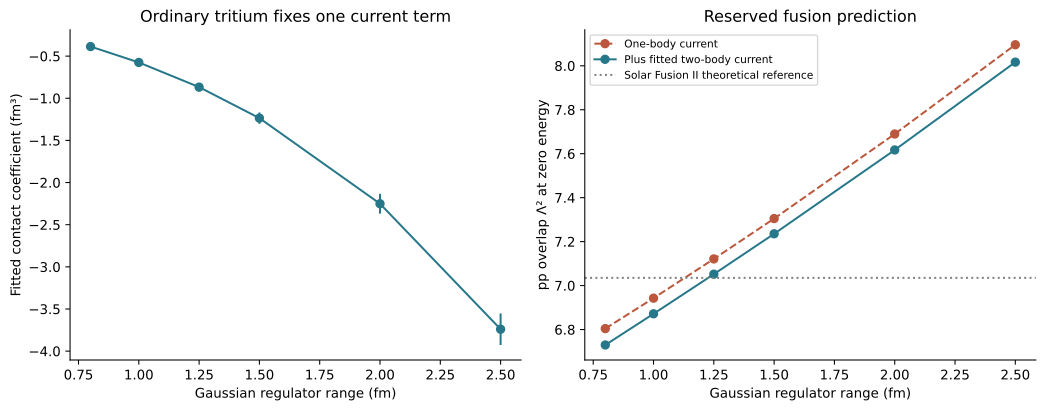
A normalized Gaussian two-body axial contact is fitted to the empirical tritium axial product, with the calculated Fermi strength retained. Bars propagate only that experimental input error. The same coefficient then acts between the independently solved Coulomb pp and deuteron states; pp fusion is not fitted. Radial, matching-radius, basis and zero-energy extrapolation checks accompany the results. The reference is a theoretical evaluation, not a direct measured pp cross section. This LO-Hamiltonian/current improvement is not a complete higher-order EFT calculation; its residual range dependence and unknown field derivative remain.
Data · Provenance · PNG · SVG
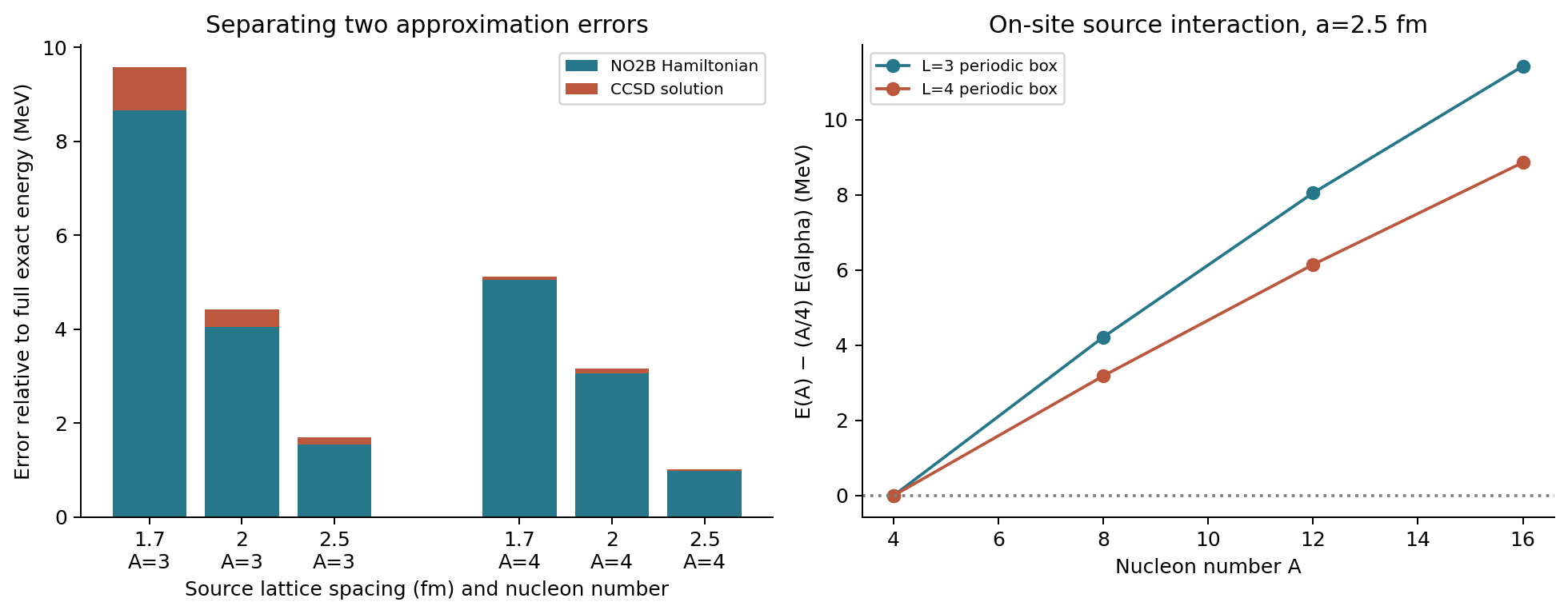
Public many-body calculations and their limits
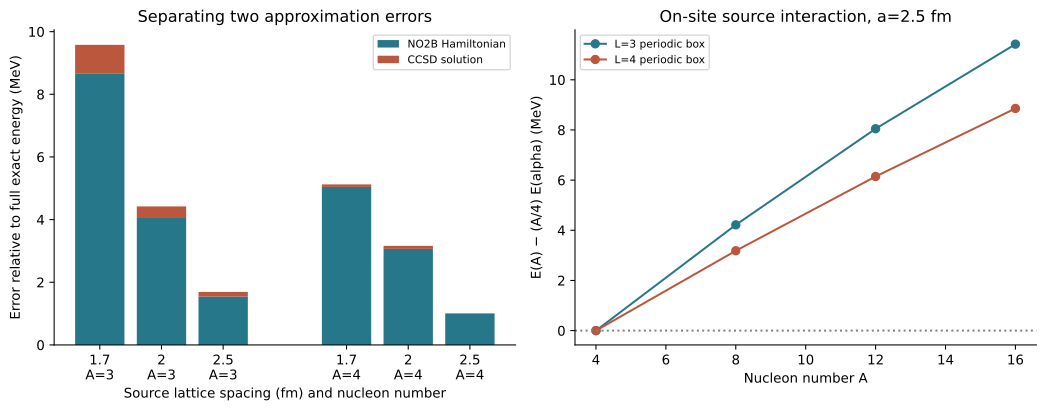
The pinned NuLattice calculation uses CCSD and the normal-ordered two-body (NO2B) truncation of its three-body force. An additional exact calculation separates these errors: the NO2B Hamiltonian contributes most of the discrepancy in all six benchmarks. Its localized reference can break translation symmetry, so that solver retains absolute coordinates. The right panel uses the same underlying on-site SU(4) force but nucleus-dependent truncated Hamiltonians in two periodic boxes. The reference dependence and omitted terms limit interpretation of the separate-alpha energy differences. These are approximation and volume diagnostics, not an infinite-volume binding or thermodynamic phase determination. This interaction is distinct from finite-range A/B and has no matched field response.
Data · Provenance · PNG · SVG
Mean-field tests of the source A/B interactions
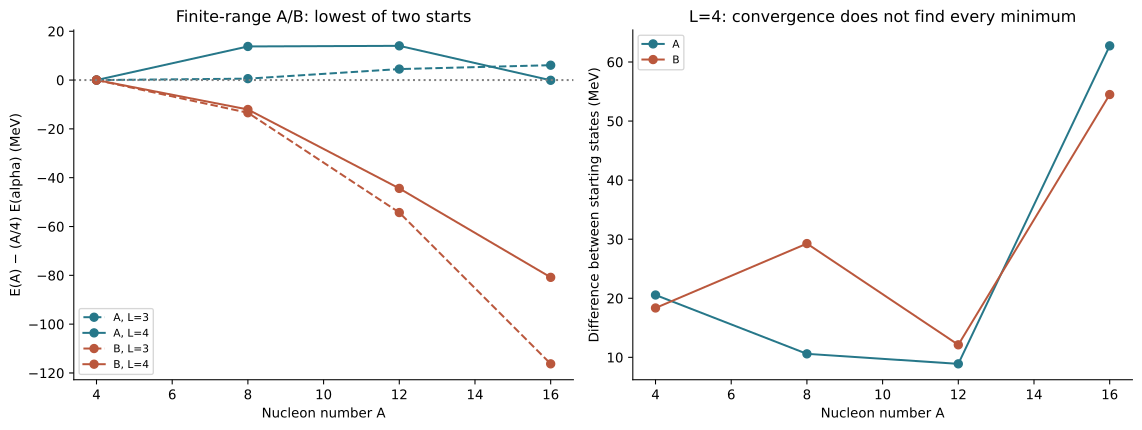
The pinned public finite-range A/B operators, including pion exchange, are evaluated in spin/isospin-saturated Slater determinants at two periodic volumes. A reduced contraction agrees with the full source operator and its energy derivative. Both spatial starts pass density and commutator checks; their sometimes large energy difference is retained, and neither is guaranteed to be the global minimum. An independent orbital-Hessian audit finds all 32 states locally stable within the real saturated Slater space. The next figure expands that test to independent complex spinors. Source NLEFT constants are applied to both families. This is a continuous-Hamiltonian mean-field calculation, not the original finite-time correlated lattice calculation. Finite-volume breakup diagnostics and different local minima do not determine a thermodynamic phase boundary, barrier or lifetime.
Data · Provenance · PNG · SVG
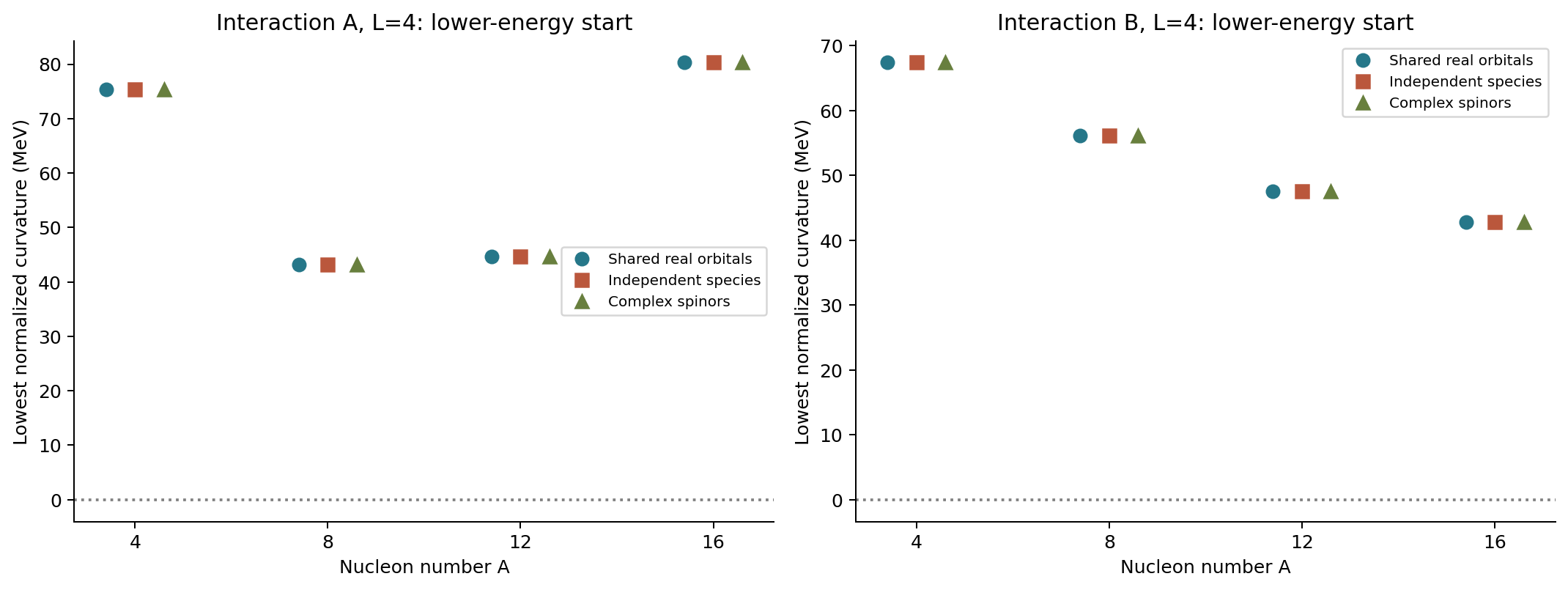
Testing every charge-conserving mean-field direction
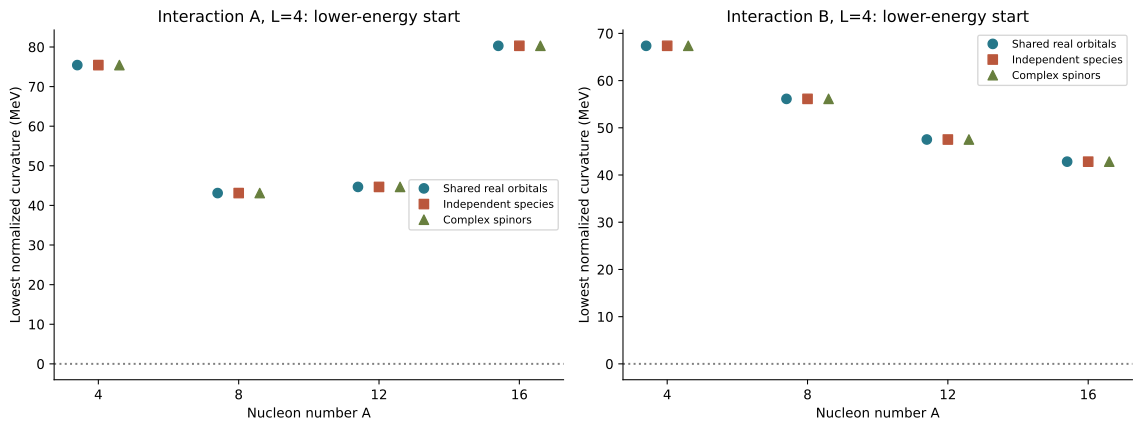
The same stationary states are tested in successively larger orbital spaces: four species sharing real orbitals, independent real orbitals for each species, and independent complex spinors for protons and neutrons. Curvatures use the same total particle-hole amplitude norm; the shared-orbital result is divided by four because that variation repeats in all four species. Horizontal offsets separate coincident values. All 32 cases are in the downloadable data; the plot selects the lower-energy start in each L=4 case. Eigen-residuals and independent finite orbital rotations check the complex Hessian. Local mean-field stability does not establish a correlated ground state, a barrier, a thermodynamic phase or a lifetime.
Data · Provenance · PNG · SVG
Paths between finite-nucleus mean-field minima
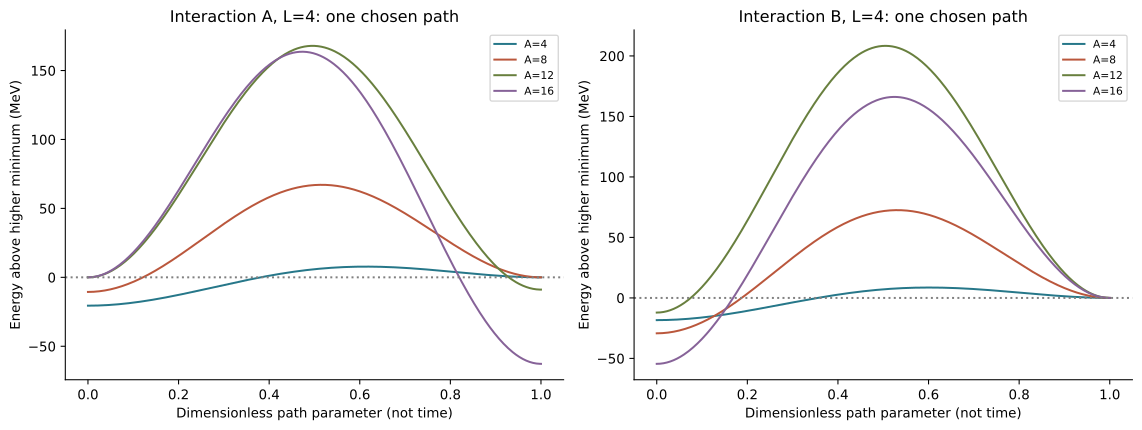
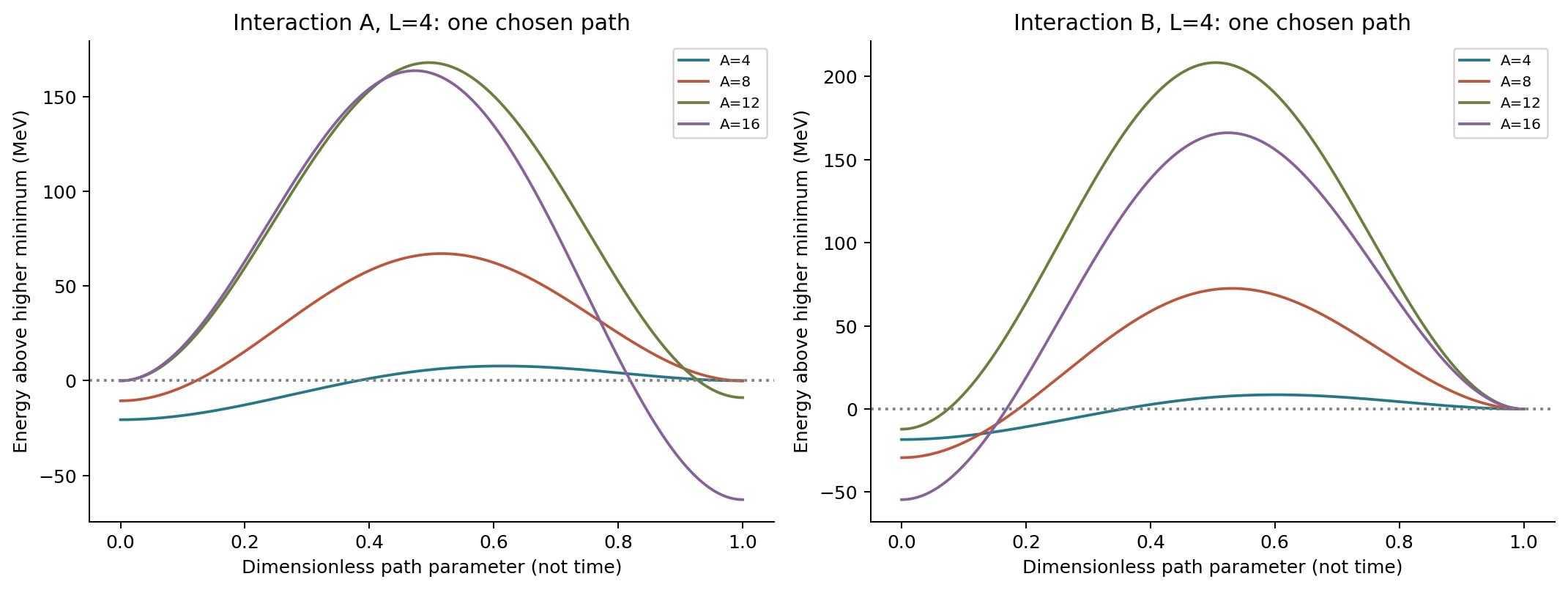
Principal-angle paths connect the two existing occupied spatial subspaces while preserving normalized orbitals and particle number at every point. The plotted energy is relative to the higher endpoint. Maximizing each explicit path supplies an upper bound on the least mean-field escape barrier from that endpoint; an easier route may exist outside the path. All L=3 and L=4 cases are downloadable. The parameter is neither time nor field displacement. No collective inertia, tunneling action, interface tension, physical preparation or lifetime has been calculated.
Data · Provenance · PNG · SVG
Correlated finite nuclei and an exact source-code control
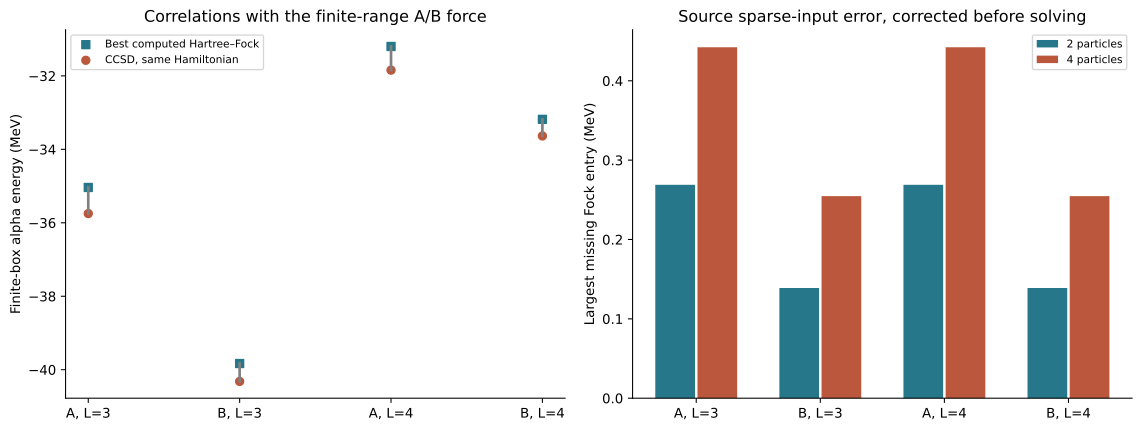
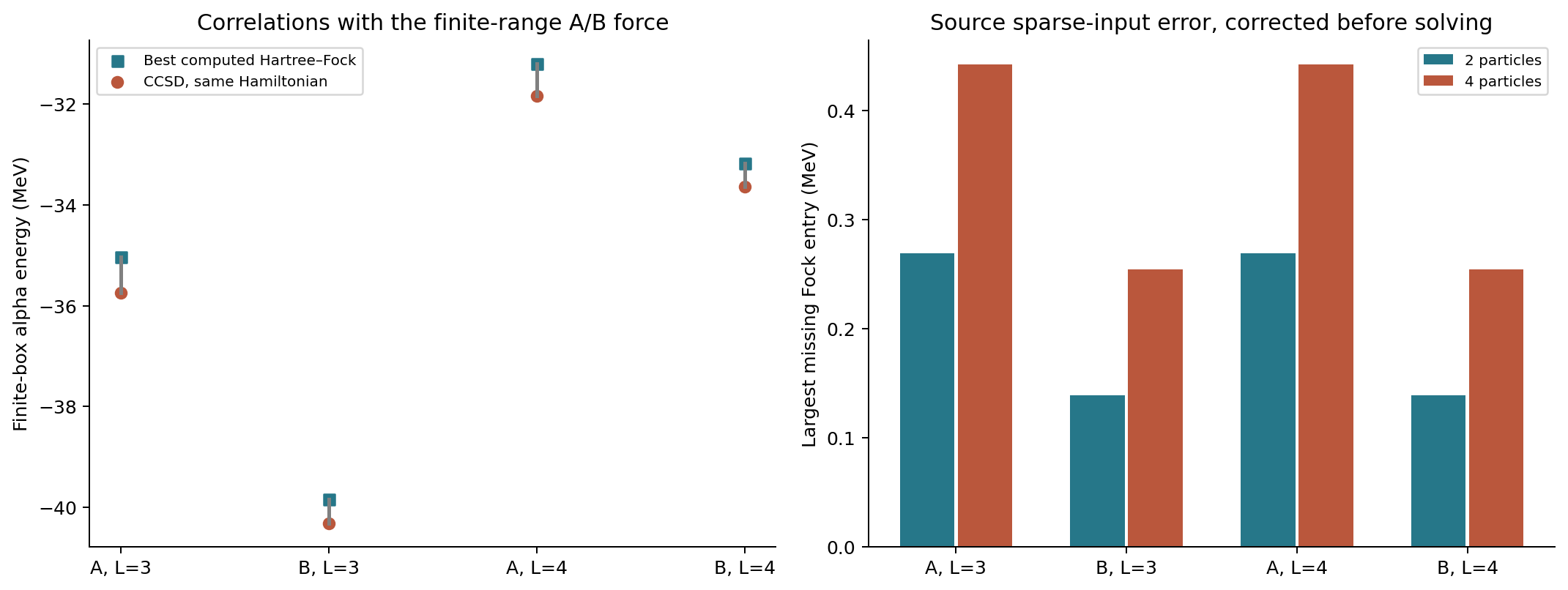
The same finite-range A/B Hamiltonians now supply complex CCSD alpha calculations in two boxes. This Hamiltonian has no three-body term and therefore no NO2B truncation. Independent exact two-particle amplitudes test the connected equations; perturbed exact amplitudes test local root recovery, not global ground-state discovery. Alpha calculations start from HF singles and zero doubles. The source Fock builder omits interaction contractions where a sparse kinetic entry is absent; supplying explicit zeros restores the full independently checked Wick field without changing the Hamiltonian. The right panel measures that corrected source-input error, not an energy uncertainty. Sparse contractions are checked against the original complex diagrams, and a real-coefficient stabilized iteration solves the unchanged equations. CCSD is nonvariational and higher correlations, larger nuclei and volume limits remain unresolved.
Data · Provenance · PNG · SVG
Binding, vacuum decay and plasma survival are distinct
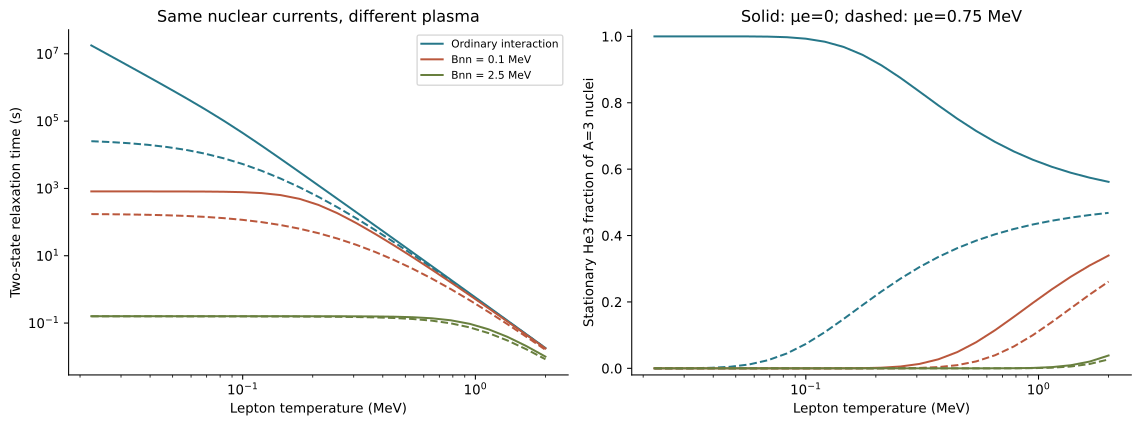
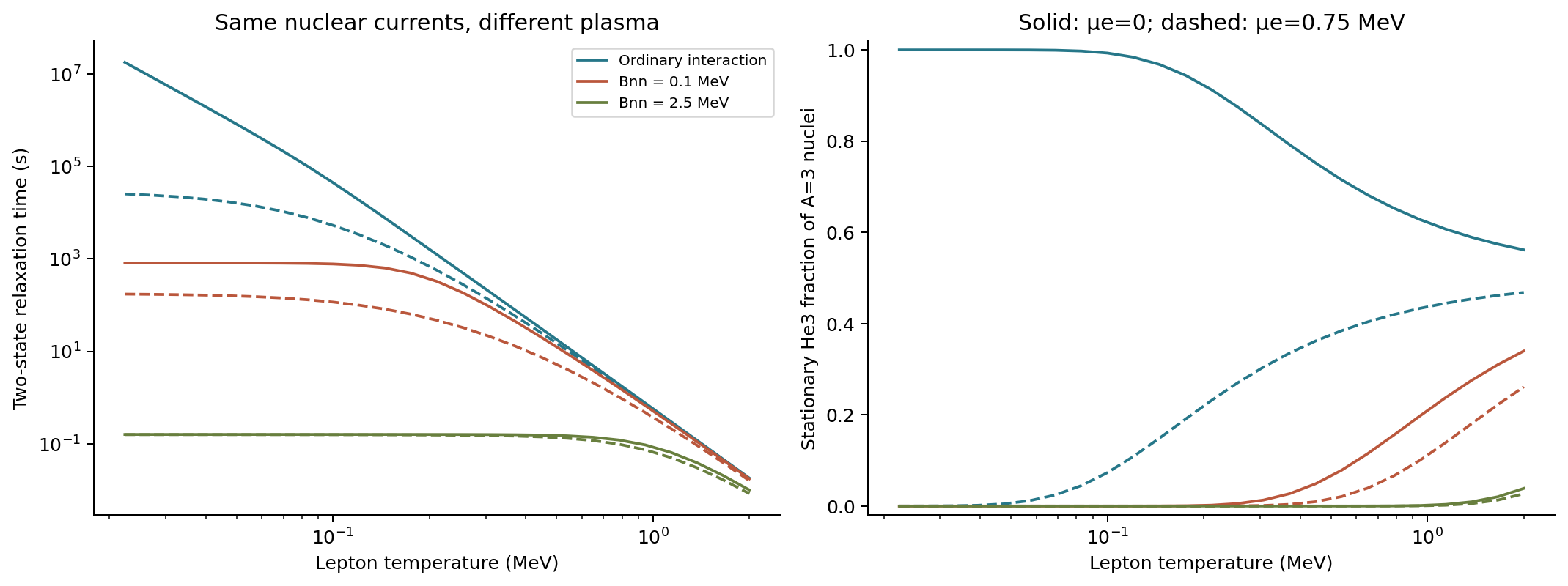
The frozen one-body tritium–helium-3 matrix elements now supply all four crossed weak-reaction pairs in prescribed lepton baths. Electron attraction, positron repulsion and Pauli blocking use identical factors for a process and its inverse. Direct hole occupations preserve detailed balance in degenerate electron baths. Both nuclear spins are 1/2, so the reverse strength has no factor of three. The plot shows the R=2-fm models at equal lepton temperatures; all regulators, colder-neutrino cases and lower temperatures are downloadable. The ordinary LO mass error is retained. These conditional two-state relaxation times and stationary fractions are not a complete reaction network or a charge-neutral stellar/cosmological history.
Data · Provenance · PNG · SVG
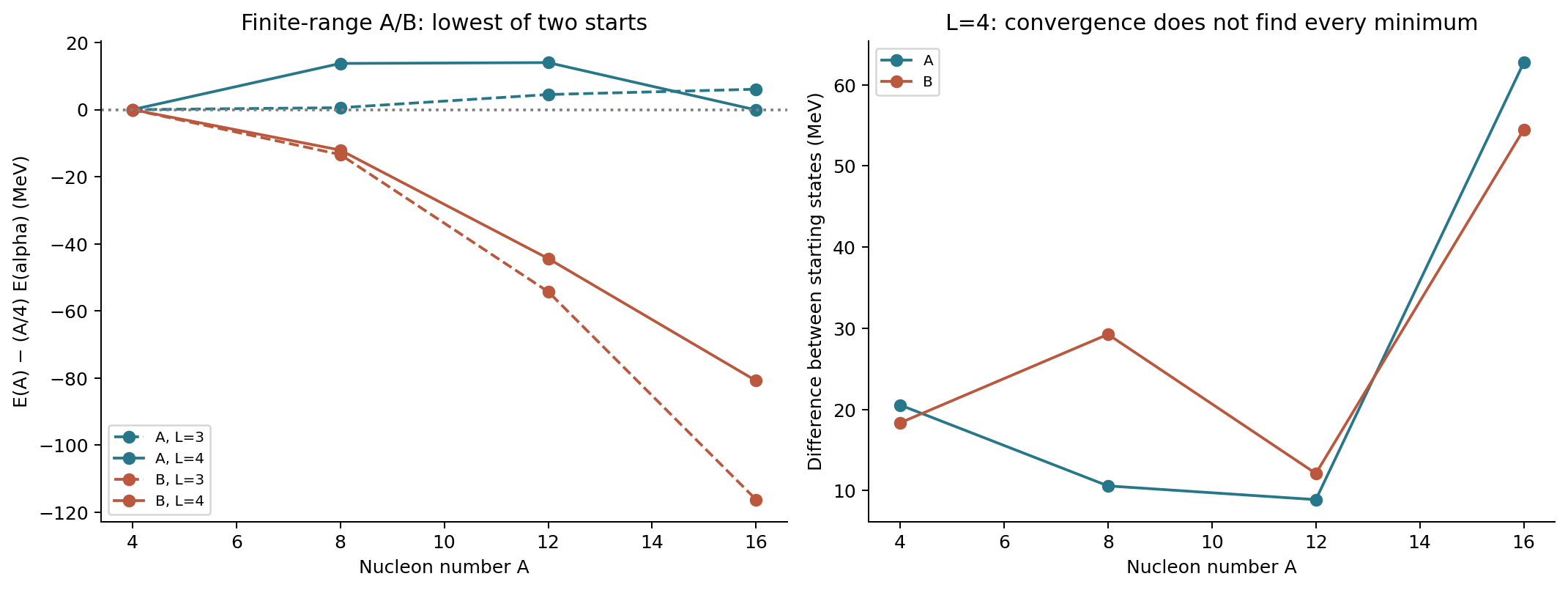
Correlated finite nuclei through oxygen-16
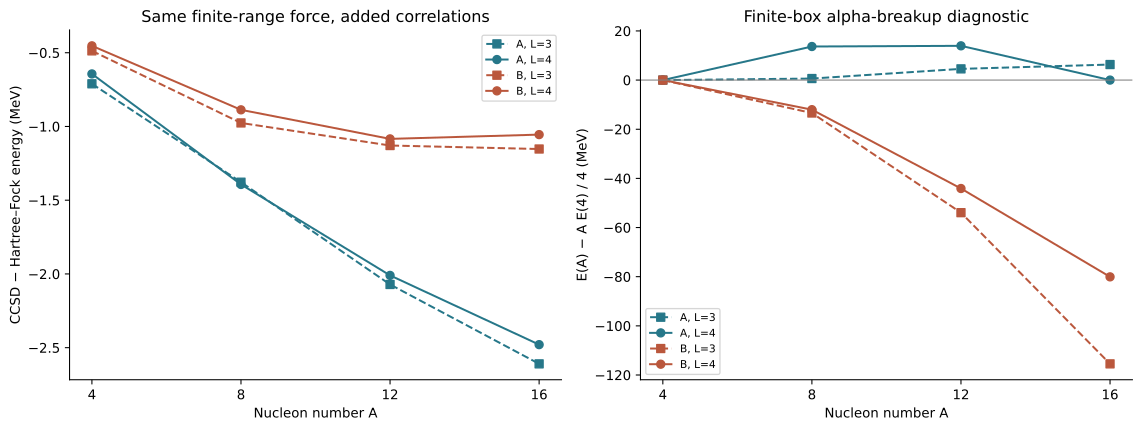
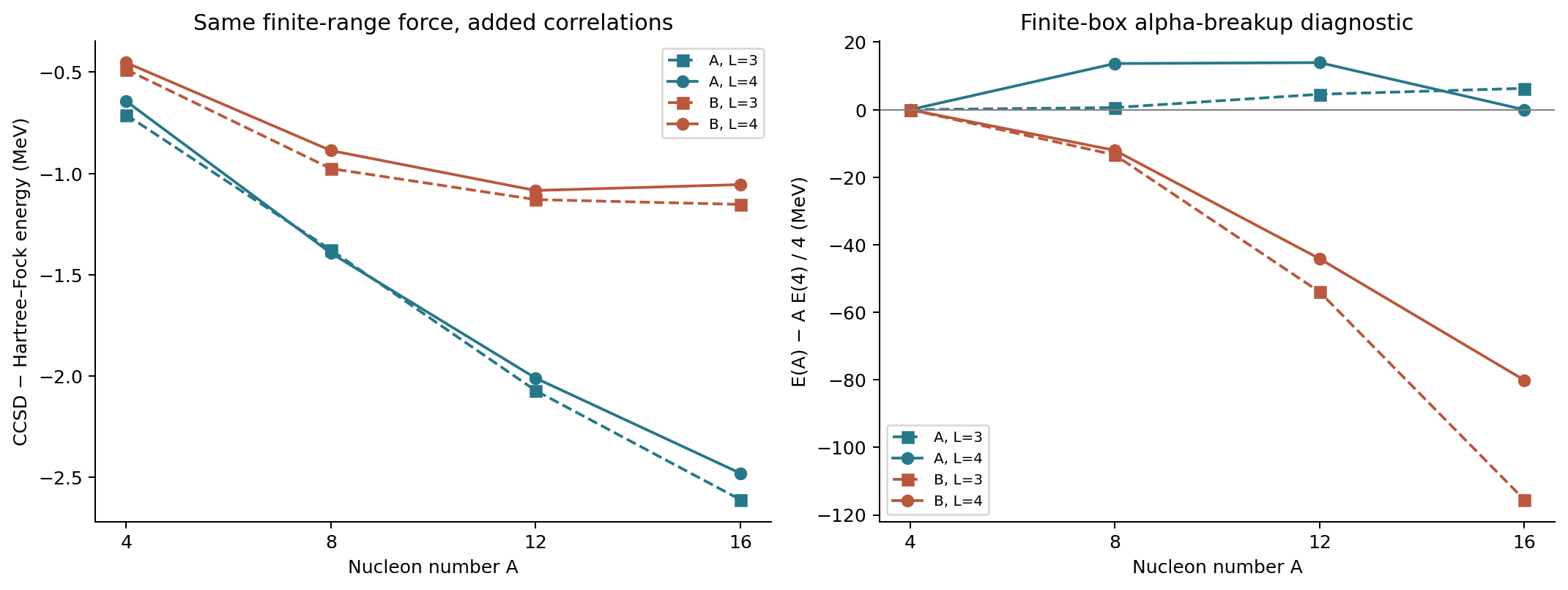
Sixteen CCSD solutions use the previously audited finite-range A/B two-body Hamiltonians, in two periodic boxes and at A=4,8,12,16. No three-body NO2B approximation enters this Hamiltonian. Pivoted QR selects localized references with nonzero overlap with the existing best HF state; it changes no interaction. The alpha energy is reserved to check the reference change. Every final energy has independent complex-contraction, Wick-field and fixed-point checks. An interrupted predecessor is retained; saved amplitudes only initialize recomputed and rechecked roots. The right panel compares computed finite-box energies with computed alphas in that same box. CCSD is nonvariational, two volumes are not an infinite-volume extrapolation, and a negative energy difference does not establish a thermodynamic phase, lifetime or physical field trajectory.
Data · Provenance · PNG · SVG
Exact small-box controls on the correlated approximation
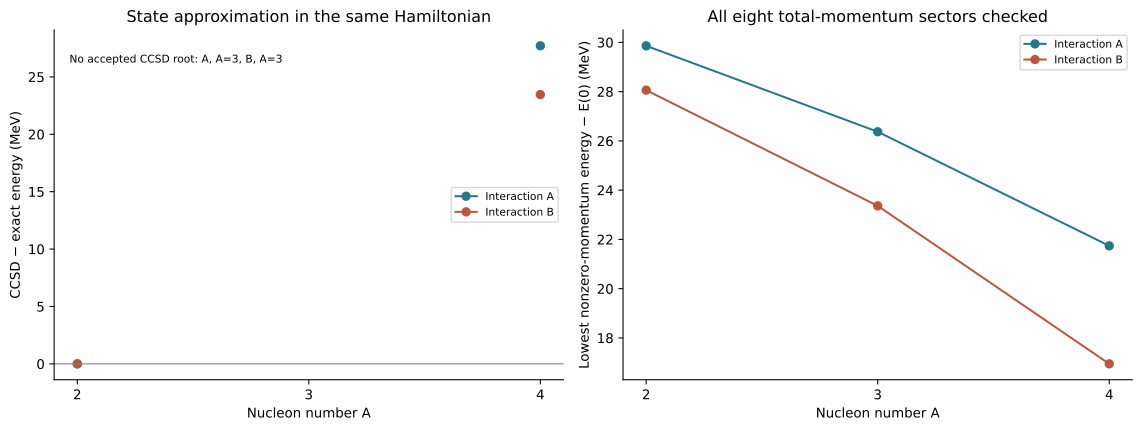
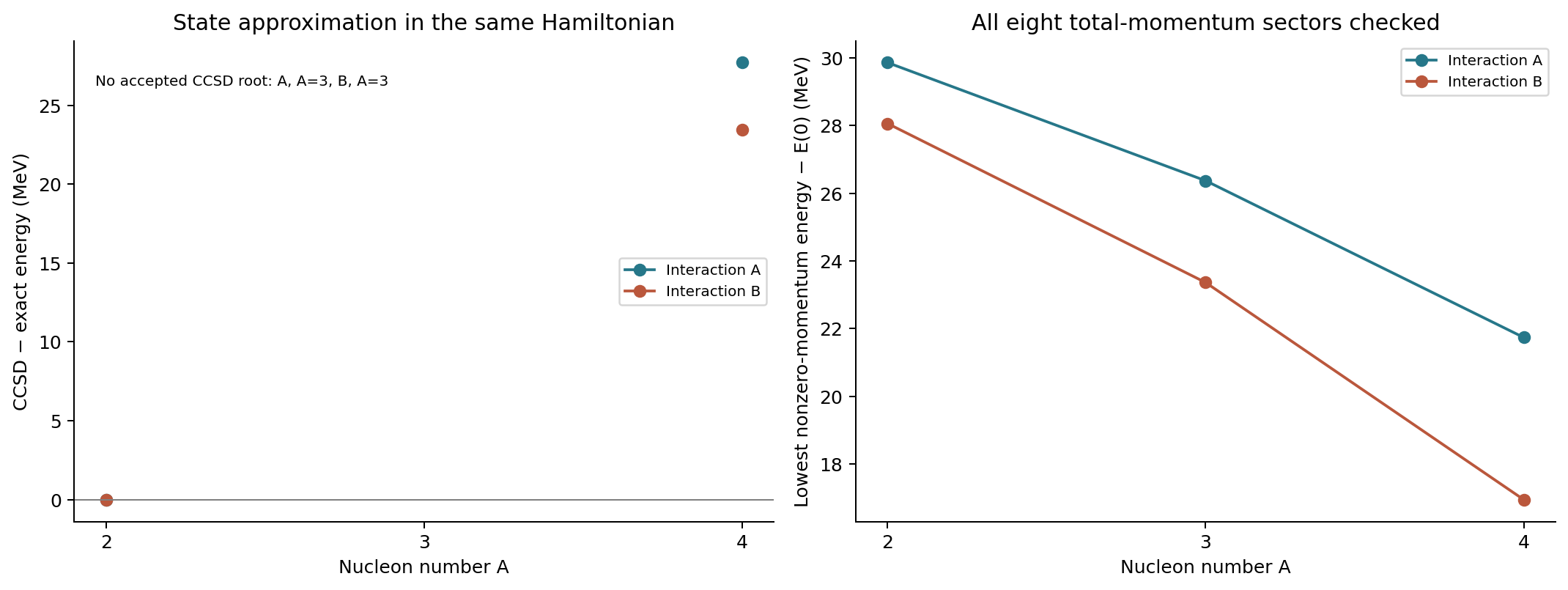
Exact fixed-charge Fock calculations for two, three and four nucleons use the same finite-range A/B forces in an L=2 periodic box. Coincident periodic neighbors carry both directed weights, matching the independent Fourier operators. Fermionic translation signs are retained and all eight total-momentum sectors partition the full Hilbert space. The exact two-particle energy also agrees with the independent Fourier solver. The CCSD comparison is initialized using exact connected singles/doubles as a local method diagnostic, not an independent search for the ground state. Complete Wick fields and converged amplitude residuals are checked. An independent full-space evaluation of exp(-T) H exp(T) verifies the energy and singles/doubles equations without using the source diagram contractions. There is no three-body force or NO2B approximation here. The differences characterize the accepted local roots and references in this small box; they are not uncertainty bounds for the larger nuclei or volumes.
Data · Provenance · PNG · SVG
Measured isomer formation and survival in ordinary environments
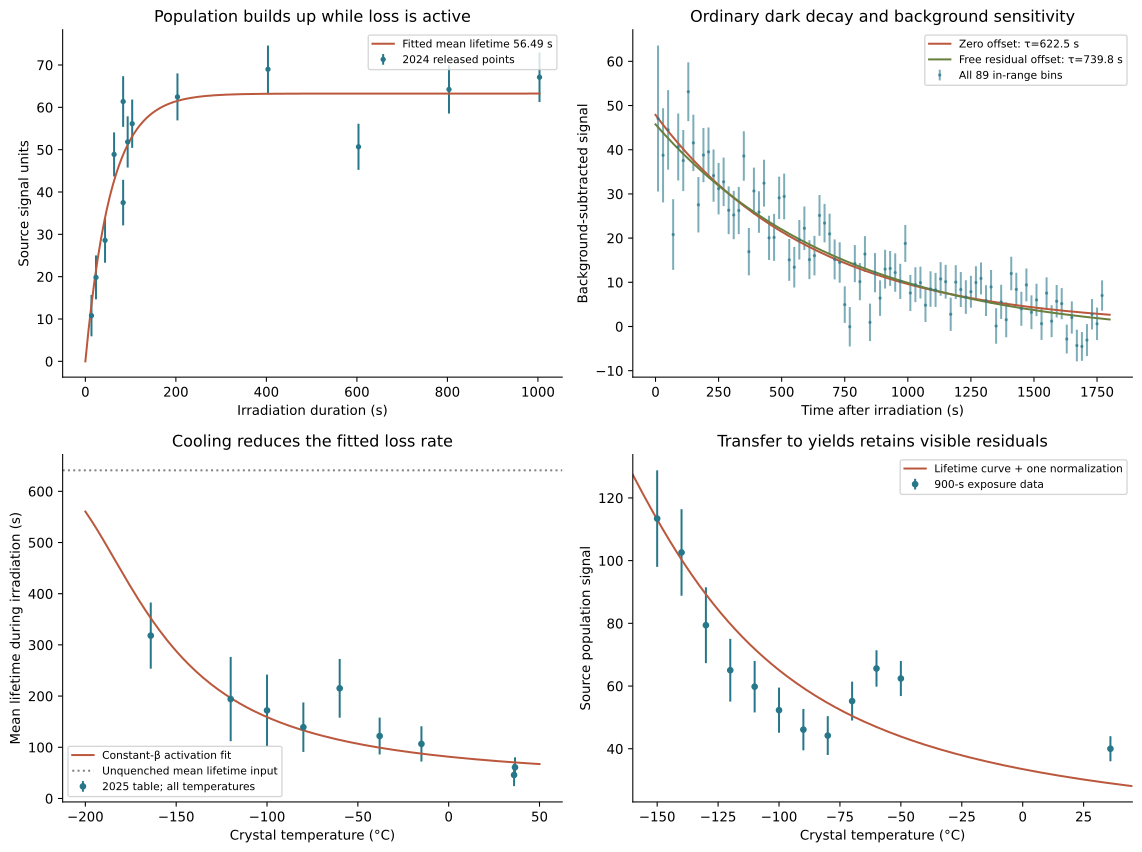
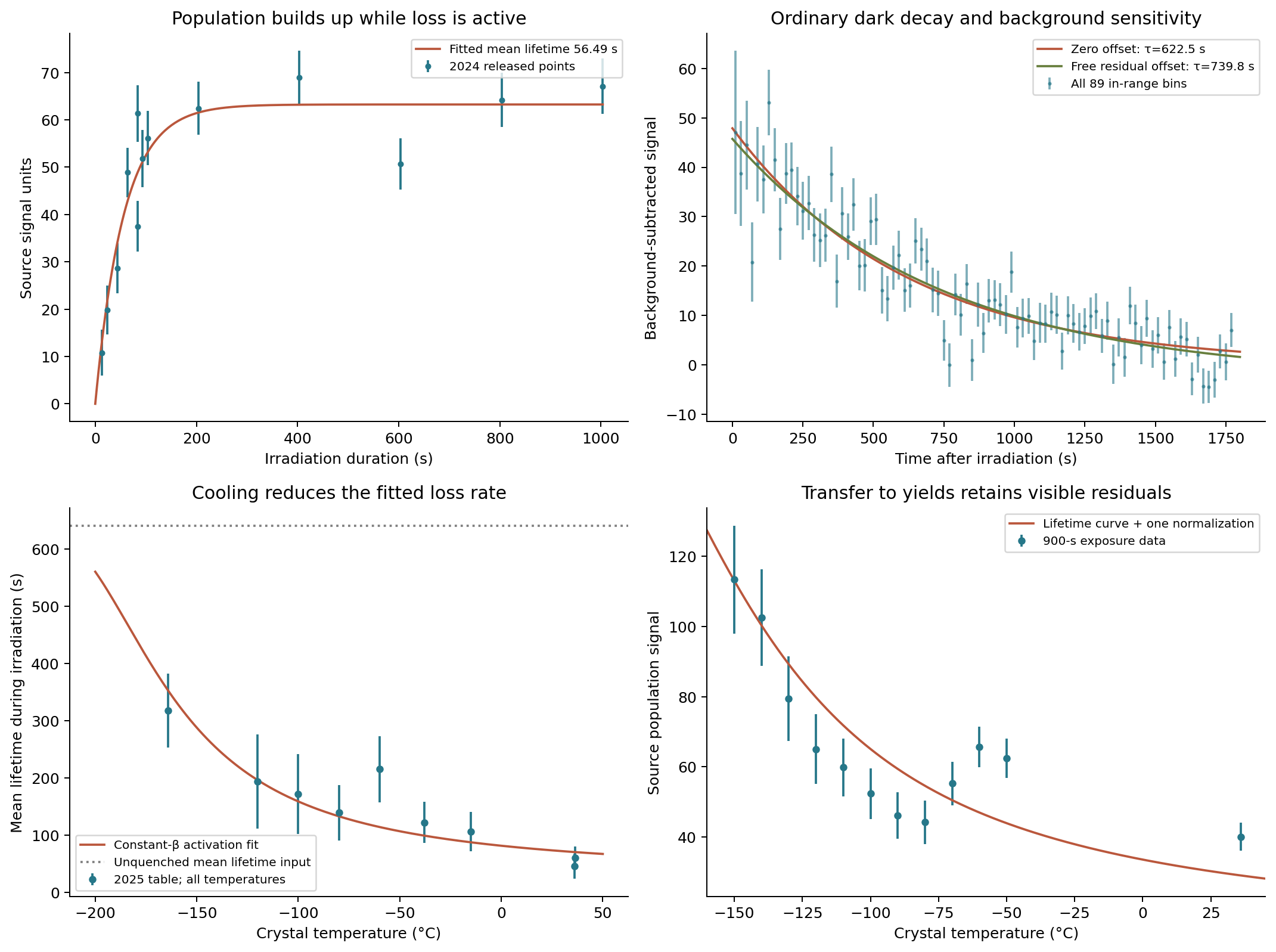
Independent fits use the released 2024 Figshare data and 2025 printed tables. The fitted 2024 mean lifetimes are 56.489 s during irradiation and 622.487 s in the dark; half-lives are smaller by ln(2). Negative background-subtracted bins are retained and the overflow bin is excluded. A residual offset changes the dark fit appreciably. The thermal fit retains every temperature, including the nonmonotonic point. Its transfer to 900-s populations includes incomplete saturation and fits one normalization; it does not remove the residual structure. Plotted errors are the source statistical summaries, without invented cross-measurement covariance or a combined significance. The separate 2025 room-temperature fit differs from its printed central value by 1.80 s, well within its quoted uncertainty. These are ordinary environmental effects, not evidence of changed fundamental constants.
Data · Provenance · PNG · SVG
Atomic binding, electron populations and weak conversion
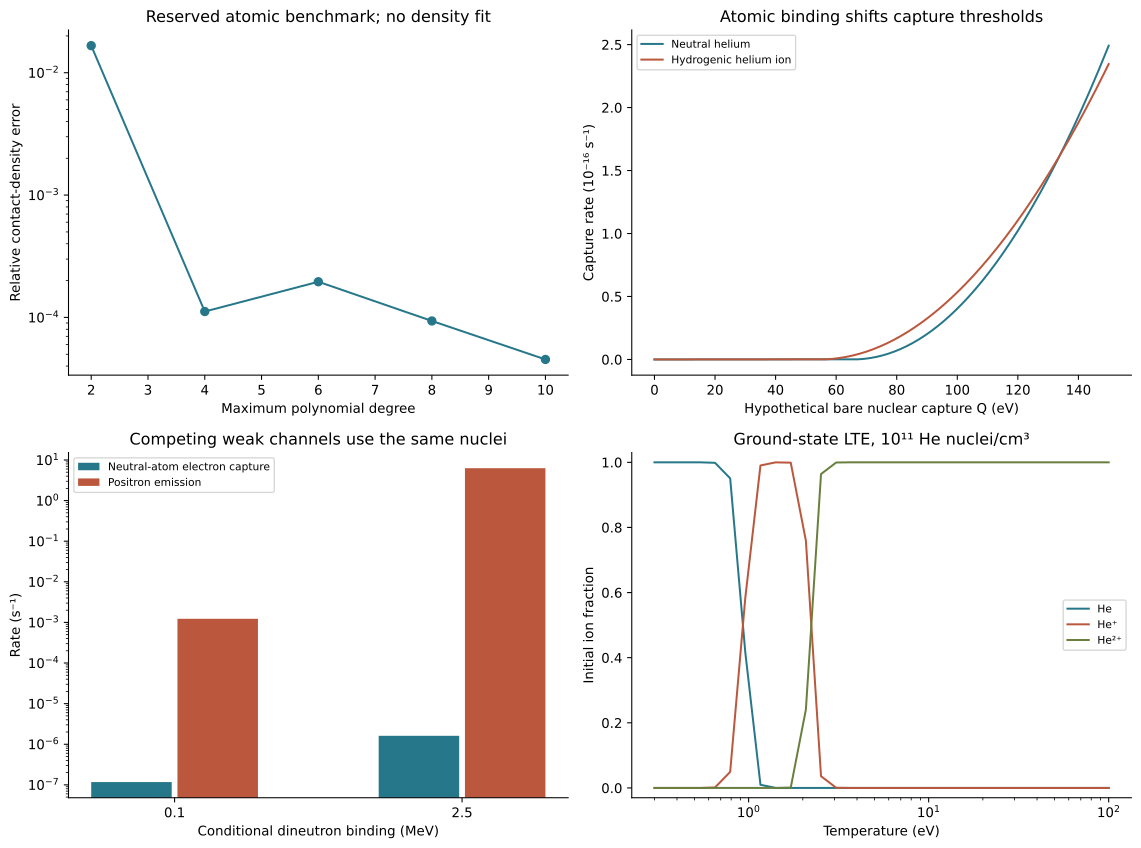
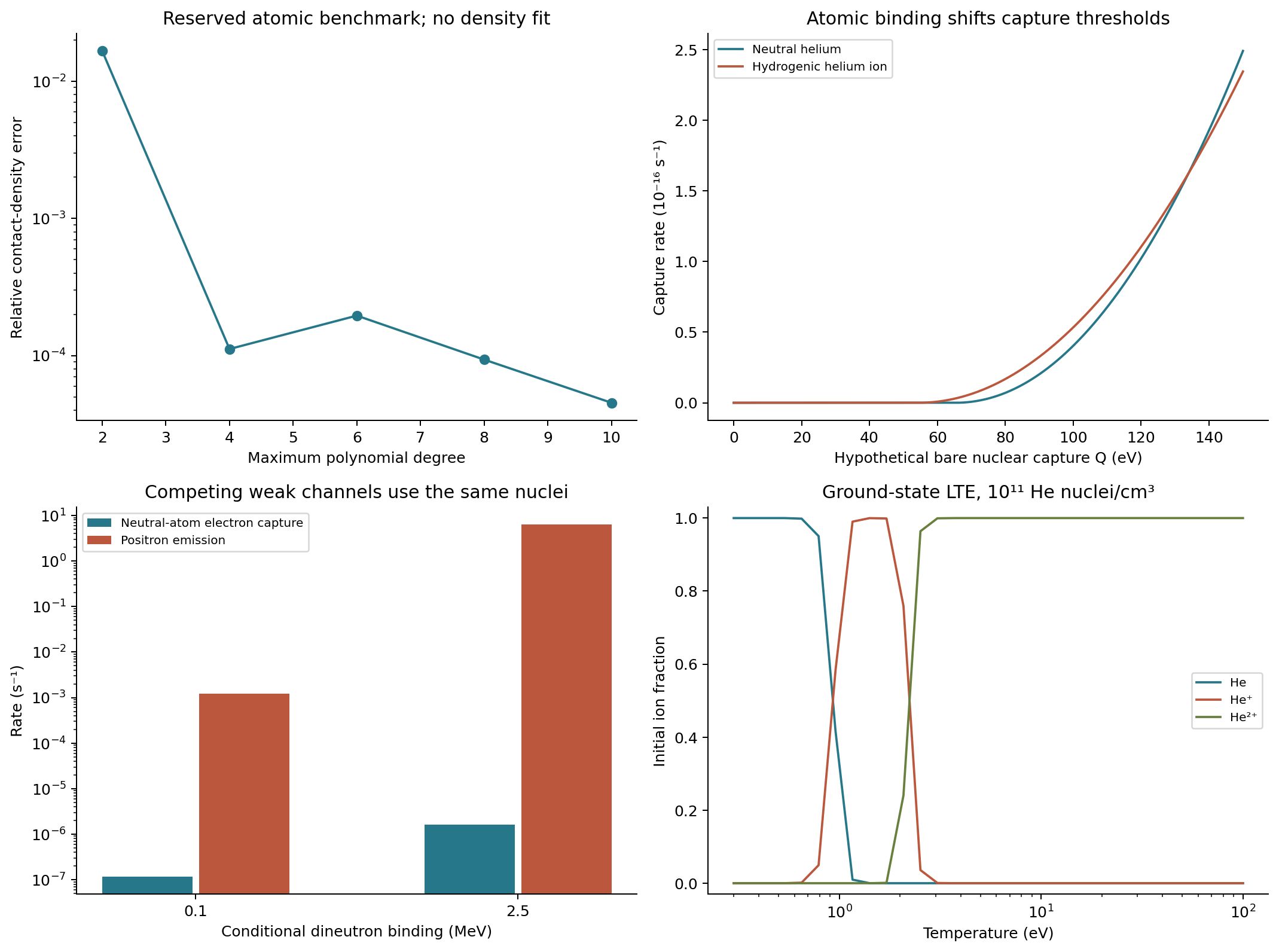
An explicitly correlated helium wavefunction supplies the electron contact density and spectator state. Nuclear masses and weak strengths remain the frozen few-body predictions. Exact hydrogen bound states and Coulomb scattering states resolve the spectator spectrum; the finite-box predecessor remains a diagnostic. Atomic binding changes the bare-Q threshold; it does not change nuclear binding. The two nn-perturbed examples already permit much faster positron emission. The empirical ordinary helium-3 capture channel remains closed. Ion fractions assume dilute ground-state LTE and show initial populations, not an evolved reaction history. Recoil, radiative corrections, screened free-electron capture on populated atoms and a matched field response remain outside the calculation.
Data · Provenance · PNG · SVG
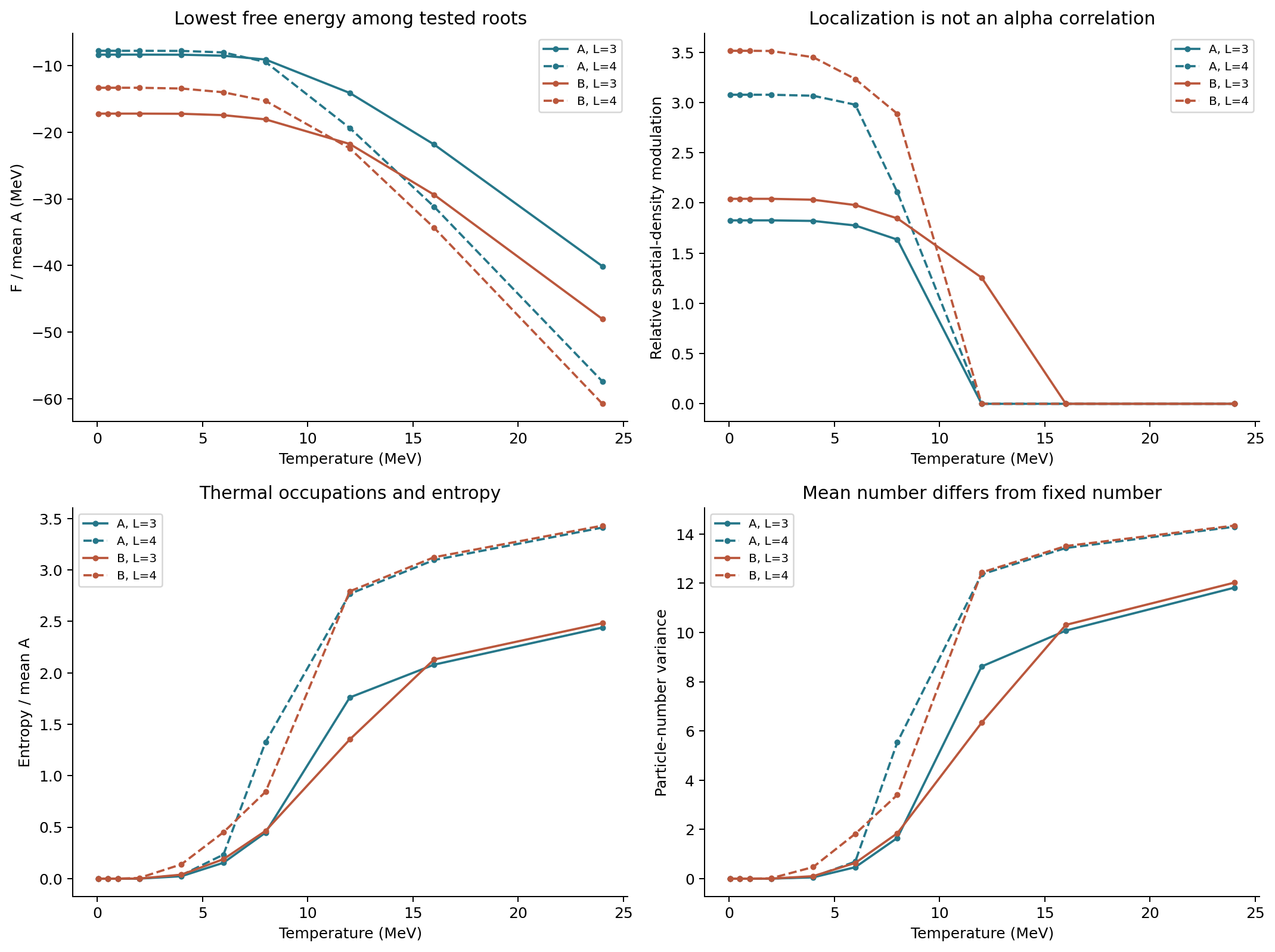
Finite-temperature mean-field ensembles at mean A=16
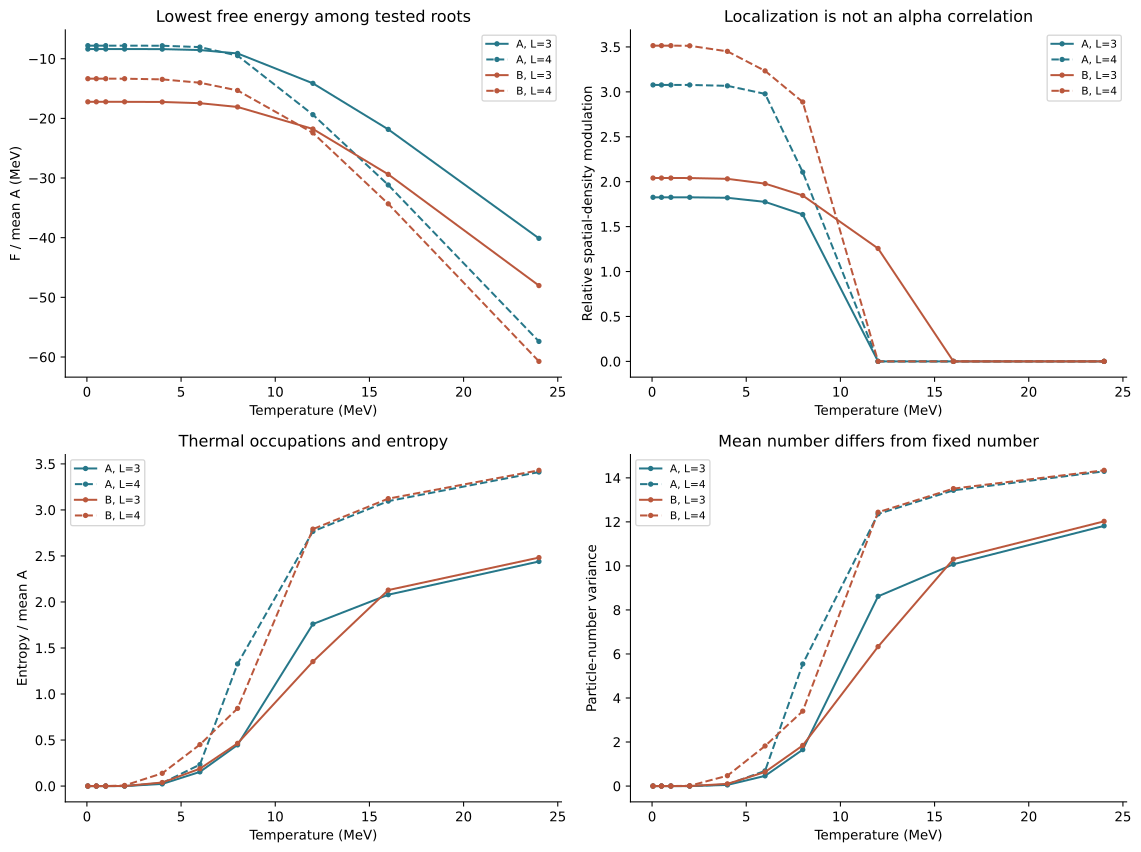
Every shown point is the lowest free energy among three converged starts of the same finite-range A/B Hamiltonian. The real spin/isospin-saturated Gaussian ensemble fixes mean particle number and permits the displayed number fluctuations. Different L at fixed A also changes density. Cold-energy, free-gas and entropy-derivative controls pass, but this is neither a canonical comparison nor a fixed-density thermodynamic limit. Loss of spatial modulation does not establish a liquid-gas transition, critical point or alpha population.
Data · Provenance · PNG · SVG
Exact finite-box thermal nuclei through four particles
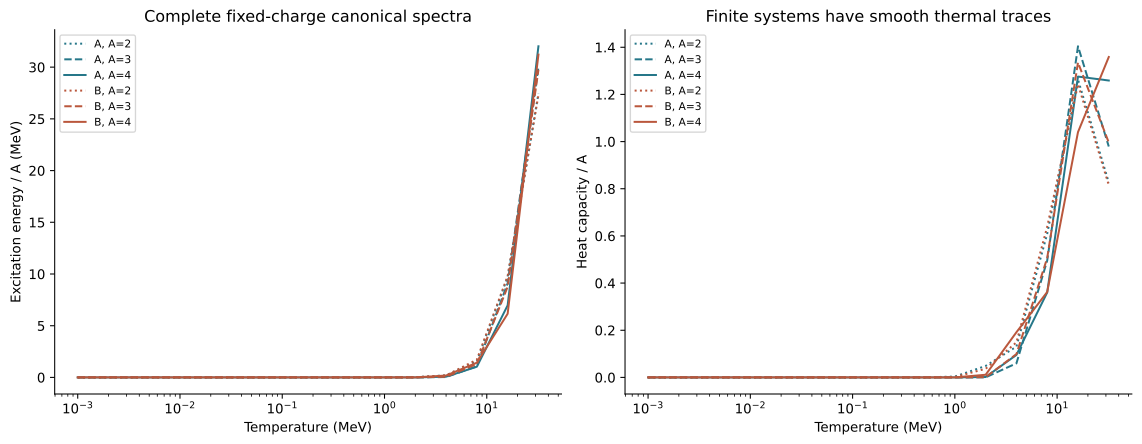
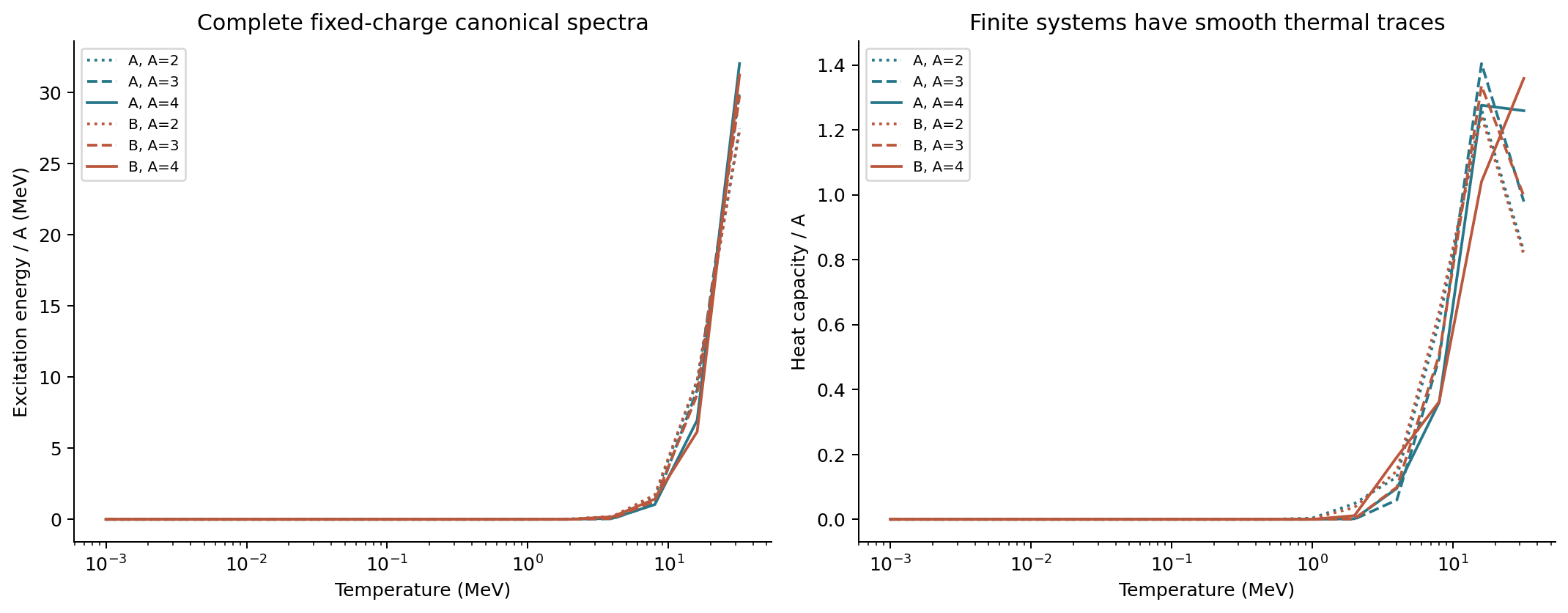
Canonical traces include every fixed-charge state in all eight momentum sectors: 256 states for A=2, 1,920 for A=3 and 14,400 for A=4. No low-level or CCSD truncation enters these small-box traces. Full eigenvector, free-spectrum, ground-energy, thermodynamic-derivative and high-temperature normalization controls pass. The 10^6-MeV normalization test is excluded from the figure. Particle number changes density in this fixed L=2 box. These finite systems are not a multi-alpha gas, bulk liquid, or physical phase boundary.
Data · Provenance · PNG · SVG
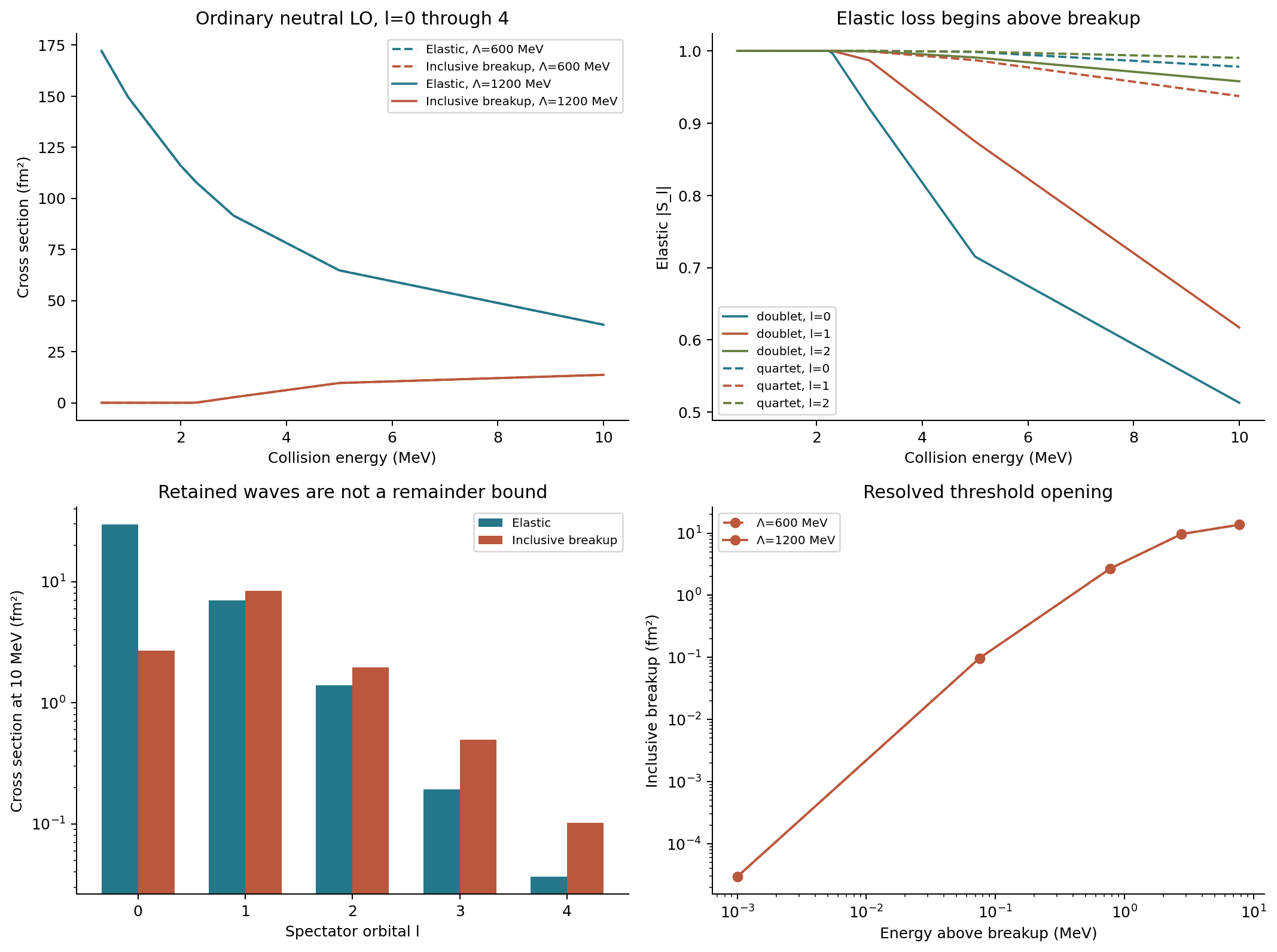
Neutral higher partial waves across three-body breakup
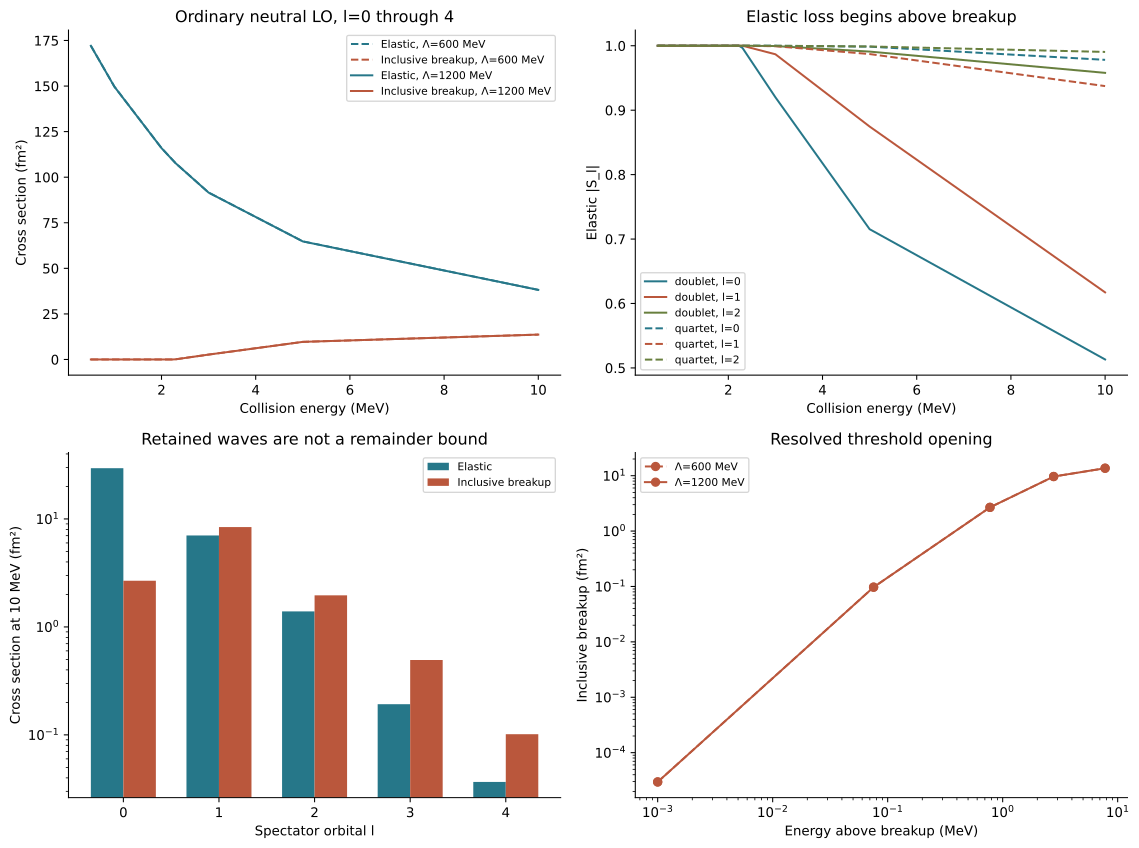
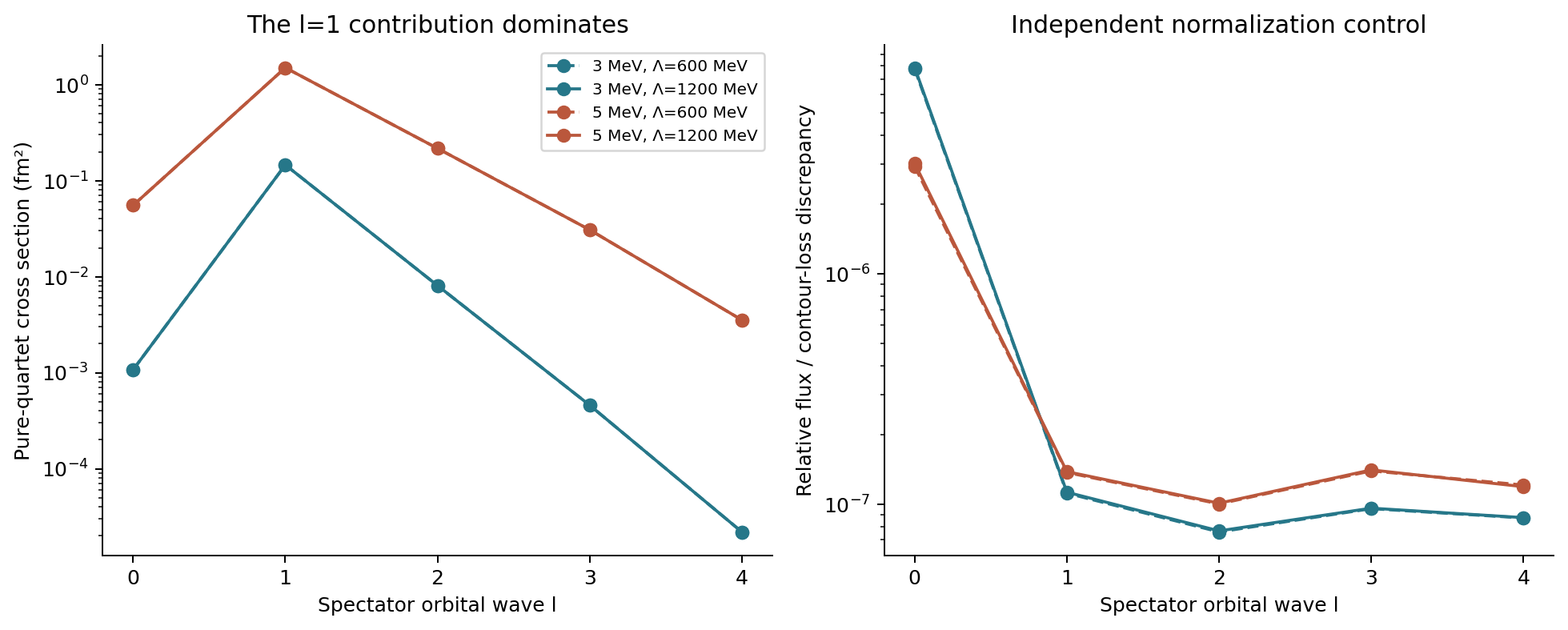
LO STM amplitudes retain pair S-wave forces and extend spectator l=0 through 4. A lower complex contour avoids outgoing poles and cuts while preserving the real regulator endpoint. Independent below-threshold principal-value amplitudes, conjugation, angular projections, grids and contour depths pass. Inclusive breakup comes from elastic loss 1−|S|²; optical balance is an algebraic normalization check, not an independent integrated exclusive three-body flux. Two cutoffs and the last retained wave diagnose sensitivity, not a complete EFT uncertainty or partial-wave bound. The later quartet l=0 exclusive calculation supplies one independent flux control; doublet/higher-wave exclusive distributions, charged breakup, thermal rates and finite-field matching remain unfinished.
Data · Provenance · PNG · SVG
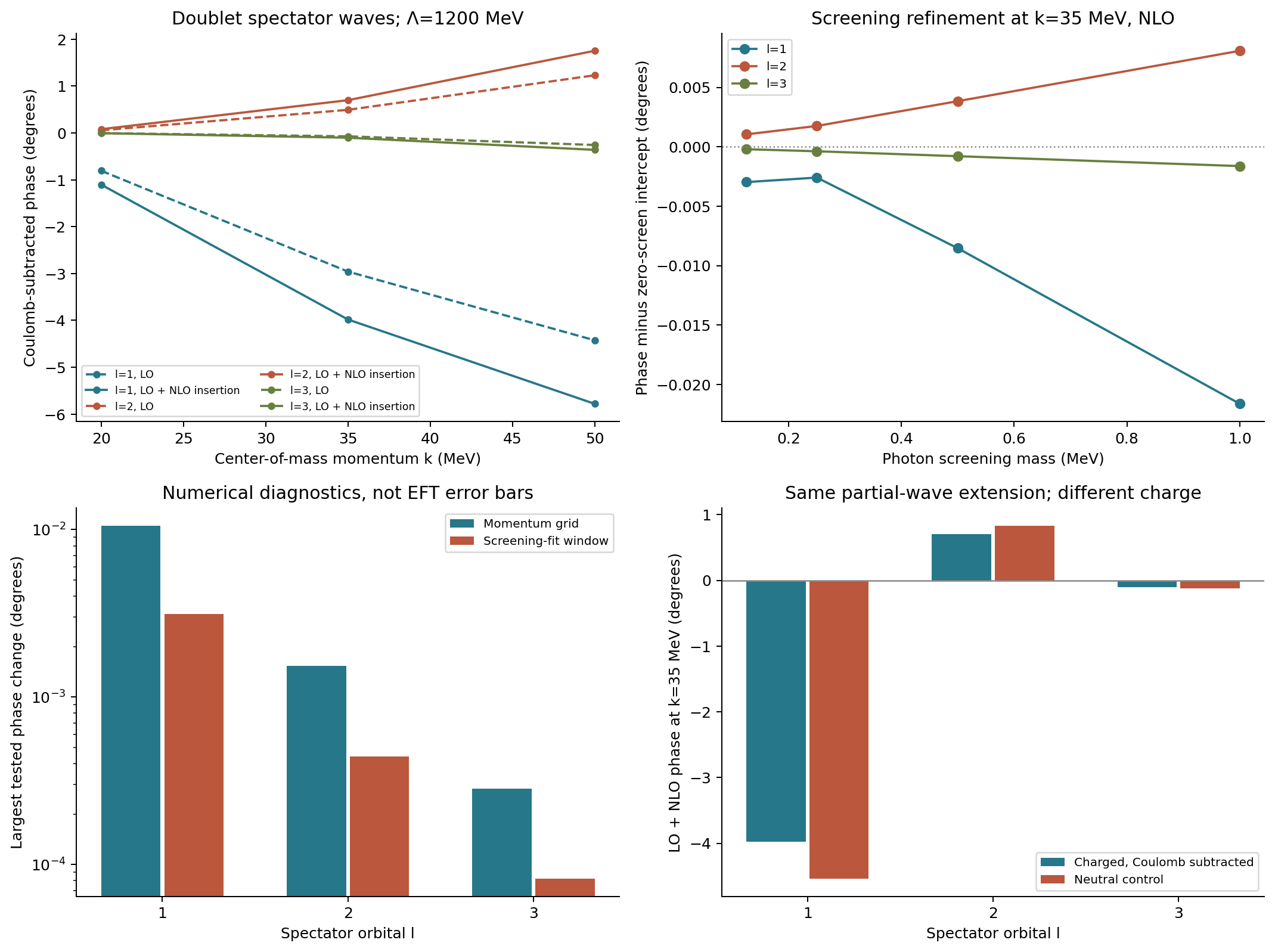
Charged doublet P, D and F waves below breakup
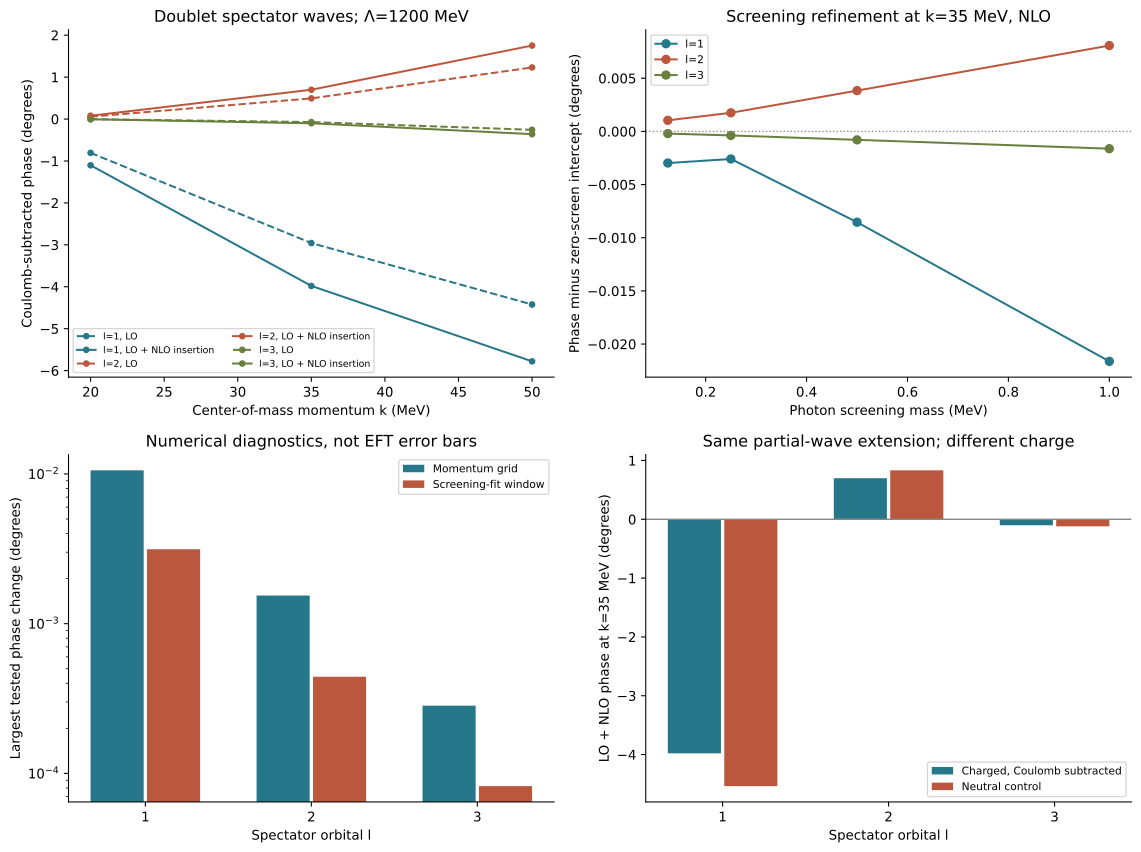
These ordinary-background doublet amplitudes extend spectator l=1,2,3 while keeping pair S-wave interactions. Angular projection is applied to the source kernels before their S-wave average; it is a new equation extension, not a published higher-wave table. LO iterates the one-photon kernels, while NLO is one perturbative insertion. A separate composite-deuteron Coulomb amplitude defines the subtraction convention. Linear zero-screen intercepts use the three smallest photon masses; the window/grid comparisons are numerical diagnostics, not an EFT truncation uncertainty. All momenta remain below breakup. Charged quartet waves, charged breakup, doublet/higher-wave exclusive neutral flux and finite-field matching remain unfinished.
Data · Provenance · PNG · SVG
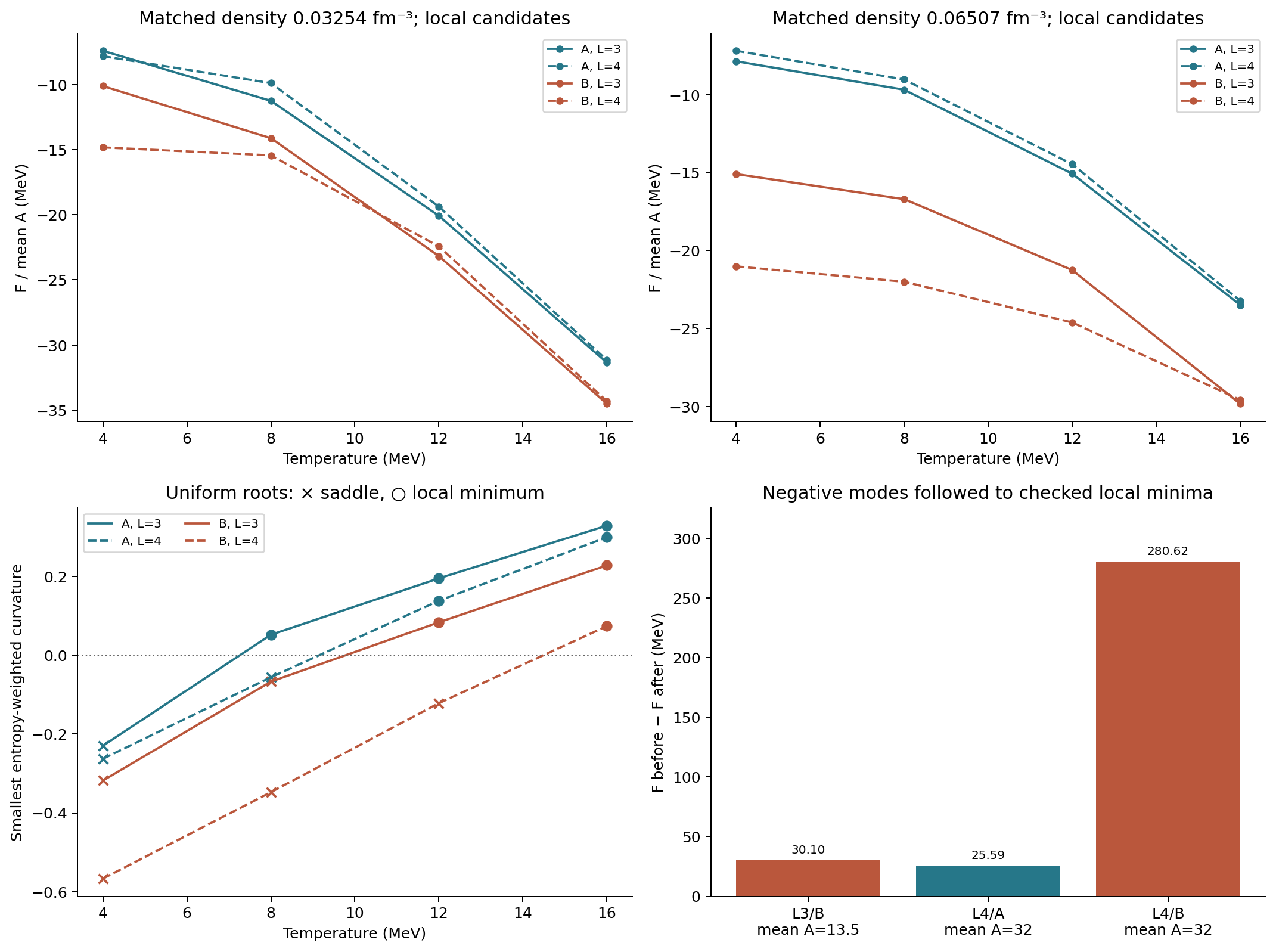
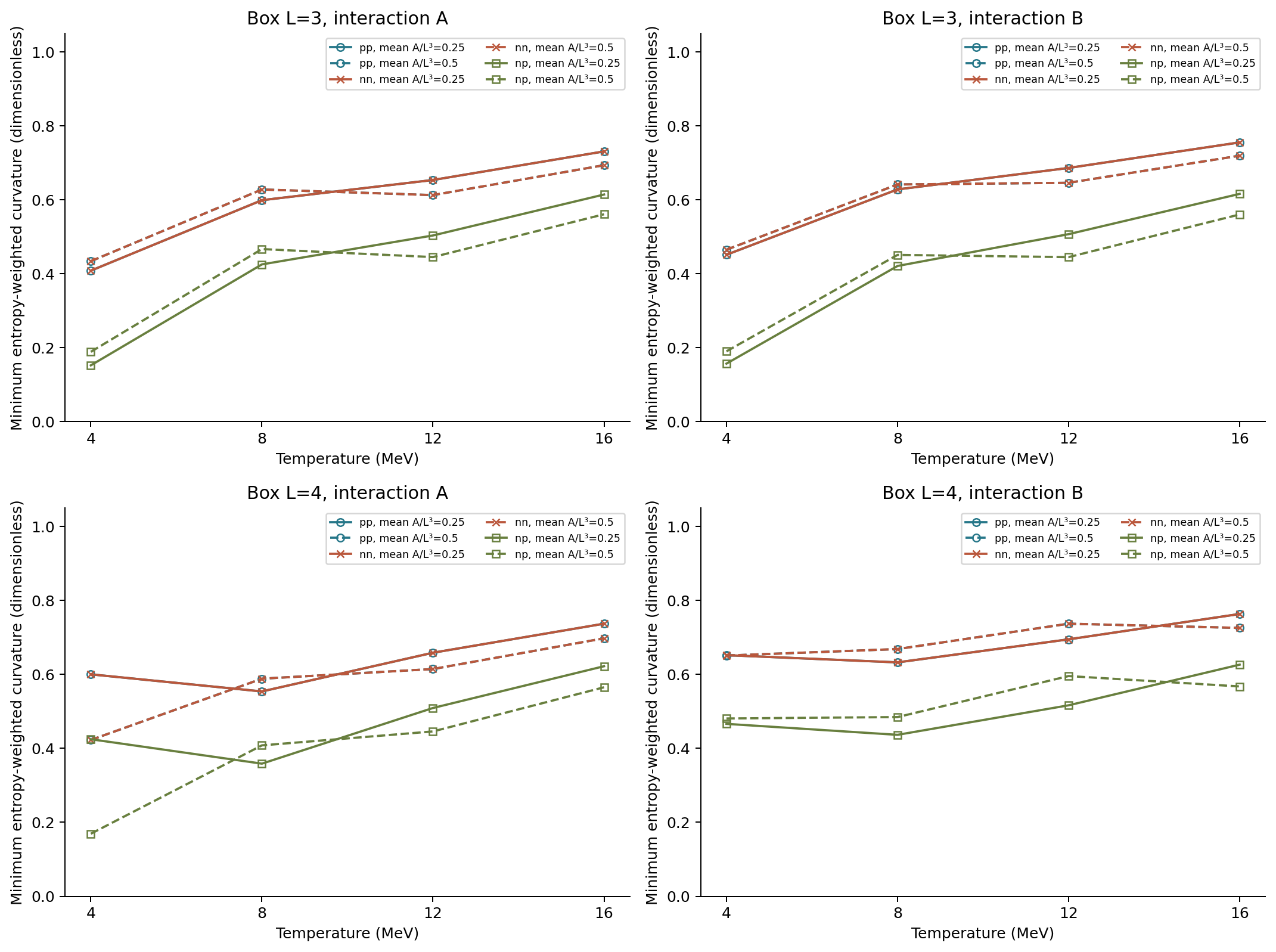
Matched-density finite boxes and full thermal Gaussian stability
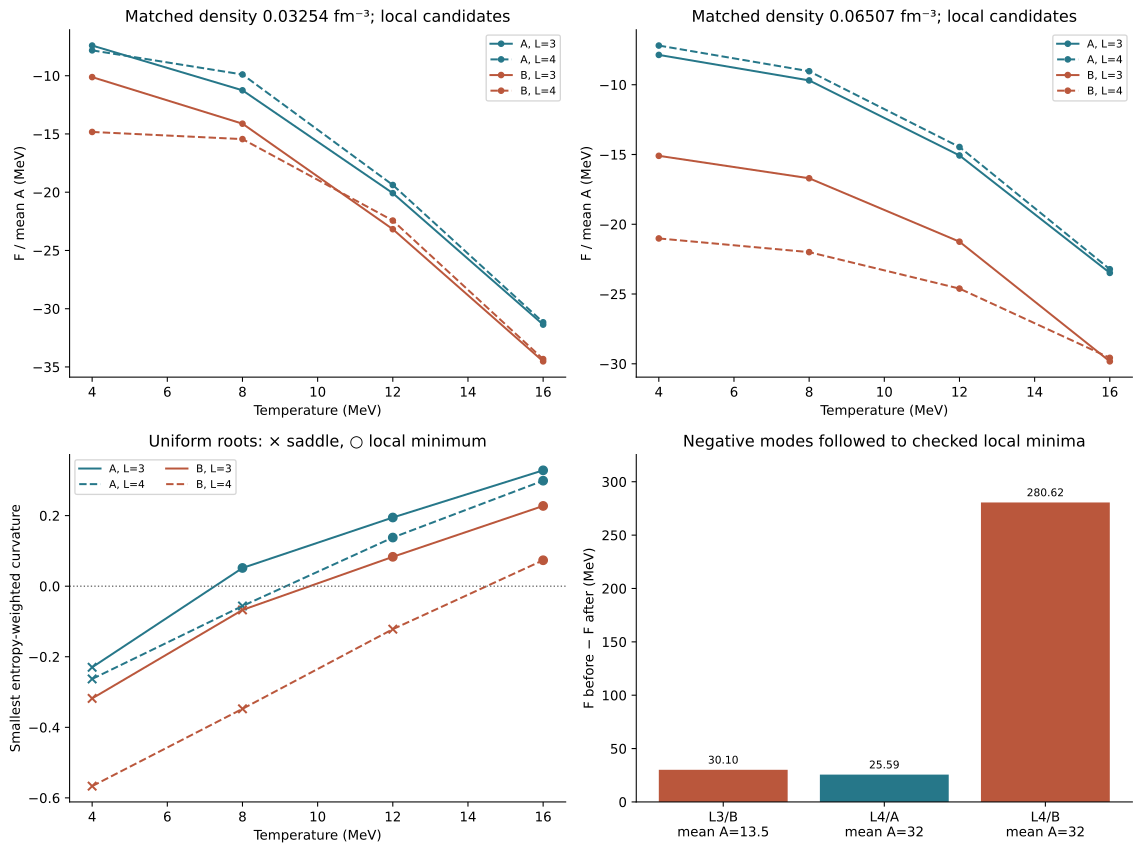
The same finite-range A/B Hamiltonians are compared at fixed mean A/L³=0.25 and 0.5 in two periodic volumes. Fractional mean numbers are permitted by the Gaussian ensemble. Five initialization/continuation paths are retained; the plotted candidates are lowest only among computed locally stable roots. Curvature includes all complex Hermitian proton/neutron charge-block fluctuations, including spin and occupation changes. The entropy susceptibility transforms each mean-charge constraint; a negative eigenvalue proves a saddle despite a converged iteration. Three unstable T=8 MeV roots are followed to lower free-energy minima and rechecked. The resulting roots remain saturated; this is not a polarized-phase claim. Two volumes, local stability and numerical heating/cooling paths do not establish a global minimum, thermodynamic extrapolation, coexistence or nucleation rate.
Data · Provenance · PNG · SVG
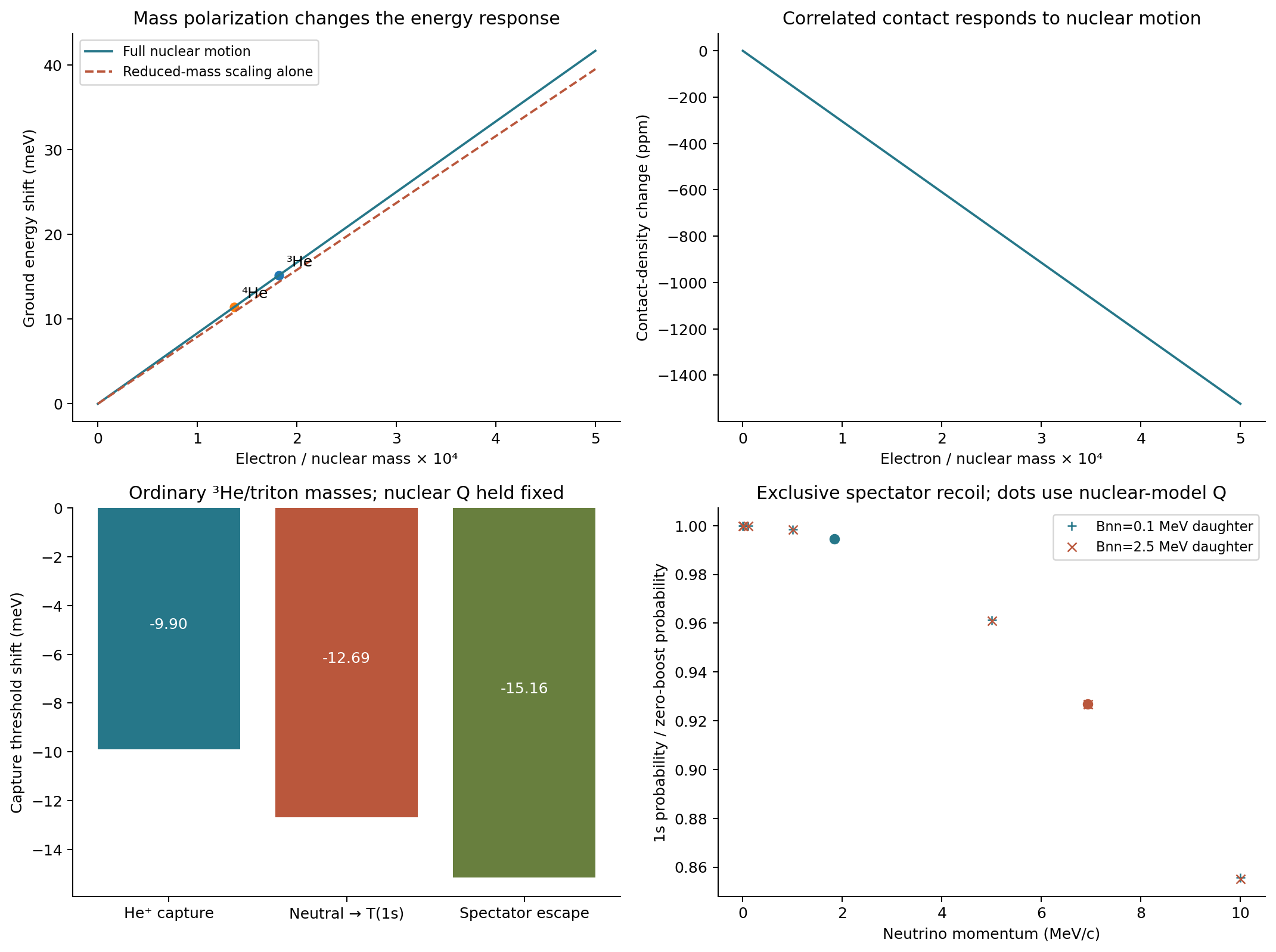
Finite nuclear motion shifts atomic capture thresholds
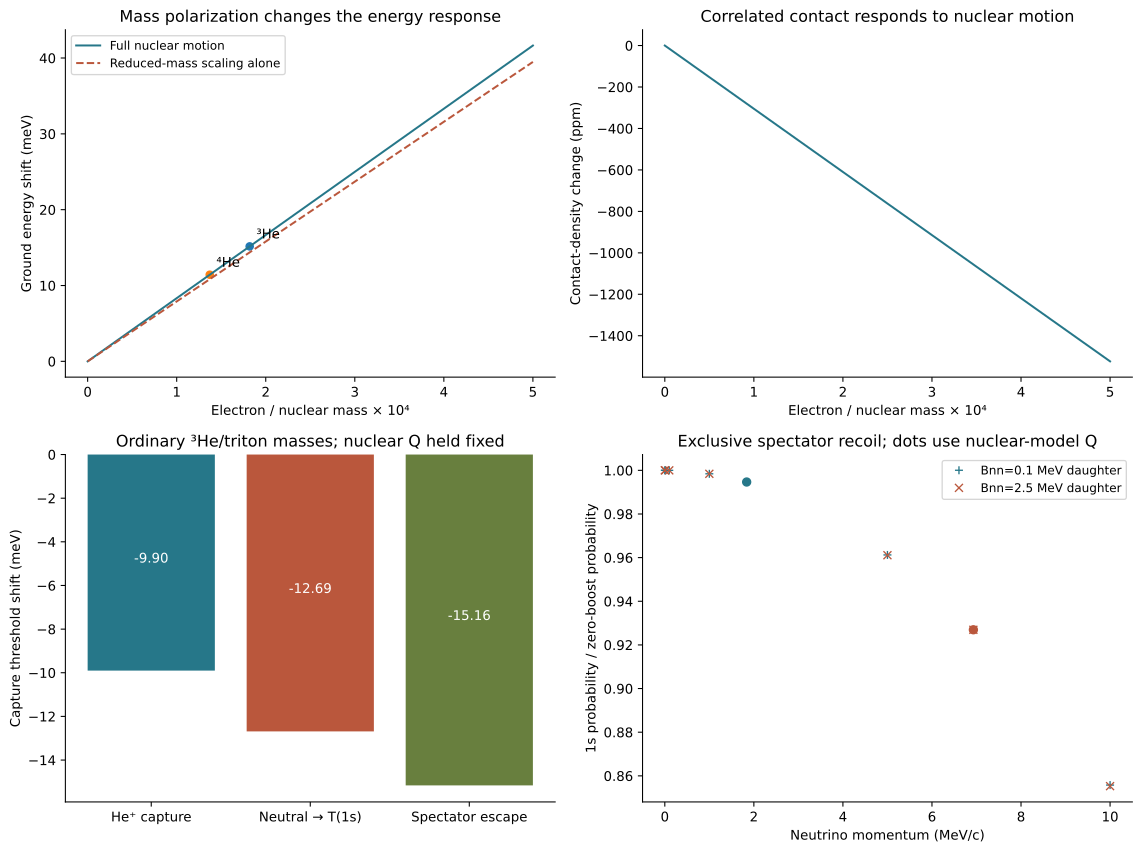
The complete nonrelativistic center-of-mass kinetic operator is included in the correlated helium Hamiltonian. The independent finite-mass helium-4 energy, normal-mass scaling, positive nuclear kinetic operator, Hellmann–Feynman response and basis controls pass. For ordinary helium-3 and tritium masses, neutral ground-channel capture shifts down by about 12.69 meV. A translational recoil boost changes the exclusive spectator 1s overlap; it can populate other bound and continuum angular momenta, which are not summed here. Crosses show sampled momenta without interpolation; filled dots retain the independently frozen hypothetical nuclear masses and their emitted neutrino momentum. No inclusive recoil-corrected rate, atomic QED precision or empirical helium instability is claimed.
Data · Provenance · PNG · SVG
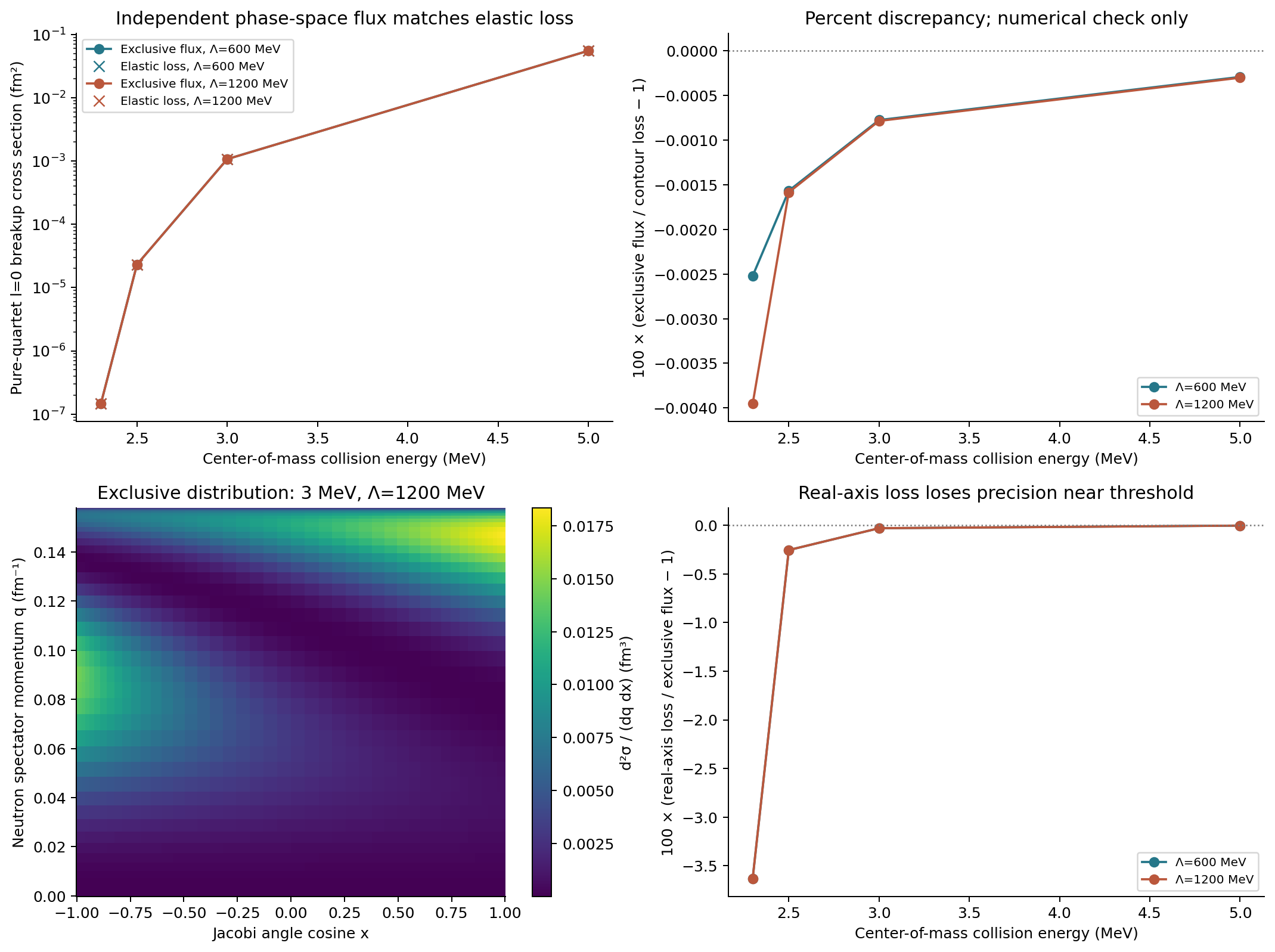
Independent neutral quartet breakup flux closes a channel-specific unitarity check
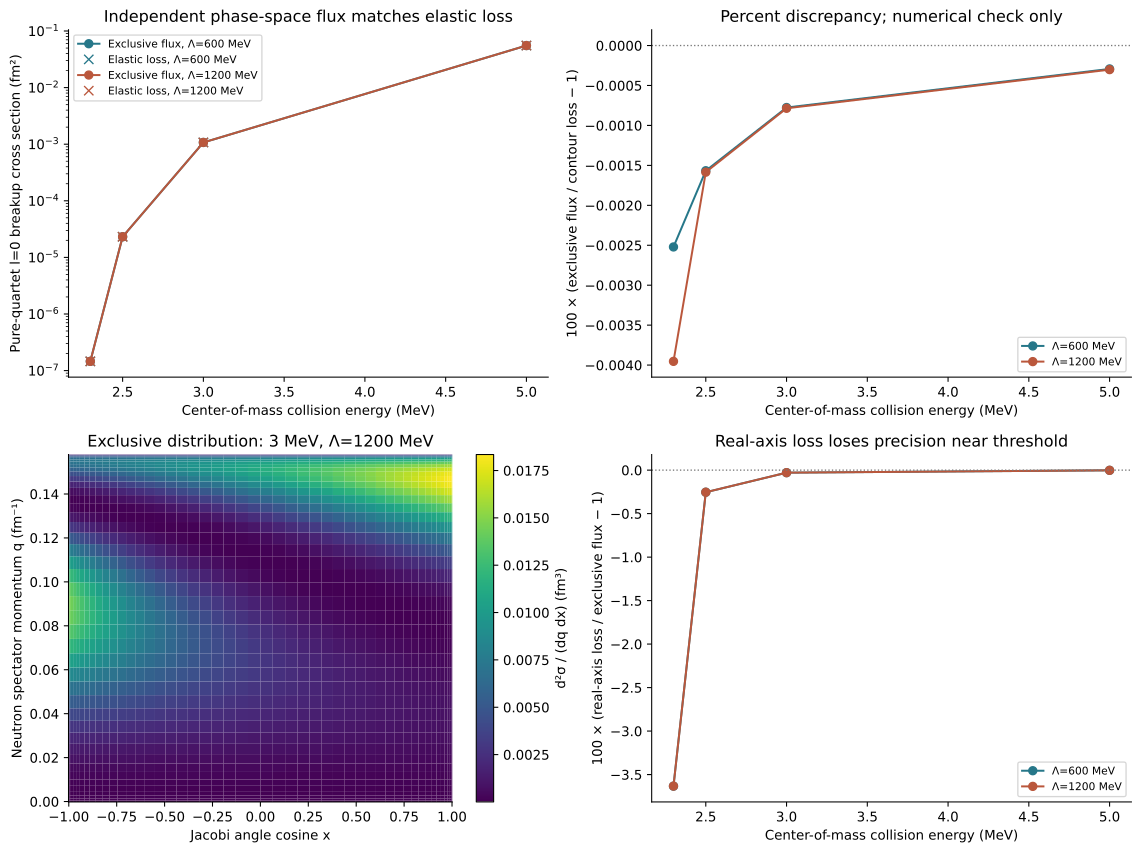
The LO neutral quartet spectator S wave is solved independently on the real axis, with explicit exchange cuts and analytic dimer-pole subtraction. The absolutely normalized antisymmetrized final amplitude is integrated over three-body phase space; no optical loss enters its normalization. Crosses are a separately computed contour elastic-loss comparator. Multiply these pure-quartet cross sections by 2/3 for their unpolarized contribution. The orientation-integrated density is not a laboratory five-fold detector cross section; convergence checks cover its integral, not pointwise detector spectra. Lines only connect sampled energies. Cutoff and quadrature differences are numerical controls, not EFT uncertainty bands. The real-axis optical-balance gate is absolute, 3e−6 fm², and permits a 3.6% relative own-loss discrepancy at the smallest cross section. Doublet/higher-wave exclusive amplitudes, charged breakup, NLO and field matching remain unfinished.
Data · Provenance · PNG · SVG
All tested normal states resist infinitesimal anomalous pairing
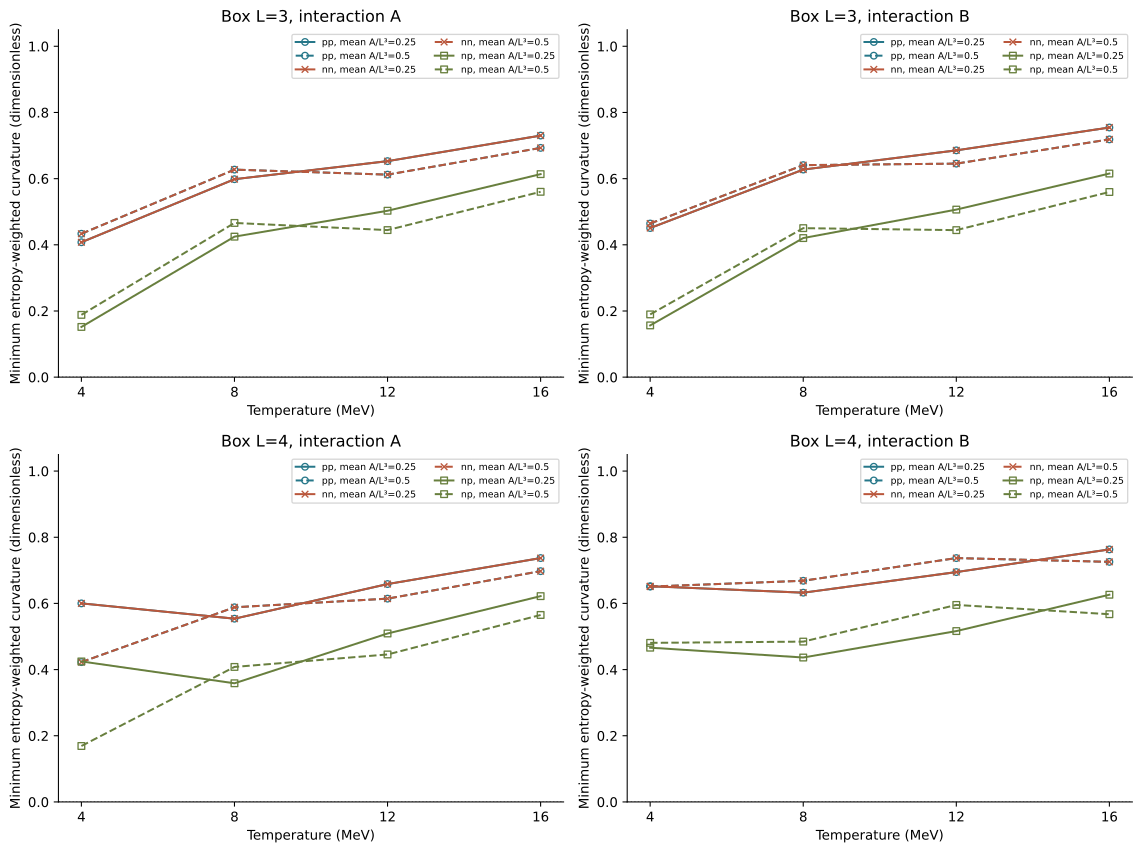
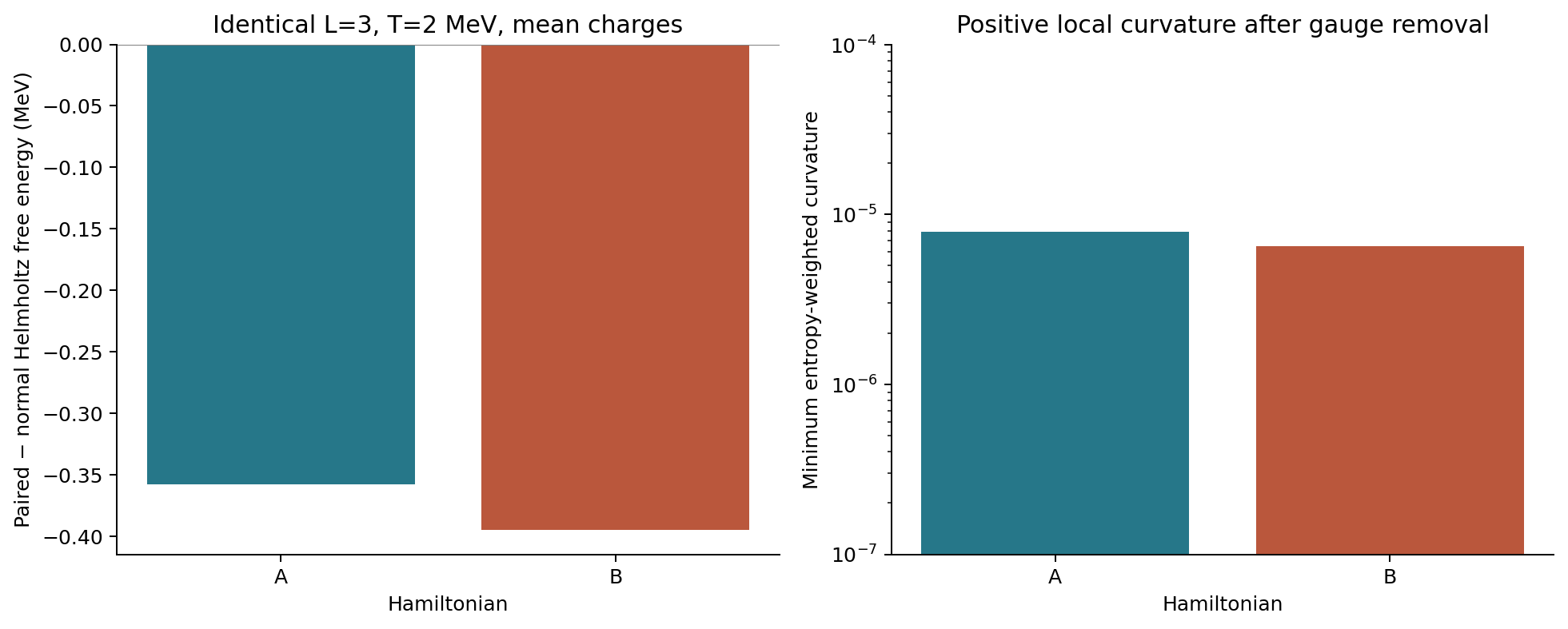
All 96 complete complex pp, nn and np pair-block audits of 32 selected normal states have positive entropy-weighted curvature. The coincident pp/nn results follow the charge-symmetric strong Hamiltonian; electromagnetic pp repulsion is not added. Solid and dashed curves connect the two separately fixed mean fillings across sampled temperatures; they do not locate a critical temperature. Curvature is dimensionless, not an excitation energy, rate or physical uncertainty. Independent finite Fock-space entropy/Wick controls and fixed-mean-charge BdG paths validate the normalization and constraints. Positive local curvature excludes an infinitesimal anomalous instability at these roots only: disconnected finite-amplitude paired minima, colder pairing, proton–neutron coherent normal densities, number projection, beyond-quasifree correlations and thermodynamic limits remain open. No paired state or phase transition is claimed.
Data · Provenance · PNG · SVG
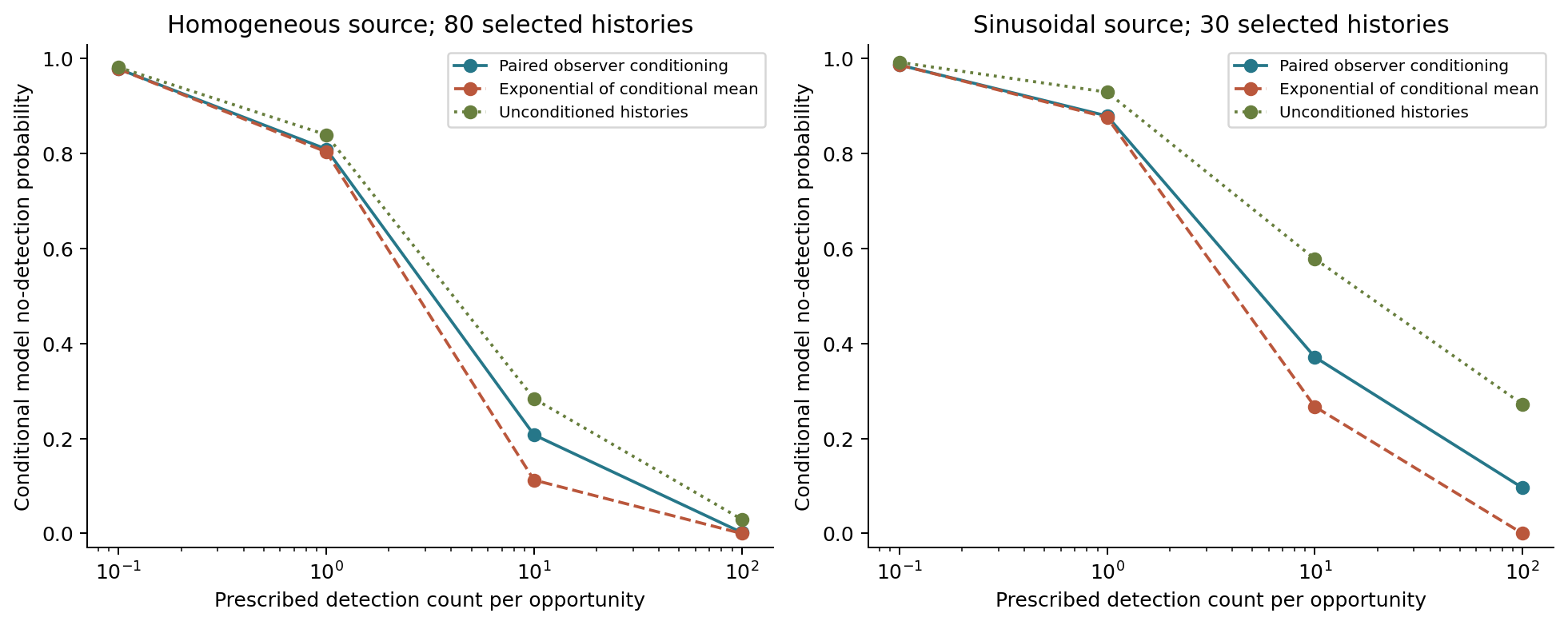
Shared realizations change observer-conditioned predictions
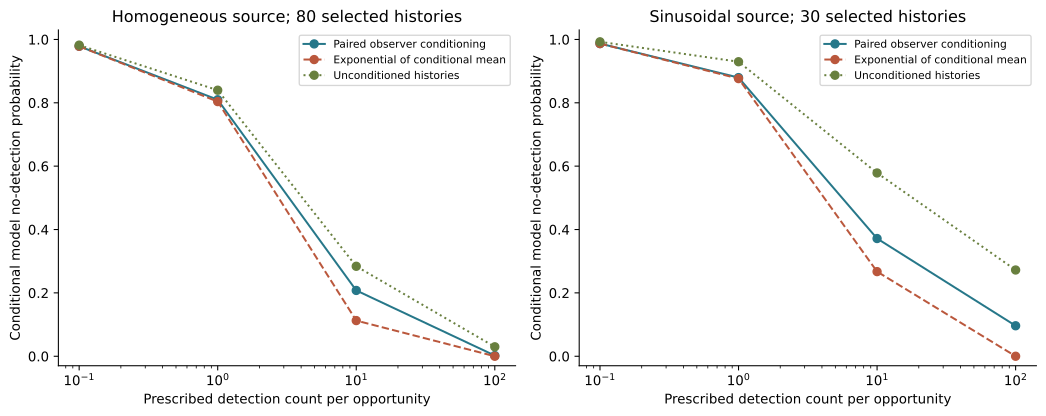
The same saved geometric Poisson history supplies both observer selection and light-cone opportunity at dimensionless distance0.3. The expectation of exp(-lambda f) uses normalized weights of80 or30 selected independent histories. The150 rays within each history are not independent histories. An independent RNG replay reproduces the parent events and aggregate observations. Physical action/parameter/population and epoch identities do not match across the wider field-to-material chain; the shown count law and model population are prescribed, not empirical cosmological probabilities.
Data · Provenance · PNG · SVG
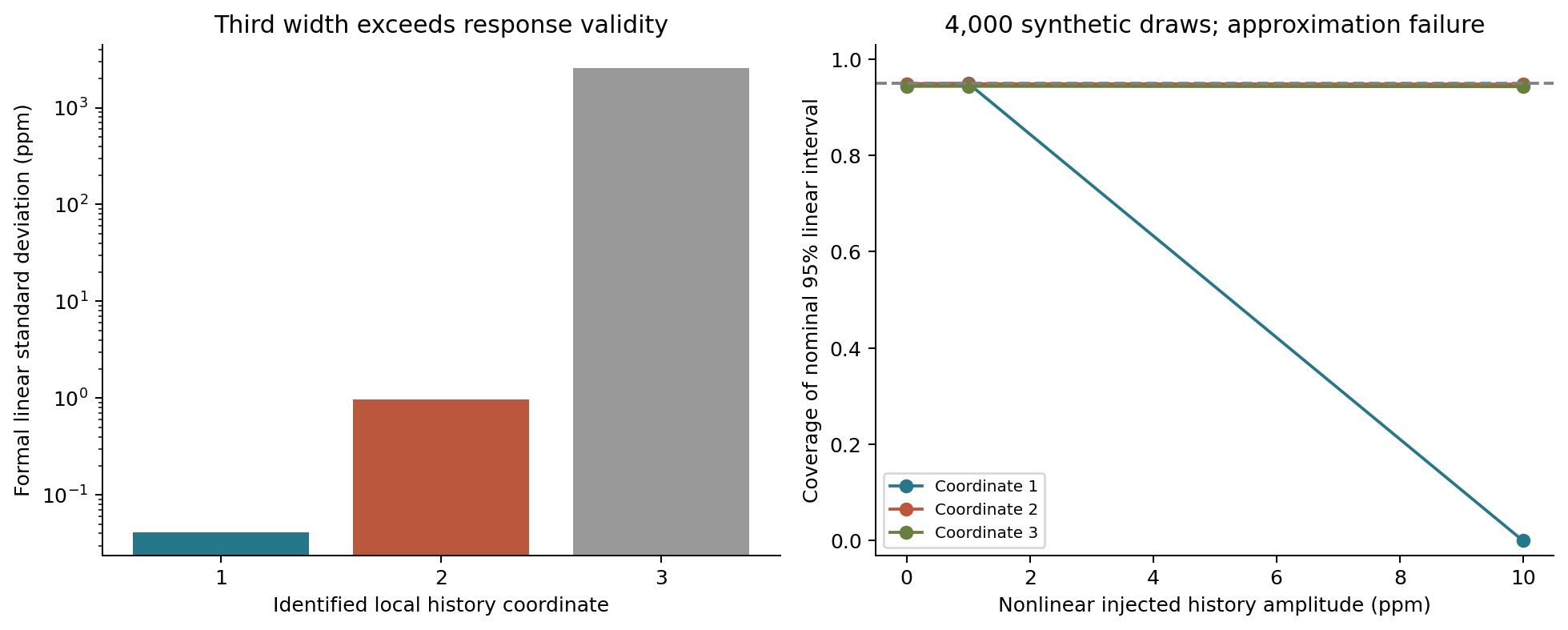
Finite-time exchange exposes limits of linear isotope inference
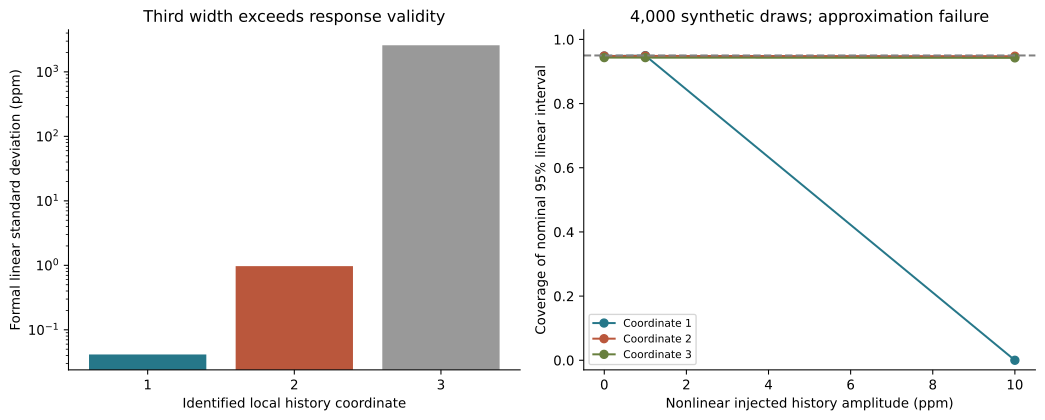
A conservative two-compartment model evolves parent, daughter and stable reference inventories through each field and exchange boundary. All initial states, mobilities, exchange histories and covariance are prescribed synthetic inputs. Six ordinary age/exchange/calibration nuisance directions are projected out. Three formal local modes remain, but the weakest has a width beyond the response domain. Exact nonlinear injection followed by linear inference demonstrates severe loss of coverage at10ppm. These are approximation diagnostics, not measured isotope exclusions. Intermediate decay-chain kinetics, energy release and measured sample/batch covariance remain missing.
Data · Provenance · PNG · SVG
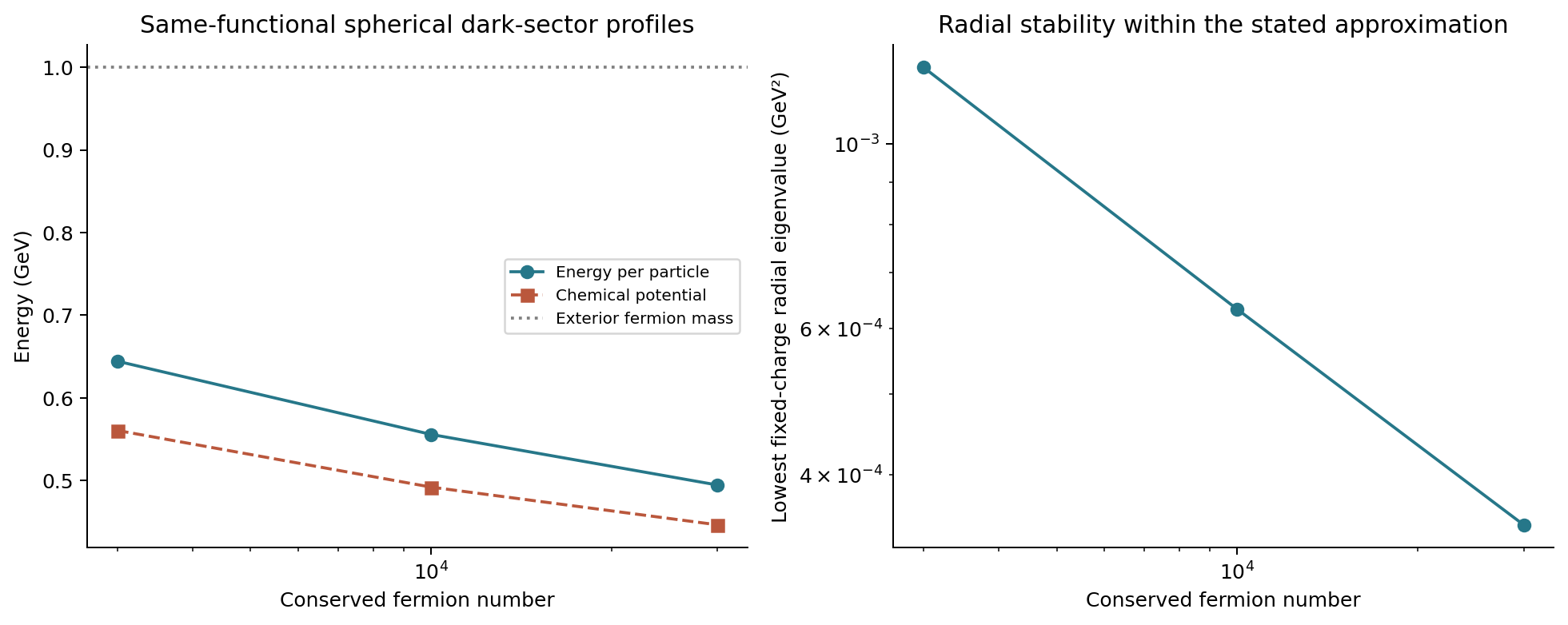
Self-consistent finite-bias pockets at fixed charge
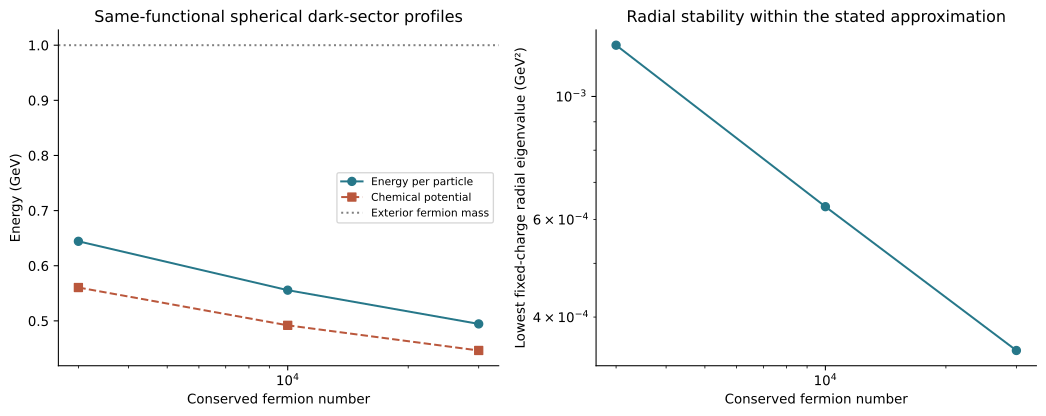
The scalar gradient, finite-bias potential and relativistic local Fermi gas enter one energy functional. A spatially uniform chemical potential is solved with the profile and total charge. The fixed-charge Hessian includes its derived nonlocal rank-one correction; a grand-potential negative direction alone is not a fixed-charge instability. Independent finite elements, energy variations, virial and precision-edge controls pass after a preserved cancellation failure. Ordinary-matter coupling is exactly zero. Nonspherical/global stability, formation and abundance are not supplied.
Data · Provenance · PNG · SVG
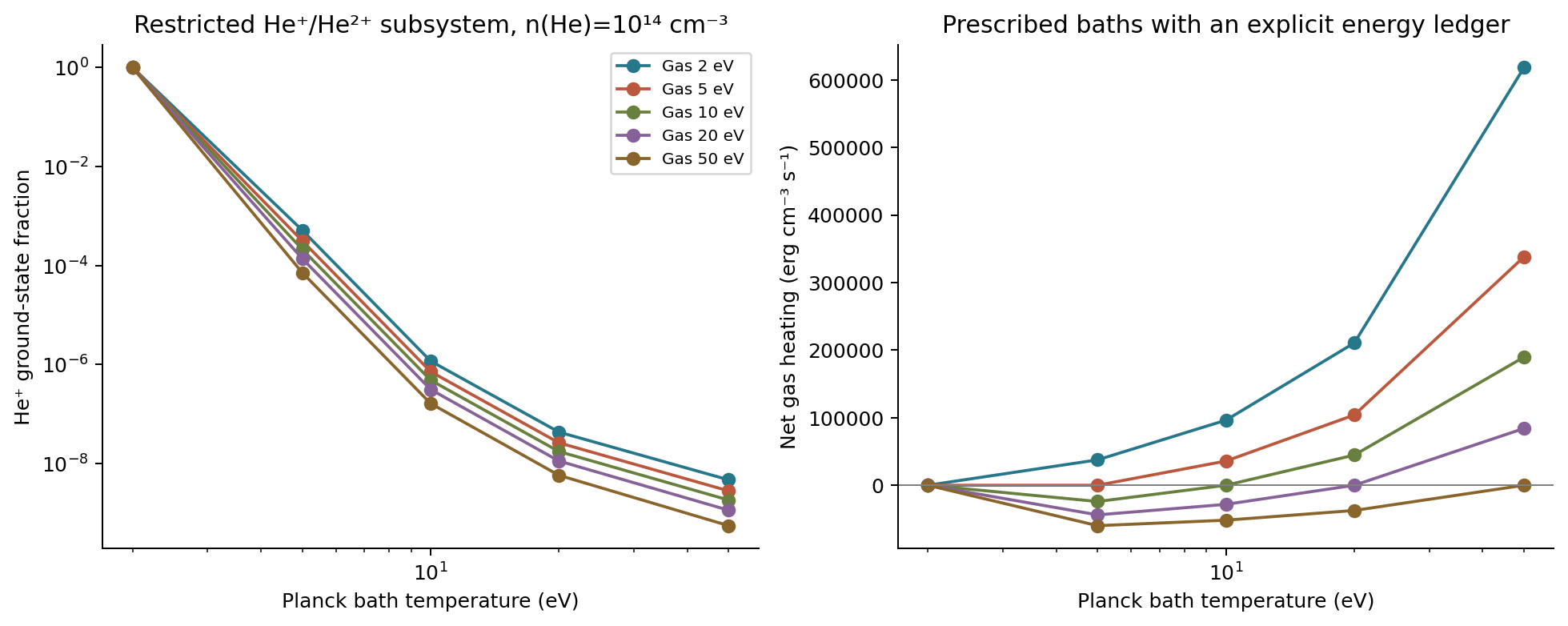
Matched atomic ionization, recombination and energy transfer
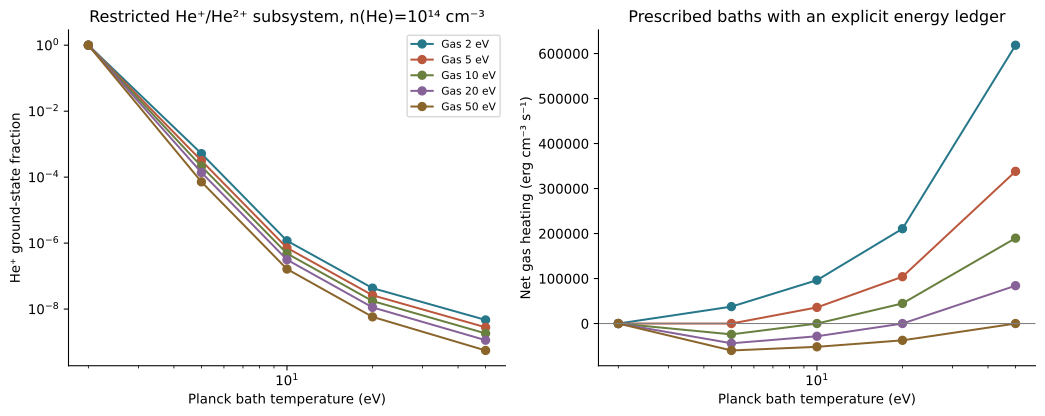
A common infinite-mass nonrelativistic Coulomb electric-dipole kernel supplies hydrogenic 1s photoionization and radiative recombination. Stimulated emission is retained. Charge neutrality sets the electron density, and kinetic plus binding energy closes the gas/photon ledger. The figure shows the densest of three prescribed reservoirs. Neutral helium, excited-state cascades, collisions, opacity, total recombination and weak destruction are absent; these are conditional subsystem fractions, not a complete plasma prediction.
Data · Provenance · PNG · SVG
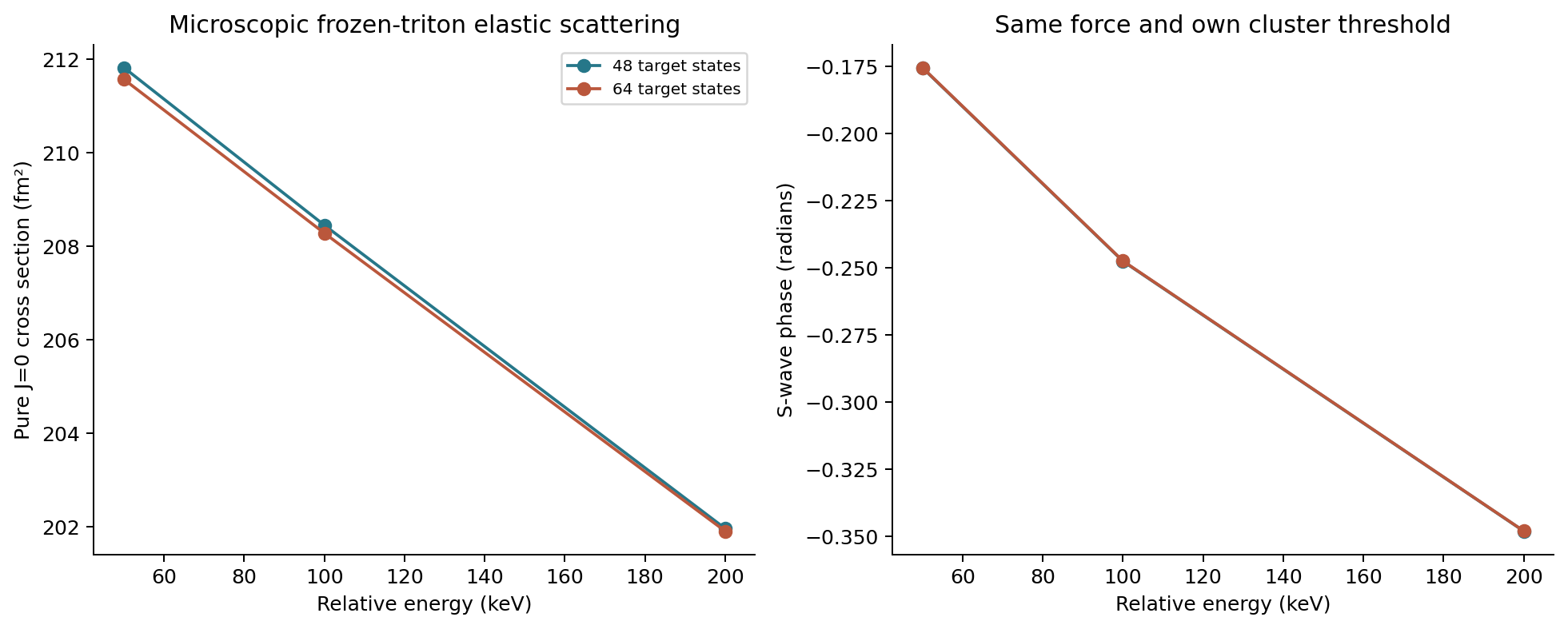
An antisymmetric four-body elastic continuum
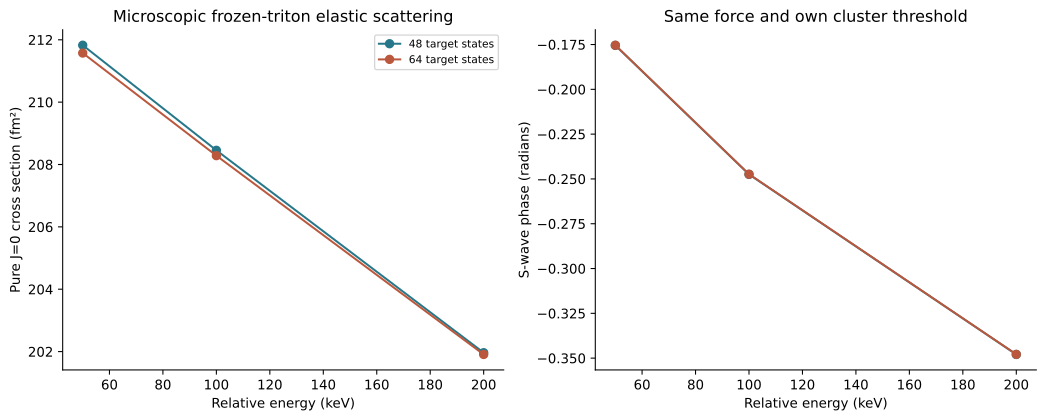
The exact same-force direct folded interaction and finite-rank nonlocal exchange/norm terms determine actual neutron–triton J=0 elastic scattering. The final relative basis has16 radial functions. Different target compressions, exterior radii, outgoing cuts and an independent inhomogeneous radial solve control numerical error. The unpolarized J=0 weight is1/4. Target polarization, J=1, rearrangement, breakup and radiative currents are absent; this is not a complete four-body reaction rate.
Data · Provenance · PNG · SVG
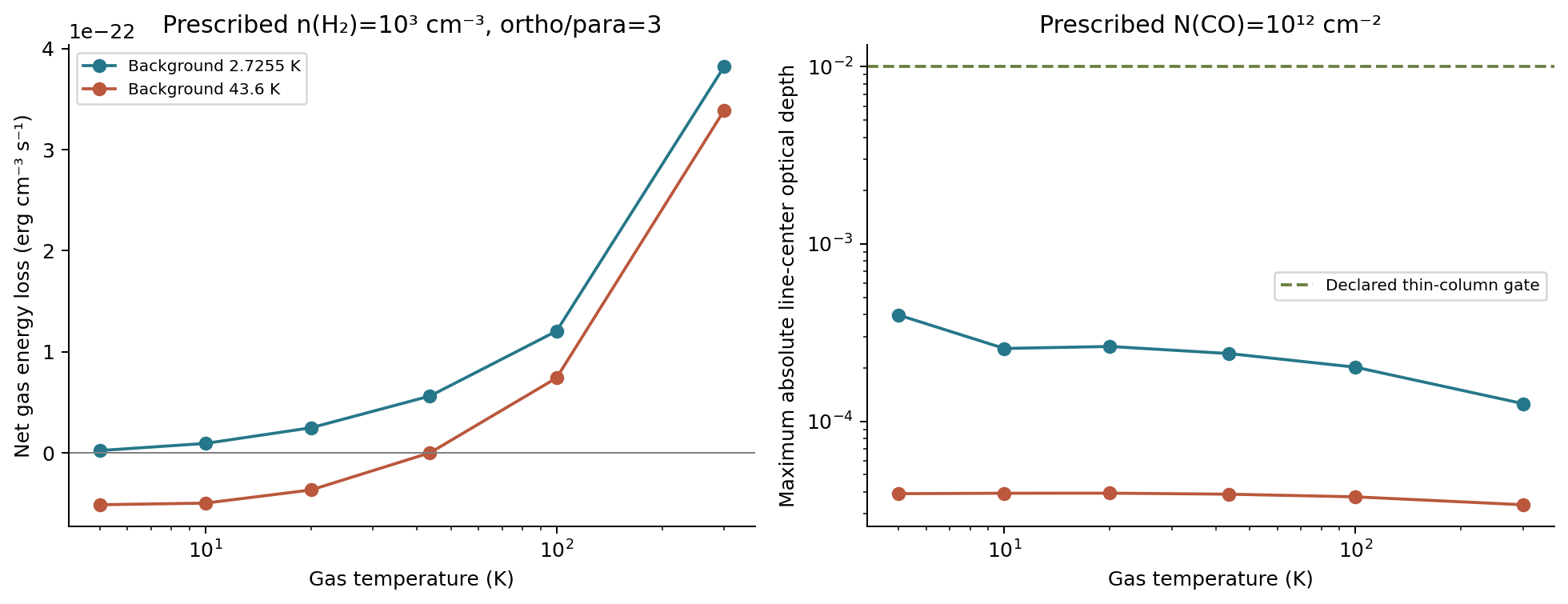
Molecular cooling changes sign under a radiation background
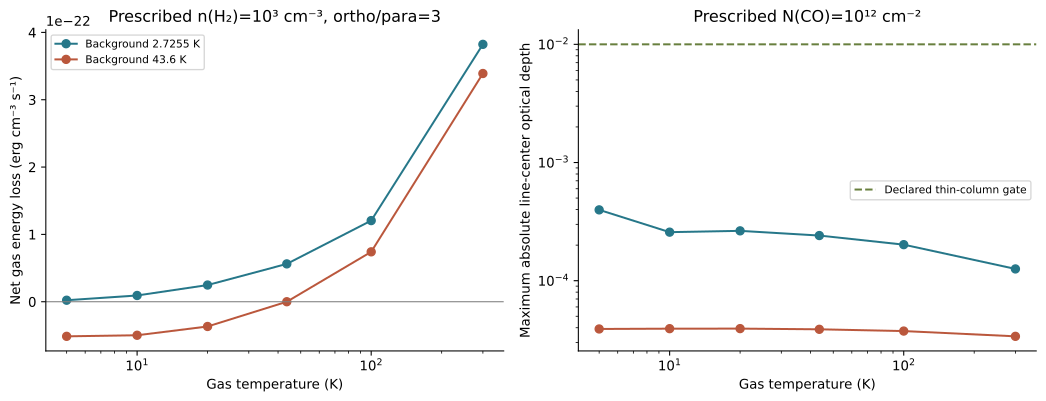
One common level spectrum determines detailed balance and both gas and net-photon energy rates. Negative energy loss means background-driven gas heating. CO/H2=1e−4 and ortho/para=3 are imposed reservoirs; the curves show density10³cm−3 from the wider324point grid. The declared microturbulent plus thermal Doppler width and thin column are checked explicitly. Other molecules, chemical evolution, dust, radiative transfer and fragmentation remain open.
Data · Provenance · PNG · SVG
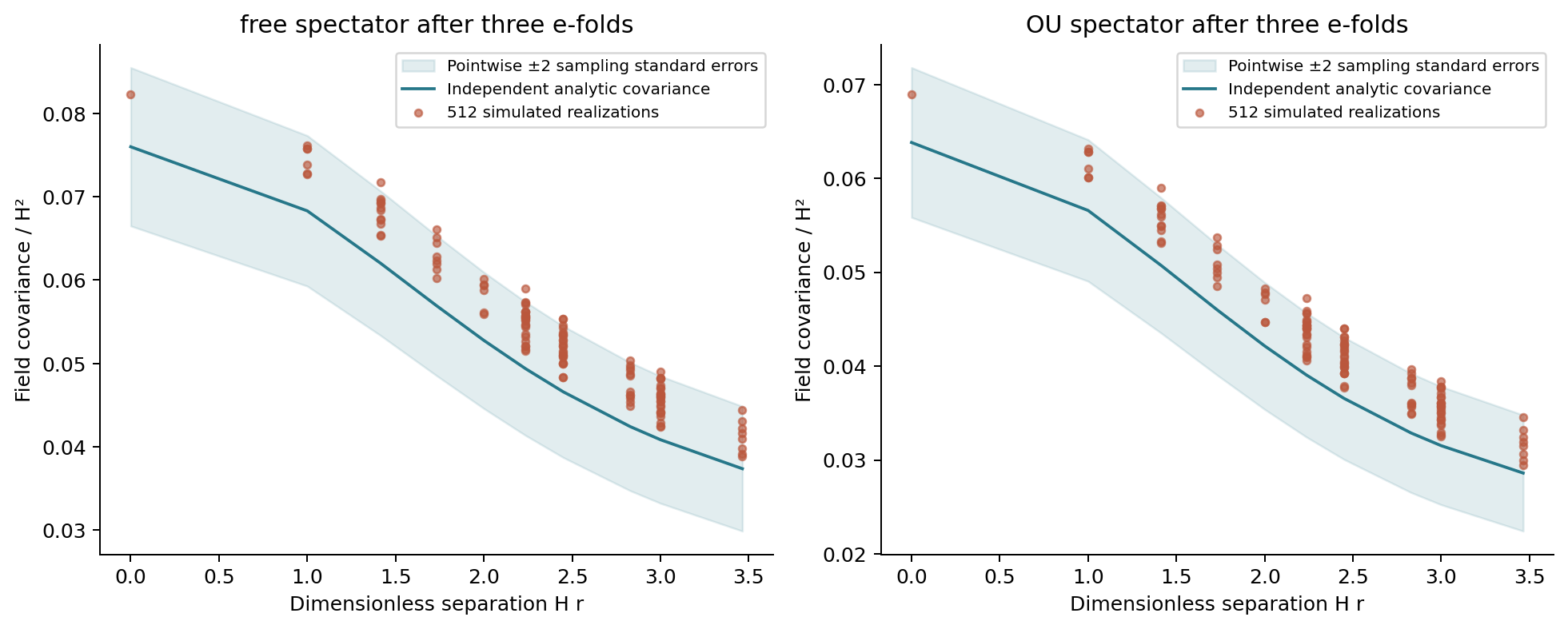
Spatial covariance from isotropic expanding-shell noise
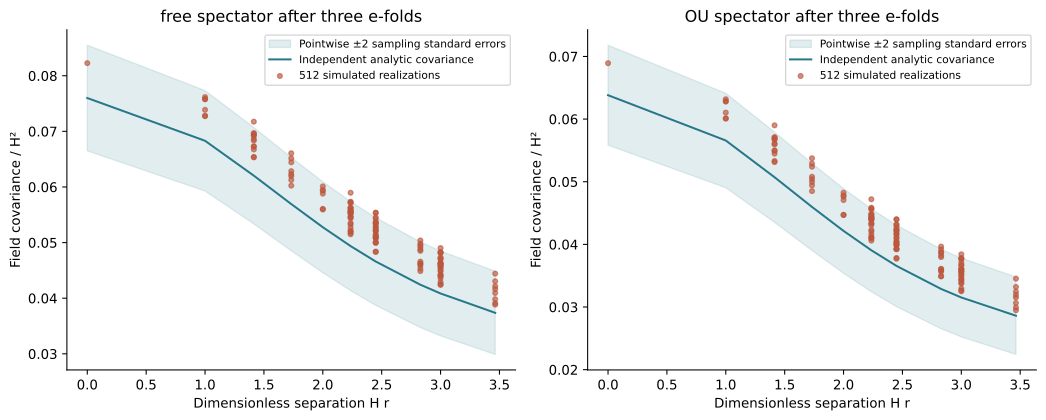
The source separate-patch Langevin equation has temporally independent noise with sinc(k r) spatial covariance and expanding comoving shell. Angular quadrature and timestep errors are controlled separately from sampling uncertainty.125 nonperiodic positions are correlated observations of512 independent realizations. The shaded pointwise two-standard-error bands use Gaussian covariance sampling variance (Cii Cjj+Cij²)/512; they are not simultaneous confidence regions or independent spatial errors. Free and linear-drift covariance have independent integral solutions; nonlinear one-point distributions also pass separate probability-equation controls. No wall dynamics, reheating, matter matching or physical domain abundance is supplied.
Data · Provenance · PNG · SVG
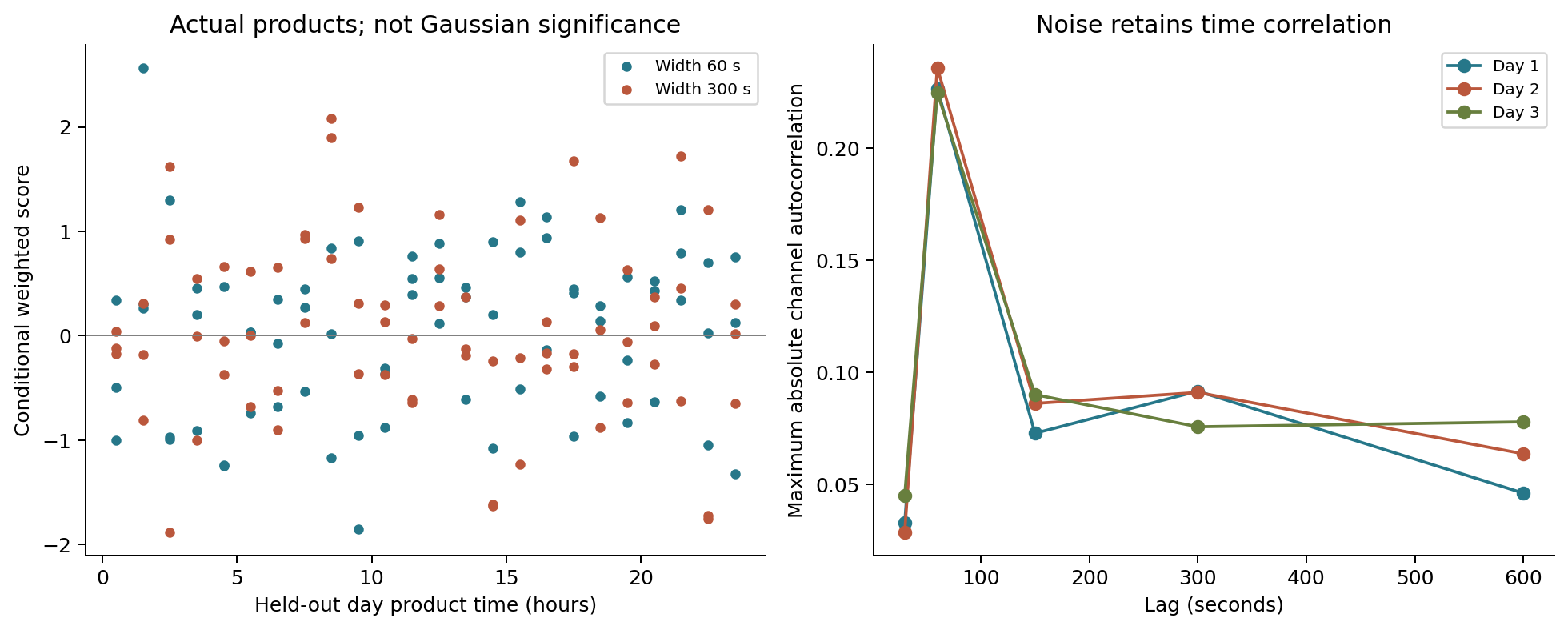
Actual satellite clock scores and unresolved noise correlations
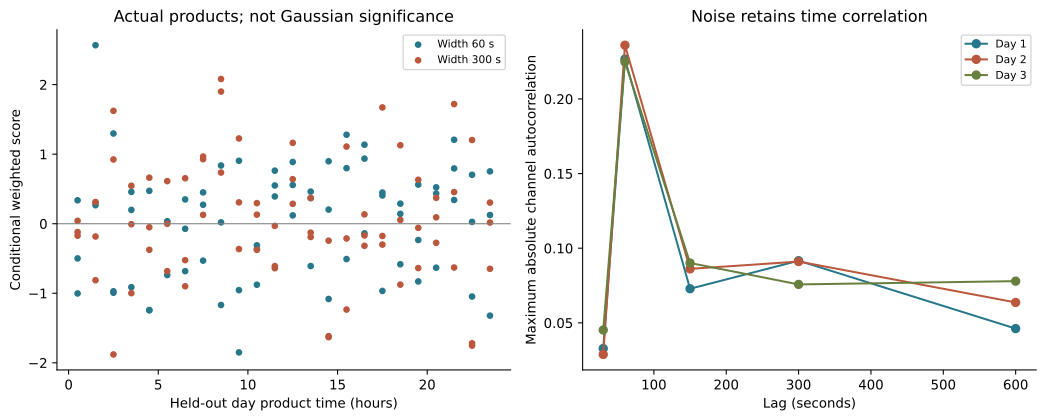
Eight GPS satellites are selected using only the first two days of ESA final products. The third day supplies a fixed144template scan after the same reference, daily difference, covariance and nuisance projections. Templates are prescribed processed-product perturbations in an Earth-fixed frame; the upstream network-adjustment response is not established. Remaining autocorrelation, covariance-parameter uncertainty, block sensitivity and a missing clock-header time-system field prevent calibrated event probabilities or physical exclusions.
Data · Provenance · PNG · SVG
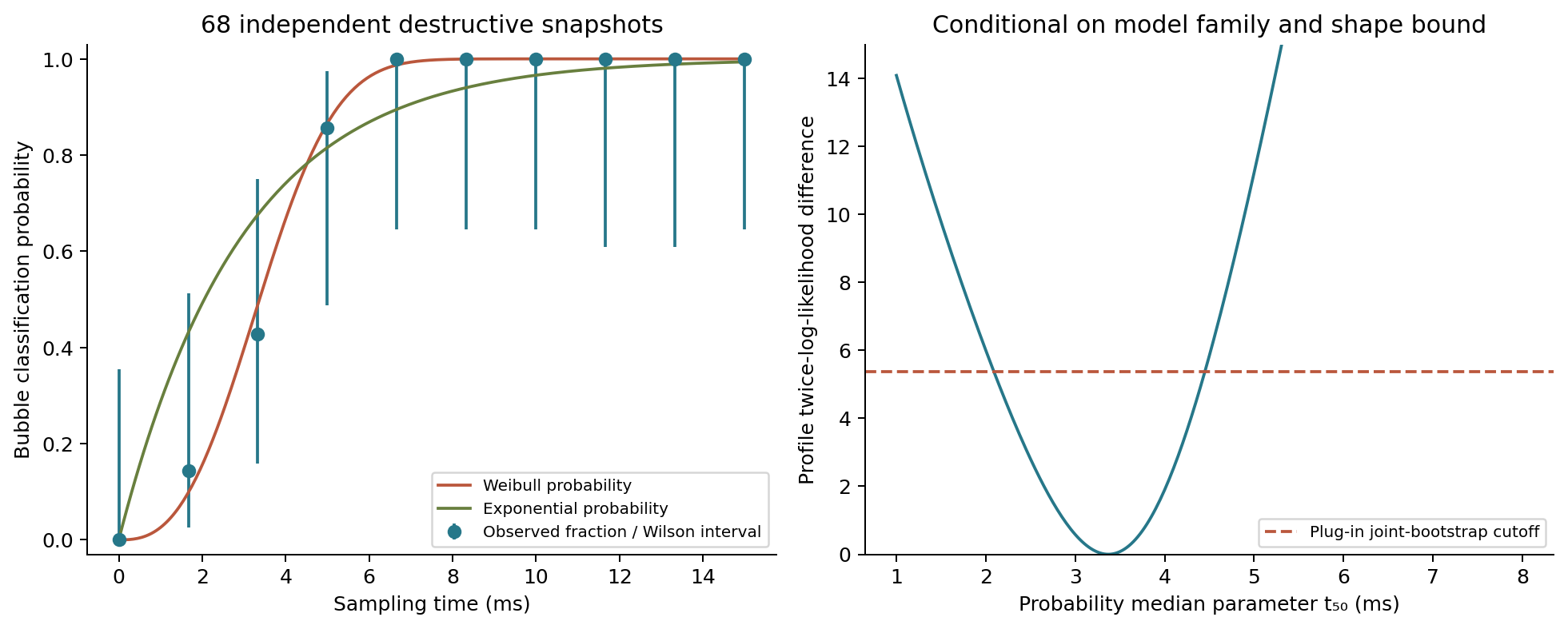
A binomial probability fit to released atomic snapshots
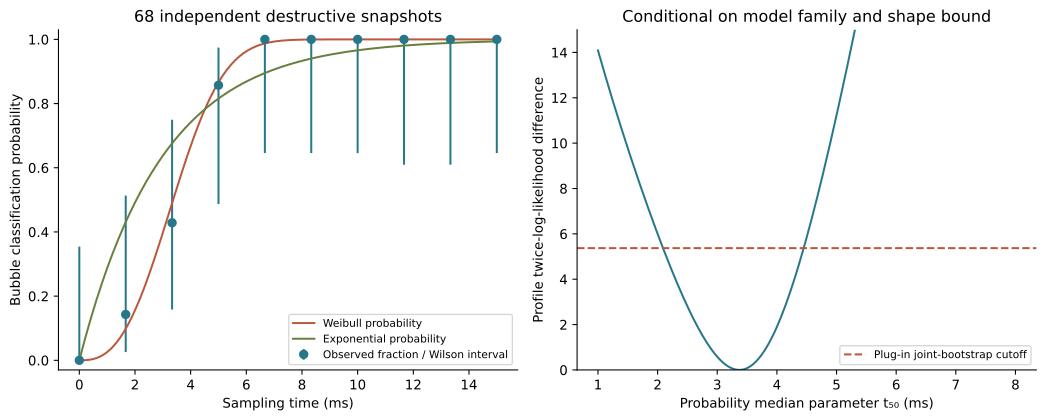
The published magnetization classifier reproduces all counts. Probability curves are fitted to independent binomial groups; snapshot labels are not longitudinal waiting-time records. Pointwise Wilson intervals visualize counts only. The profile uses a plug-in bootstrap joint-region cutoff with finite Monte Carlo error;16.3% of fitted-family bootstrap replicates hit the declared upper shape bound. Assumed classification errors and window variants are saved separately. No microscopic lifetime, exact-coverage interval or fundamental-vacuum claim follows.
Data · Provenance · PNG · SVG
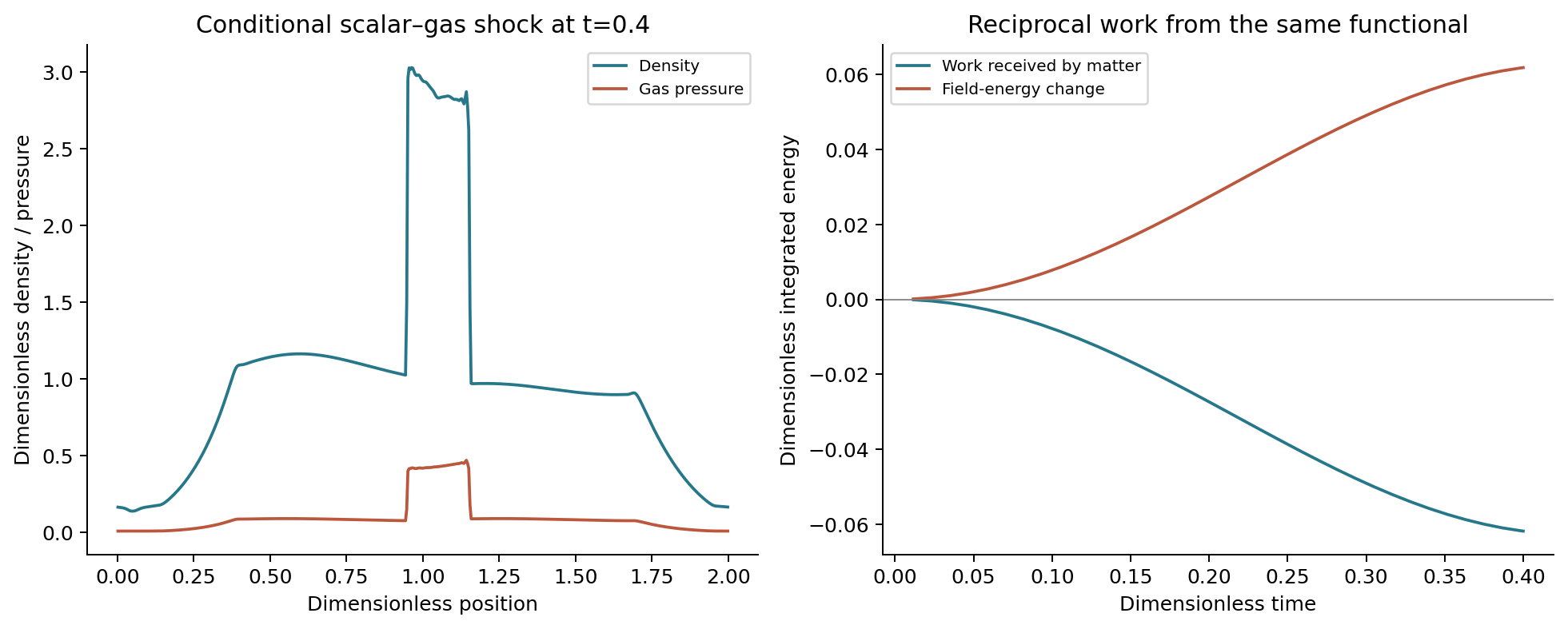
Shock heating with reciprocal scalar work
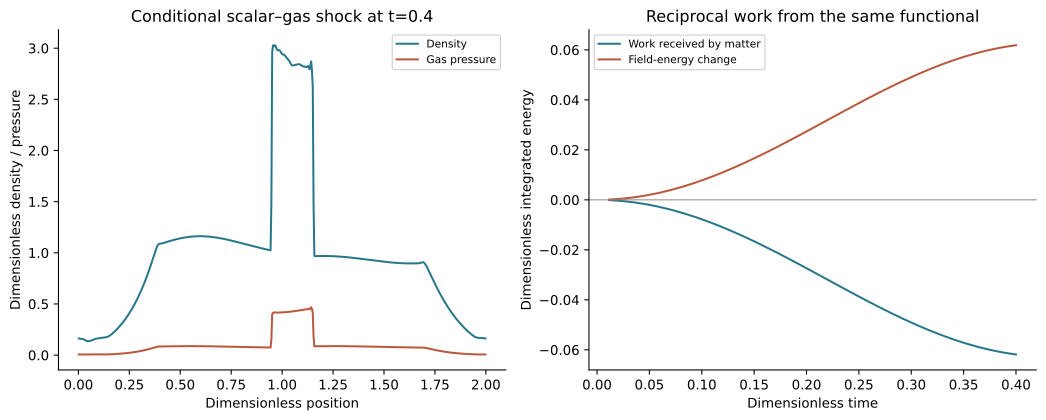
A periodic dimensionless ideal-gas/scalar counterflow uses one energy functional with V=phi²/2 and mass coupling W=phi². Gas entropy increases at shocks, total energy closes and matter/field work is reciprocal. The finest 512-cell run and independent 1024-cell reference control profile error; exact smooth controls separately audit numerical entropy. This is not a nuclear EOS, metastable-star simulation, gravity calculation or physical wall occurrence prediction.
Data · Provenance · PNG · SVG
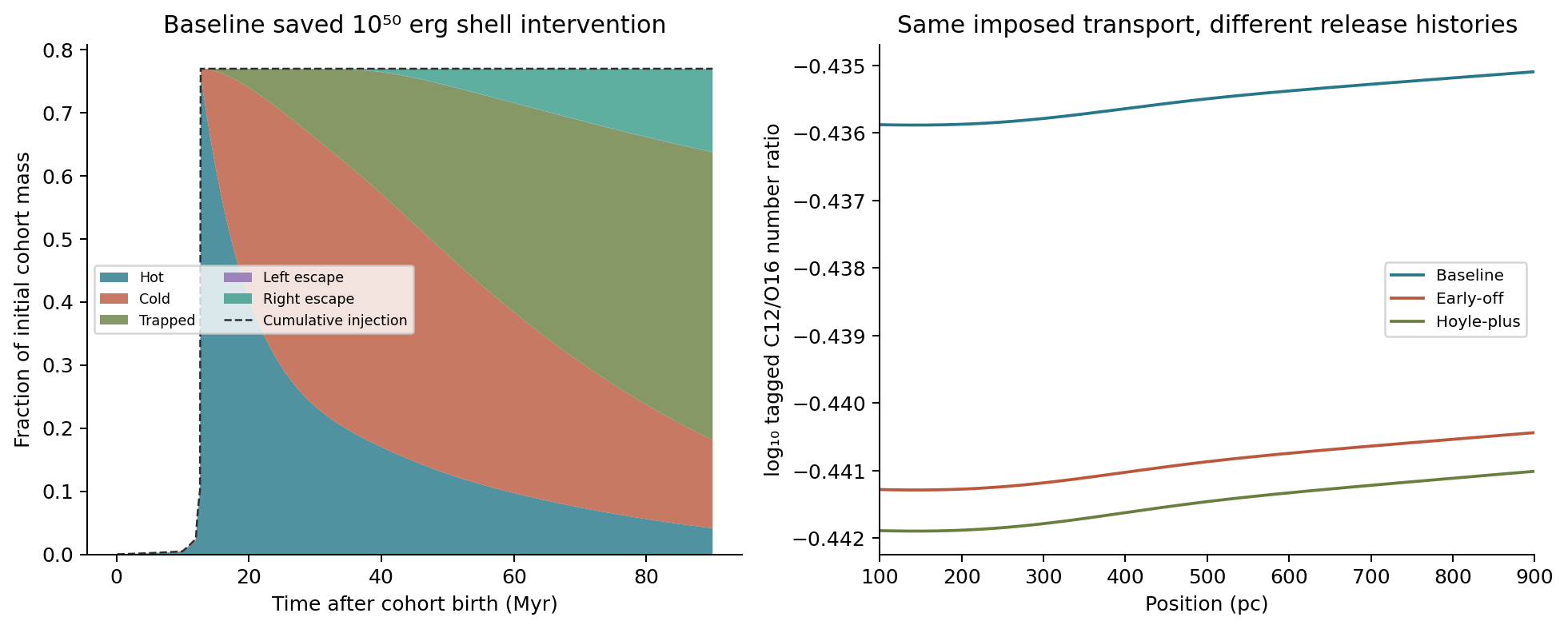
Spatial isotope transport with a closed release ledger
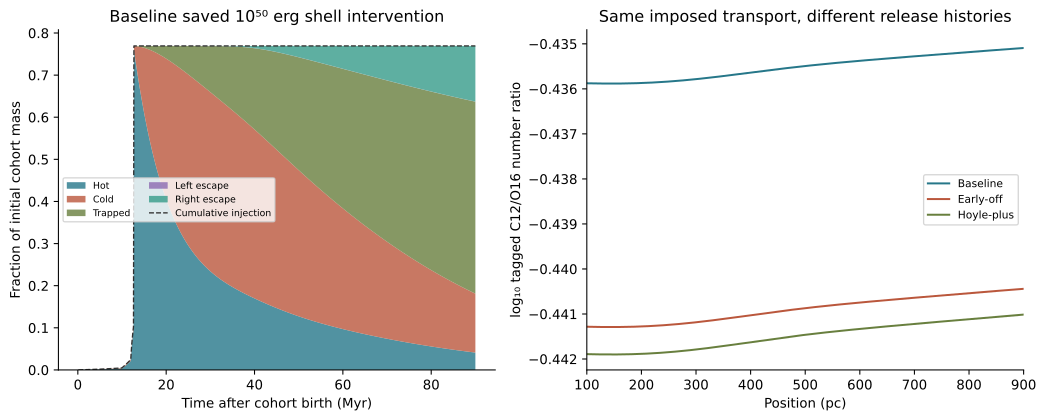
The exact saved stellar wind and helium-exhaustion intervention are normalized to one initial cohort. All 10 tagged channels obey a positive conservative hot/cold transport operator with separately inventoried trapping and absorbing boundary loss. Space is pc and time Myr, but velocities, diffusion, exchange and source geometry are prescribed. Spatial abundance ratios refer only to injected material; no ambient gas, calibrated cloud population, terminal yield, field survival or observational significance is inferred.
Data · Provenance · PNG · SVG
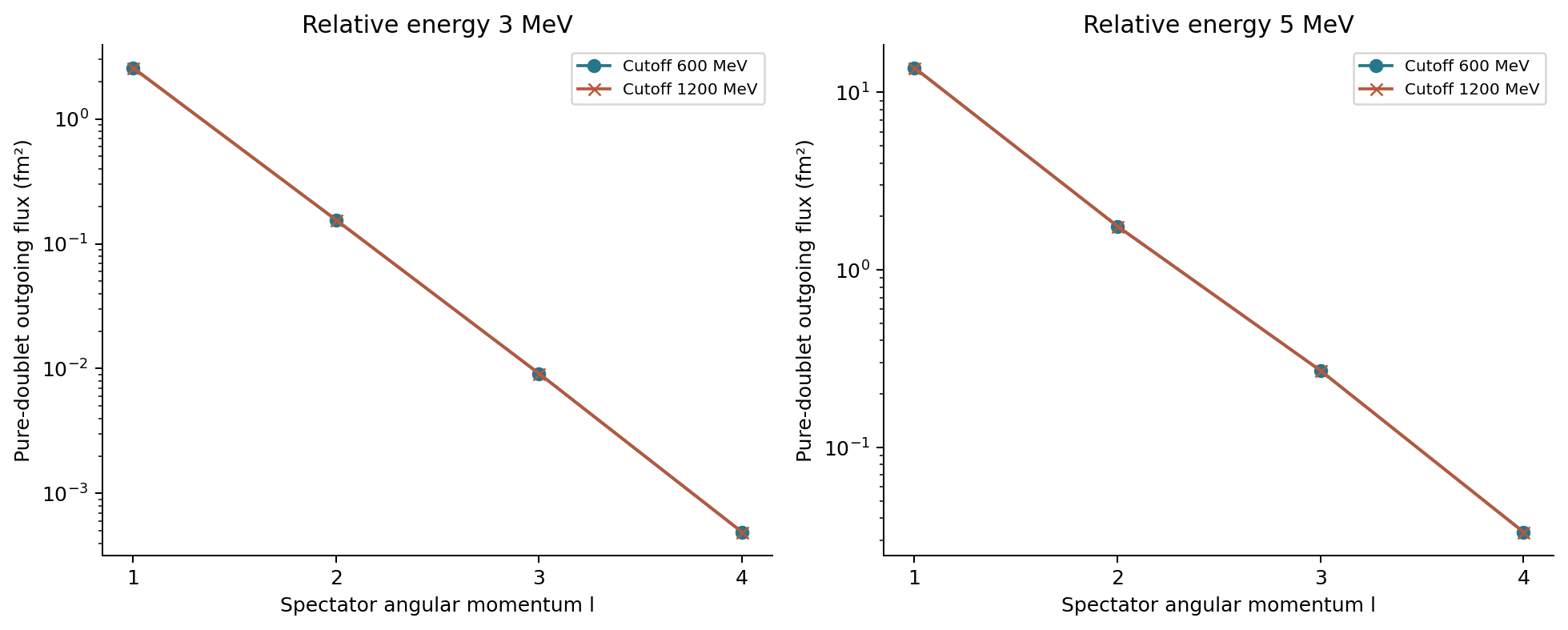
Higher-doublet breakup with explicit spin interference
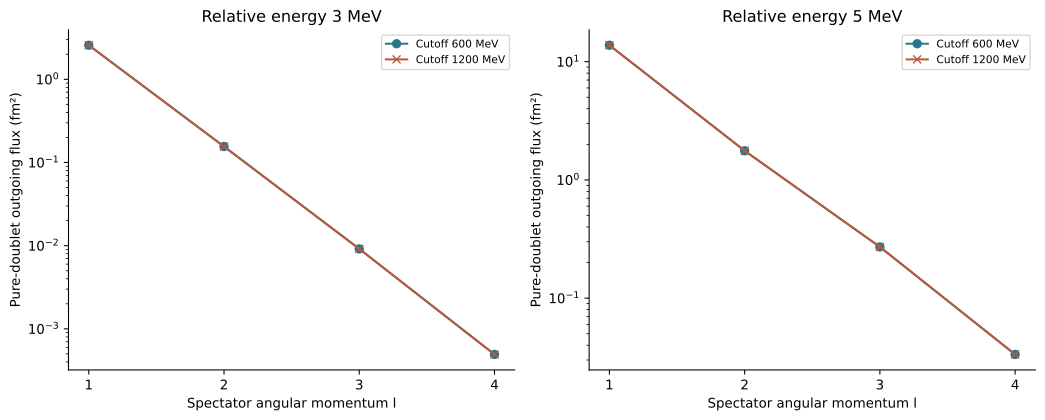
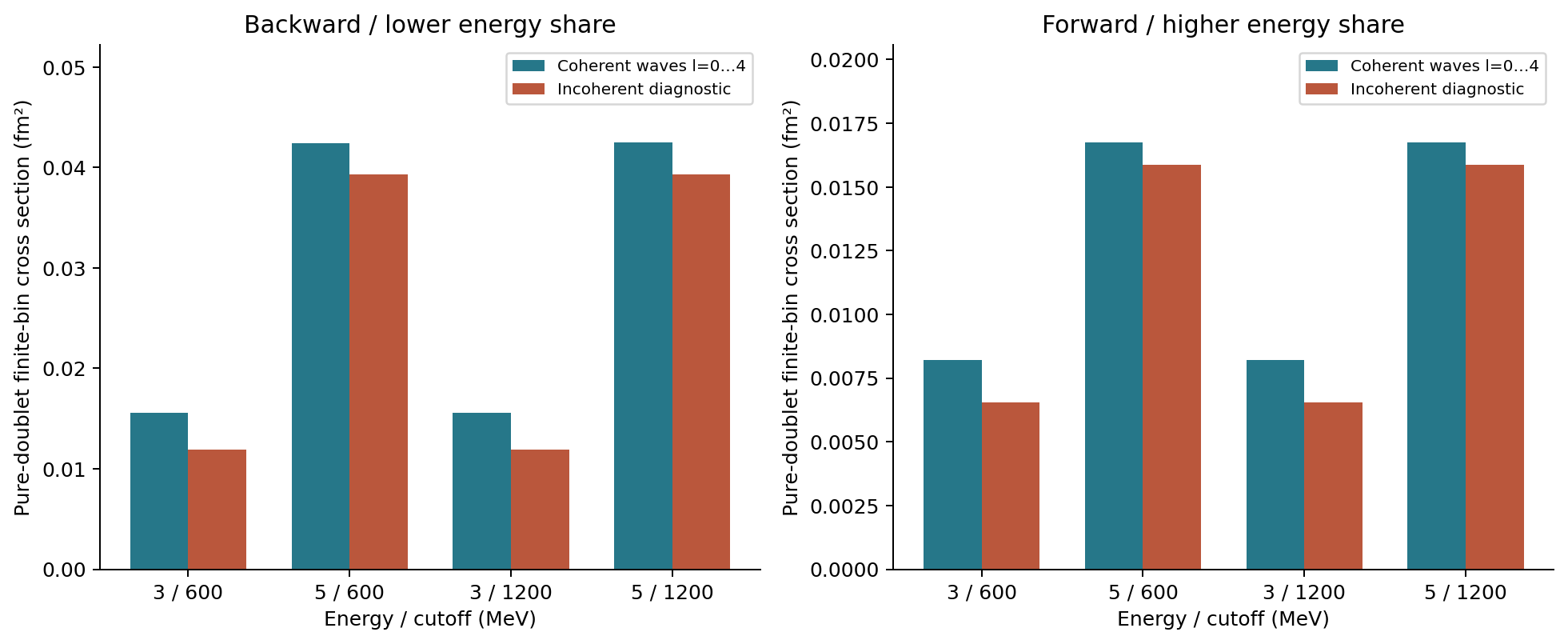
All four energy/cutoff cases enter this synthesis. These are independently normalized neutral LO l1..4 fluxes with S-wave pair interactions and all doublet spin interference. Complete beam-orientation integration justifies summing different spectator waves; a coherent differential distribution is not supplied. The unpolarized doublet fraction is 1/3. Agreement across cutoffs and elastic-loss controls is numerical evidence, not EFT truncation uncertainty or a certified infinite-wave remainder.
Data · Provenance · PNG · SVG
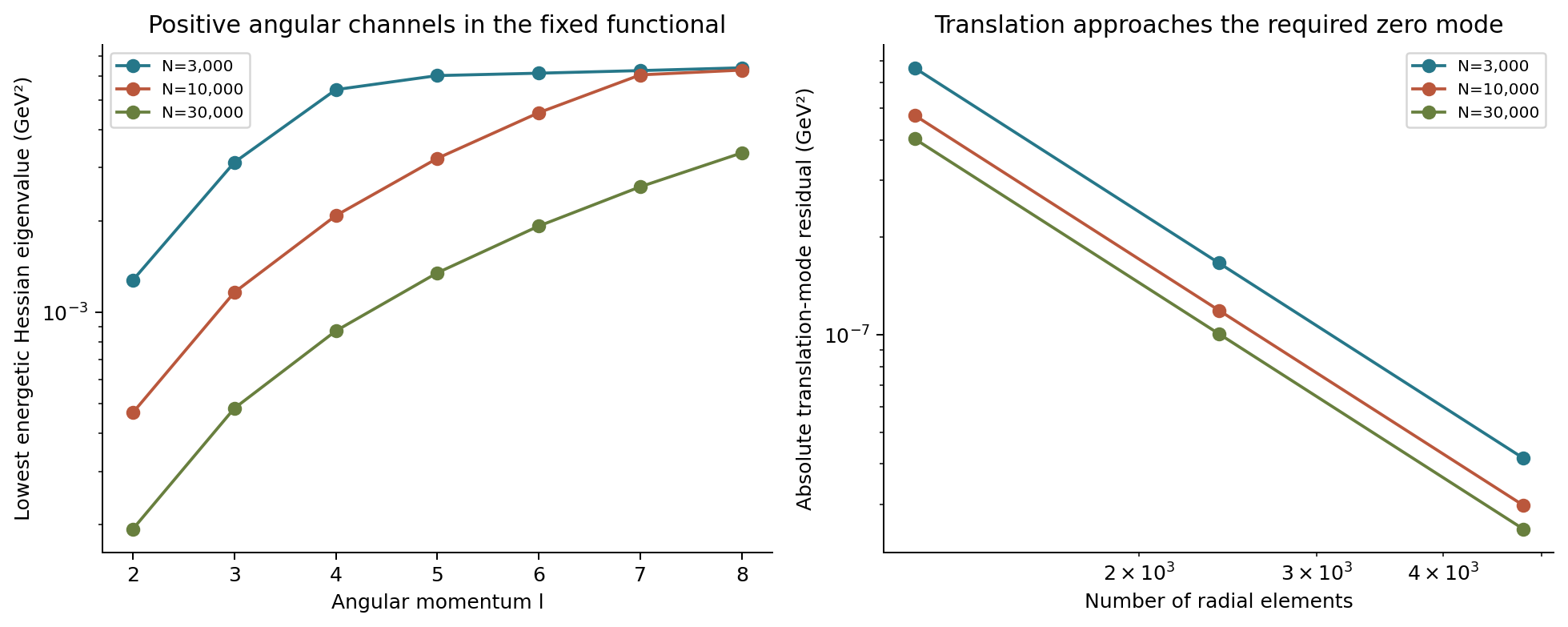
Angular stability and the translation control
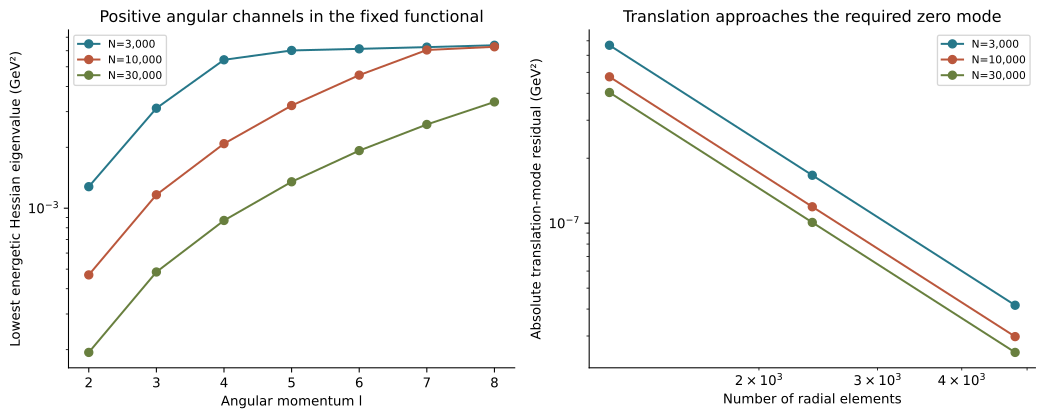
The same fixed-charge scalar/Thomas-Fermi energy determines every angular operator. The global rank-one radial constraint is absent at l>=1. Edge-split finite elements, independent consistent-mass elements and fixed-charge nonlinear energy differences control the spectrum. An all-l positivity argument additionally assumes an exact monotone infinite-space stationary profile. These are static energetic eigenvalues, not coupled dynamical frequencies. Ordinary coupling remains zero; quantum-shell corrections, nonlinear fission and formation remain unresolved.
Data · Provenance · PNG · SVG
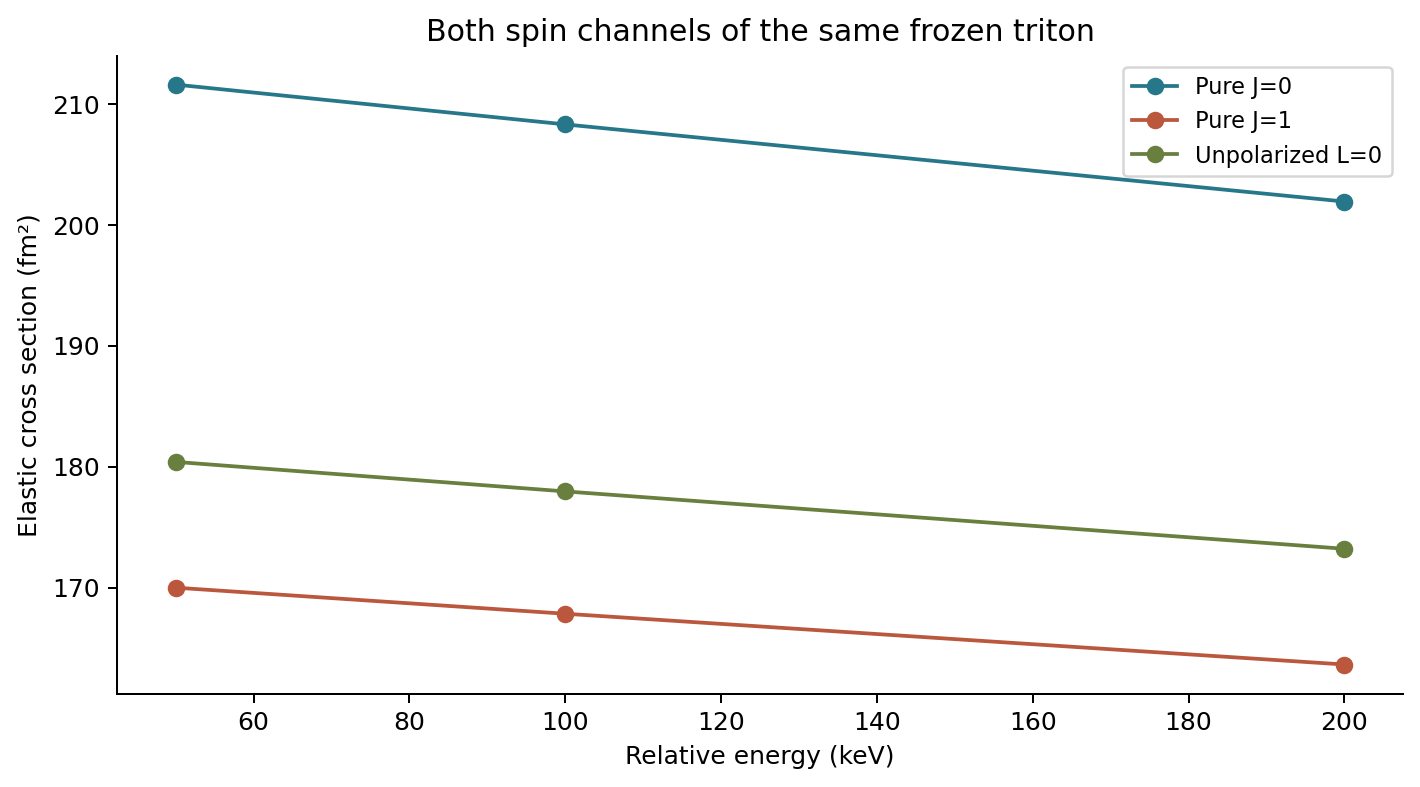
Authenticated neutron–triton spin average
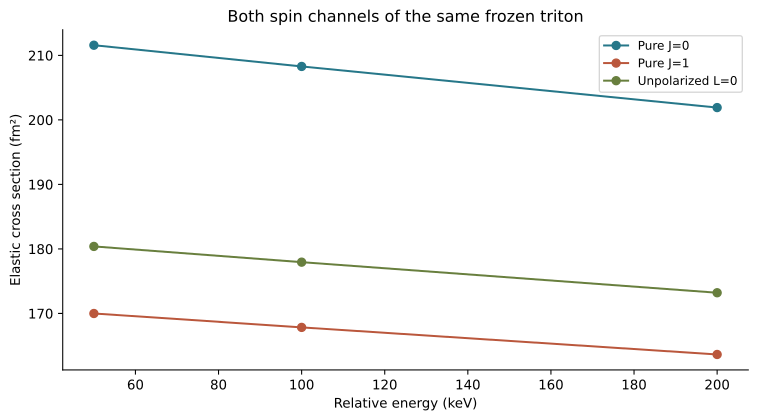
The same LO Gaussian pair/three-body force, compressed triton, relative basis and threshold supply both pure spin channels. The unpolarized average is one quarter J=0 plus three quarters J=1. An independent finite-element boundary map and an initial-spin density trace verify continuum normalization and weights. This remains a frozen-target L=0 elastic approximation without polarization, higher orbital waves or reaction channels.
Data · Provenance · PNG · SVG
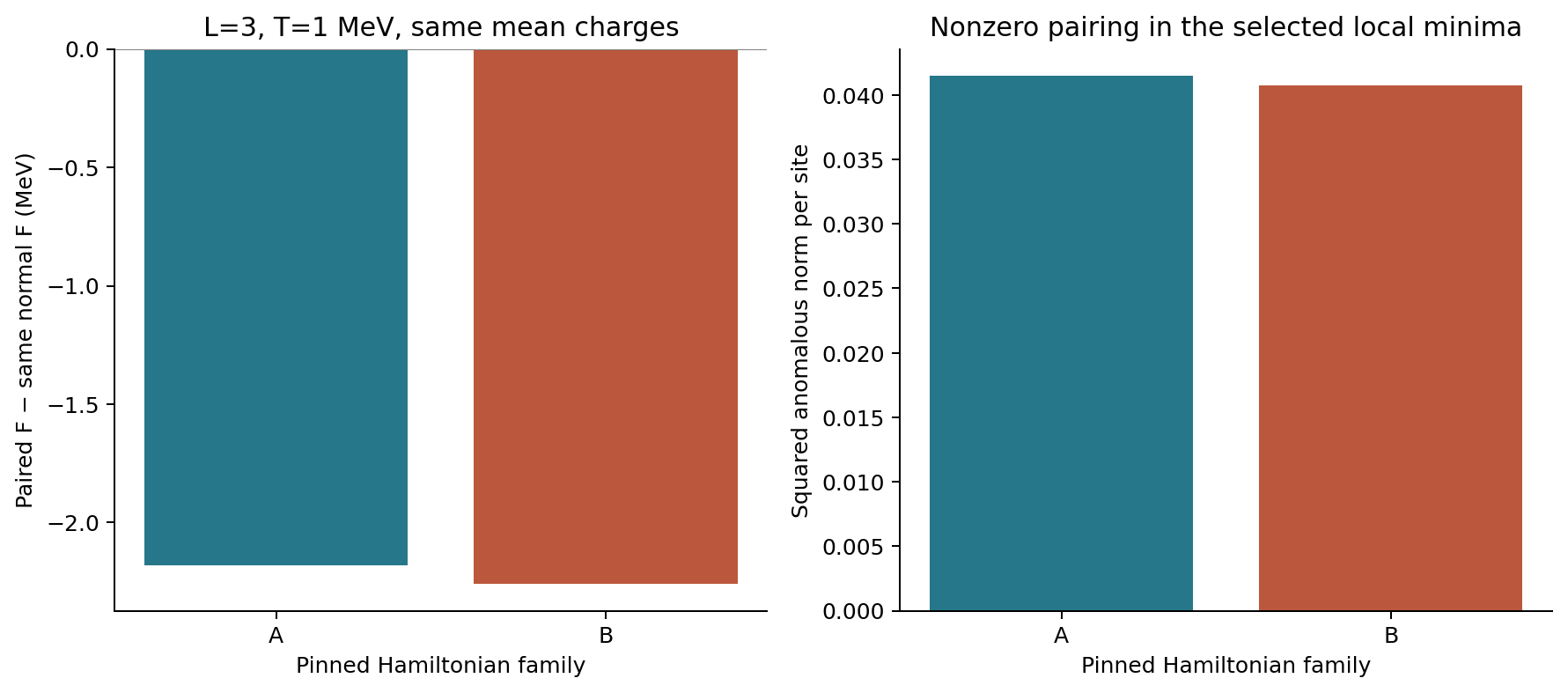
Colder paired minima within the same finite ensemble
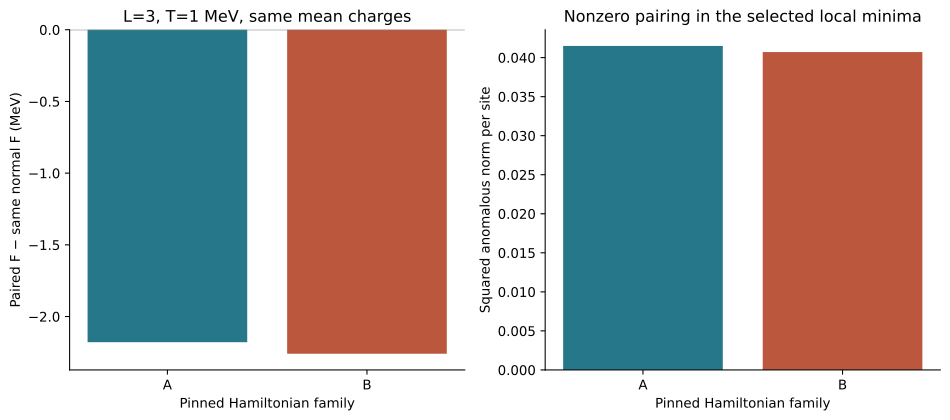
The continued A/B roots compare only against their own normal state at L3, T1 MeV and mean Np=Nn=3.375. Positive enlarged coupled Hessians are sufficient for restricted local stability. The four random paired starts return to normal saddles. Independent Fock thermodynamics and a separate response Hessian review control the selected calculation. L4 attempts failed their original charge or curvature controls; these bars establish neither volume convergence nor an exact-number thermodynamic phase.
Data · Provenance · PNG · SVG
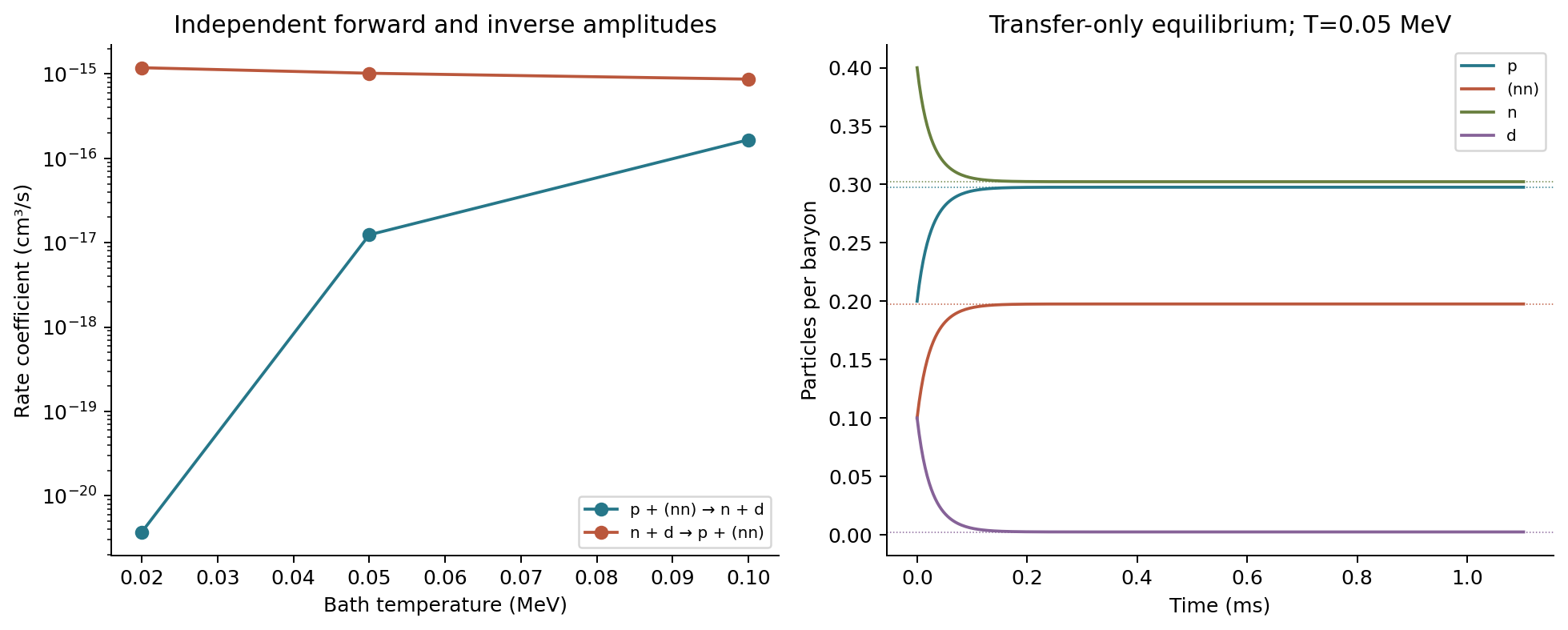
A thermally controlled reaction subset with consistent masses
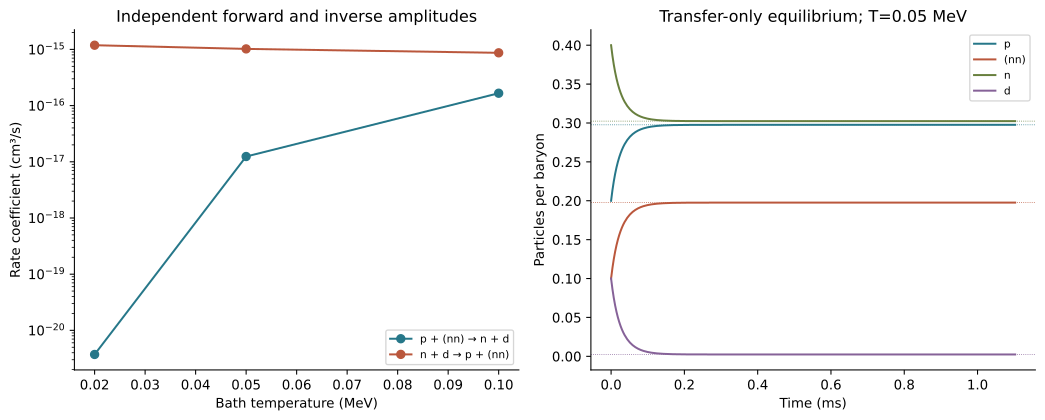
The same neutral LO STM force at cutoff 1200 MeV and Bnn=2.5 MeV determines both directions. Only the three plotted temperatures are certified; lines guide the eye. The selected S-wave omitted-energy bounds are below 1.86e-7 relative, while numerical thermal-quadrature differences reach 6.49e-5. The prescribed dilute bath has 10^20 baryons/cm³. Charge, baryon number and dimer count constrain equilibrium. Tritium is inactive; higher waves, missing reactions, expansion and microscopic field matching remain absent.
Data · Provenance · PNG · SVG
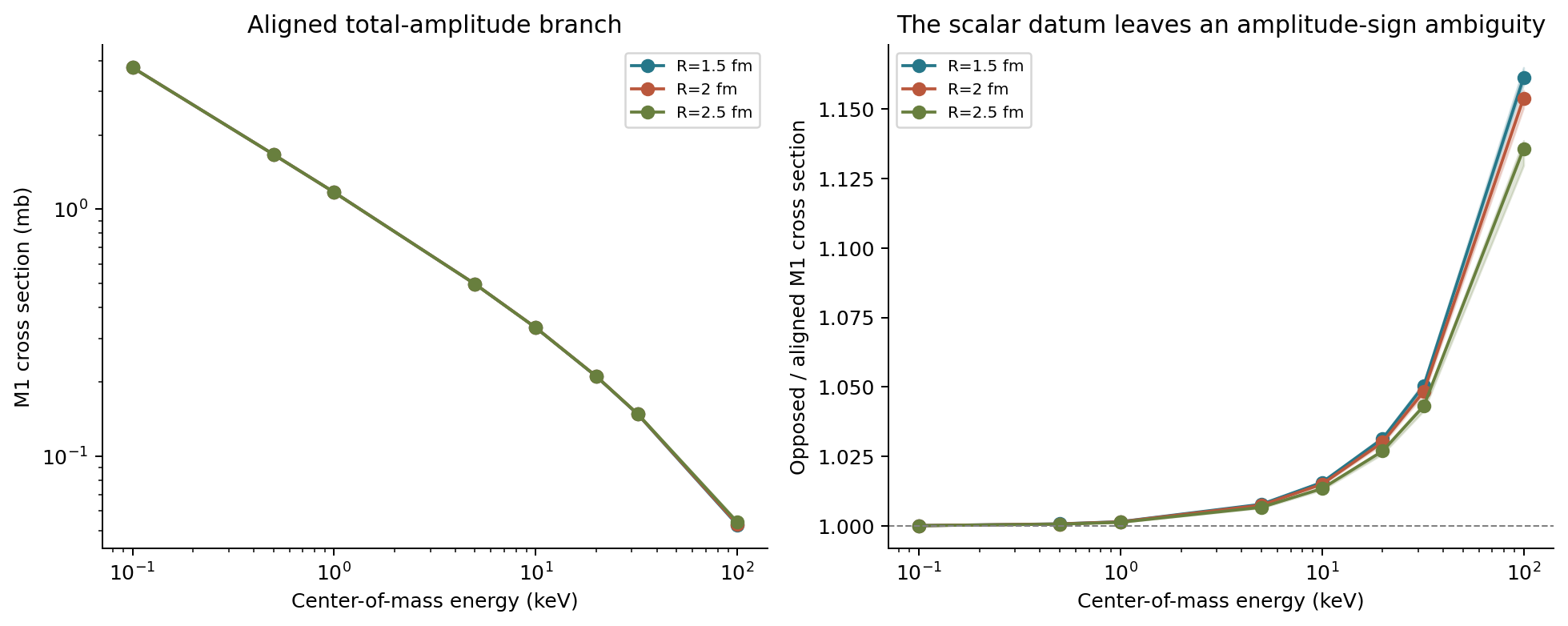
Two magnetic-contact branches from one scalar datum
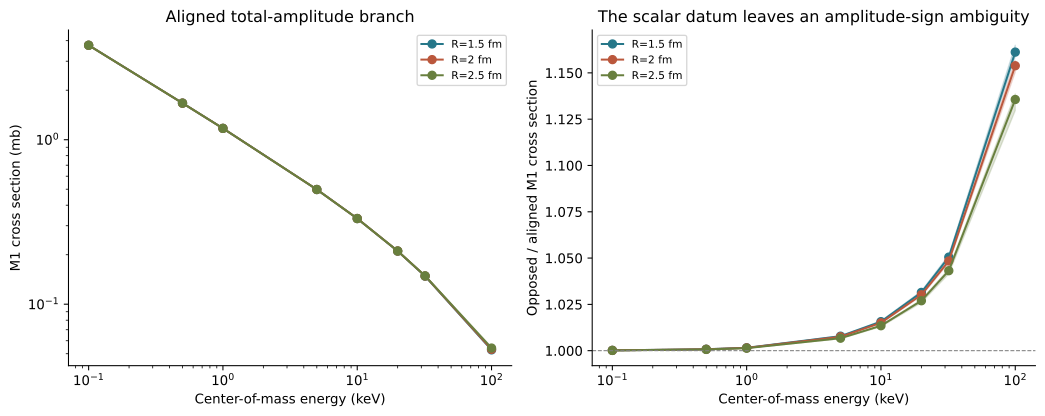
Each of 24 joint draws per regulator keeps its own NN force, binding and waves. Curves show medians and central 95% finite-sample NN quantiles after a central cold-rate fit. The right panel forms the branch ratio within each joint draw before taking quantiles. The separate cold-input envelope and omitted-current uncertainty are not these bands. Both real amplitude branches are retained; the displayed observable is leading long-wavelength M1 only, without E1, finite-q or an experimental finite-energy test. Regulators are not pooled.
Data · Provenance · PNG · SVG
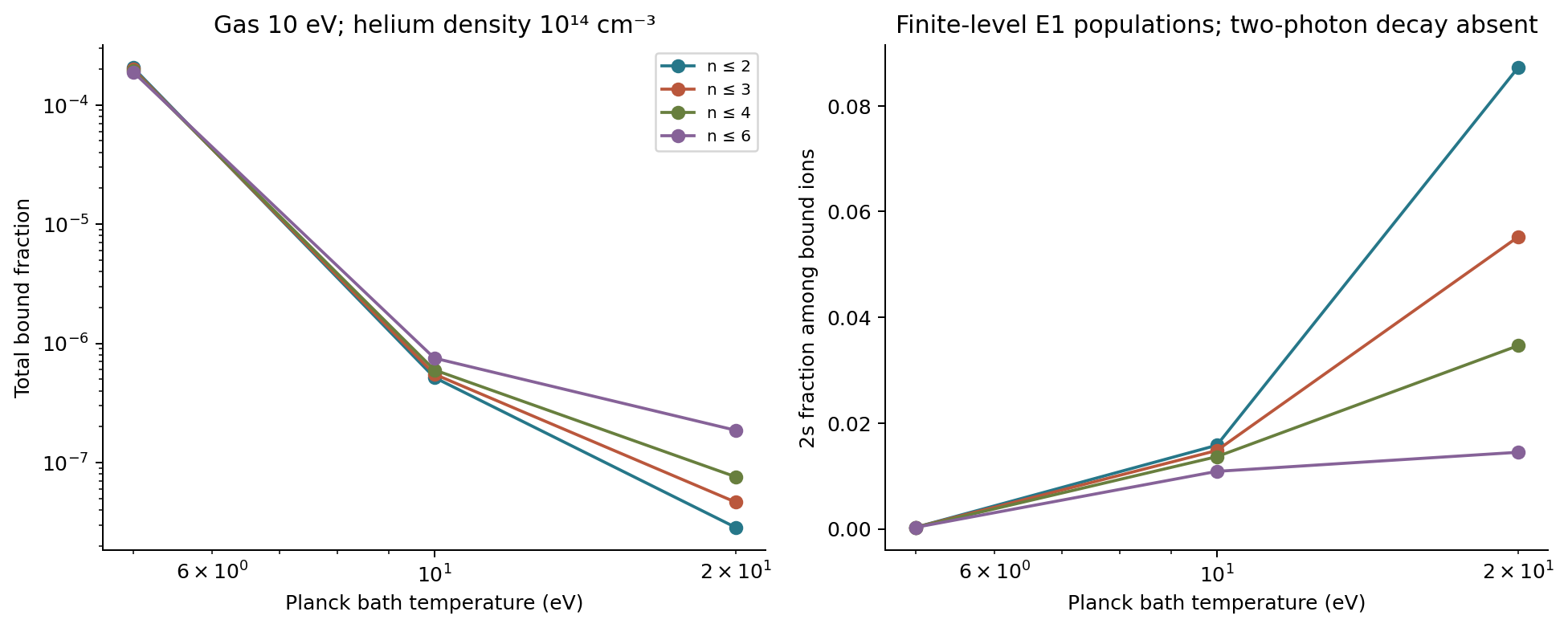
Resolved radiative populations and the finite-level boundary
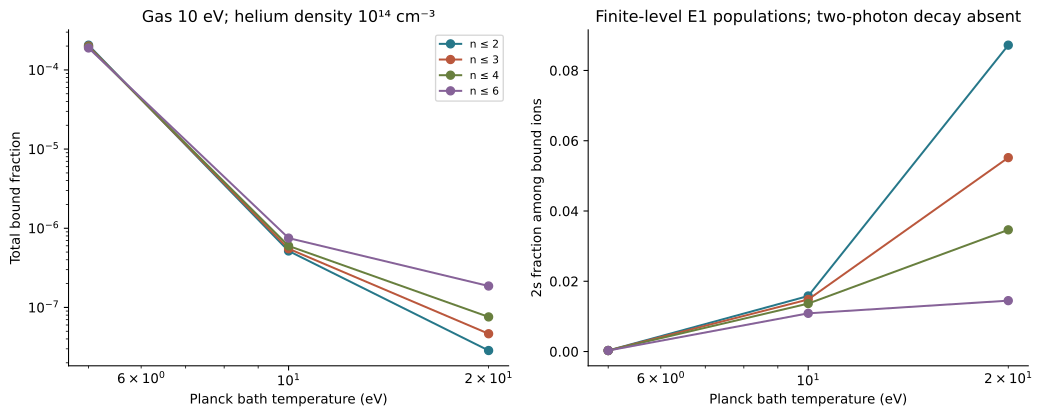
Bound/continuum Coulomb E1 kernels, stimulated recombination and Einstein transitions share one normalization. These charge-neutral equilibria use prescribed gas and photon baths. Each ceiling defines a different finite model; the isolated Coulomb partition sum diverges as the ceiling grows. Neutral helium, collisions, two-photon relaxation and plasma dissolution are absent. The 2s population is therefore a model-boundary diagnostic, not a physical metastable lifetime.
Data · Provenance · PNG · SVG
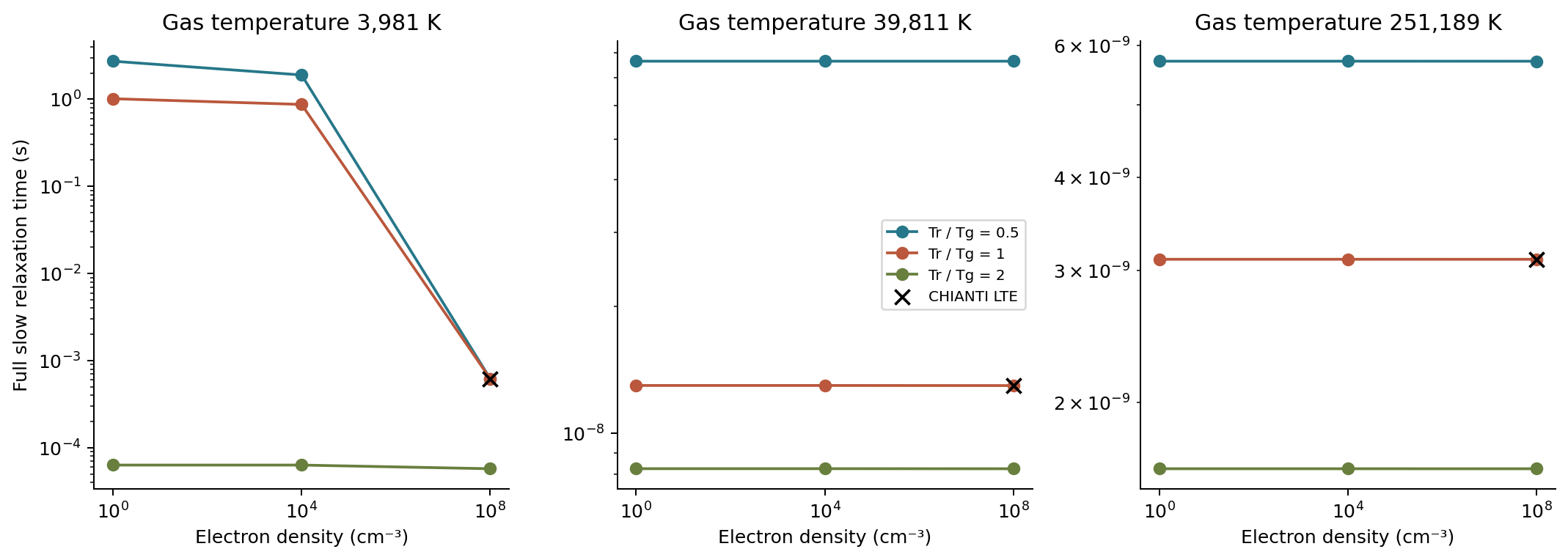
All 24 relaxation modes define the slow clock of the closed helium model
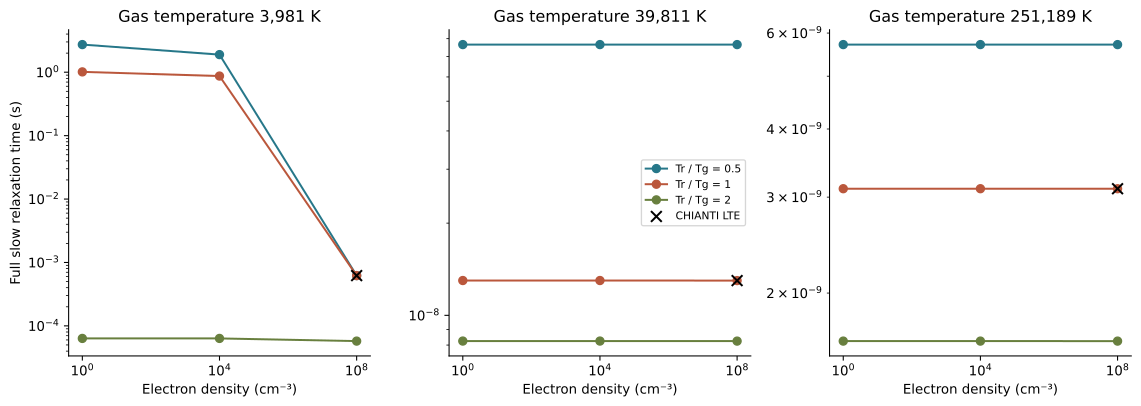
Thirty independently reviewed cases retain the full 25-state source-matched collision and Table 2 radiative operators. Each panel uses one printed gas temperature, three electron densities and three prescribed radiation temperatures; black crosses show the additional CHIANTI-energy LTE controls. The plotted time is 1/min(−Re λ) over all 24 tangent modes at MP100, a spectral clock rather than a bound on nonnormal transient equilibration. Lines connect the three declared density points and do not assert an intervening density survey. Each panel has its own vertical scale. The two-photon channel, bound-free chemistry and evolving reservoirs are absent.
Data · Provenance · PNG · SVG
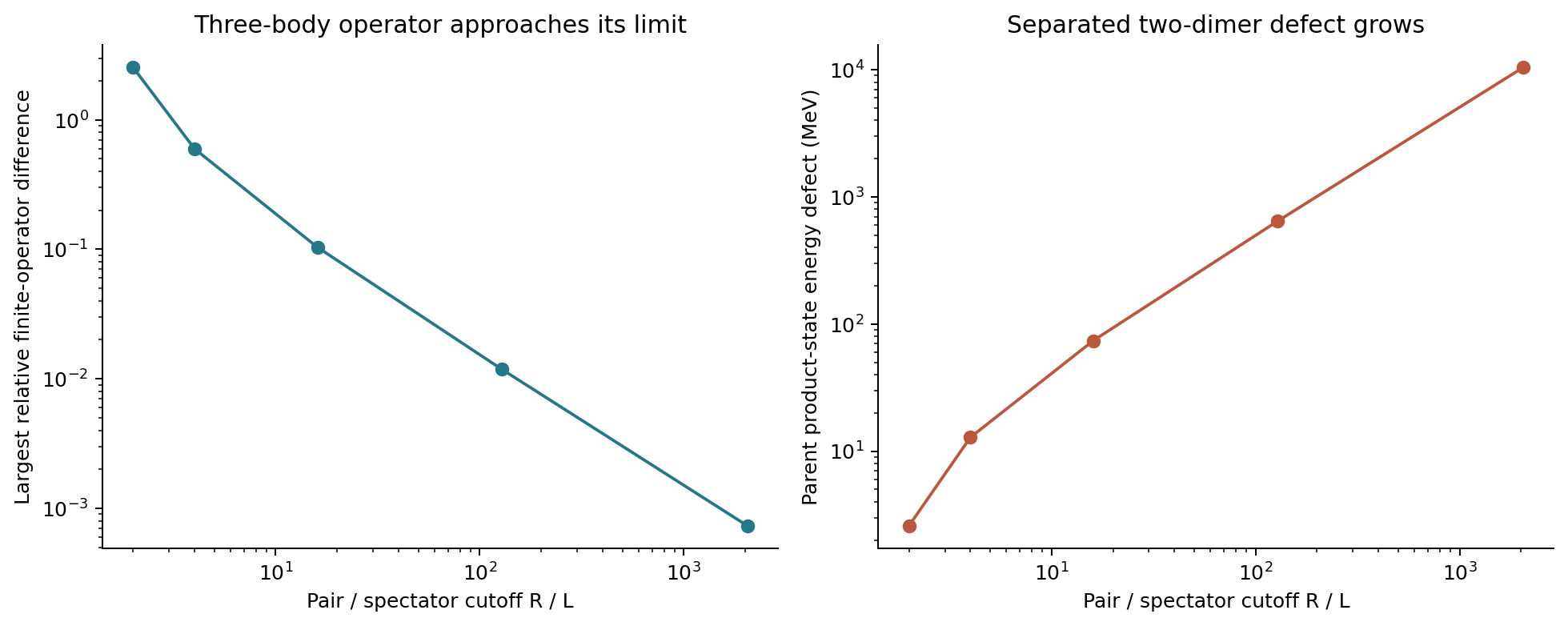
A matched three-body limit does not repair the separated-dimer prescription
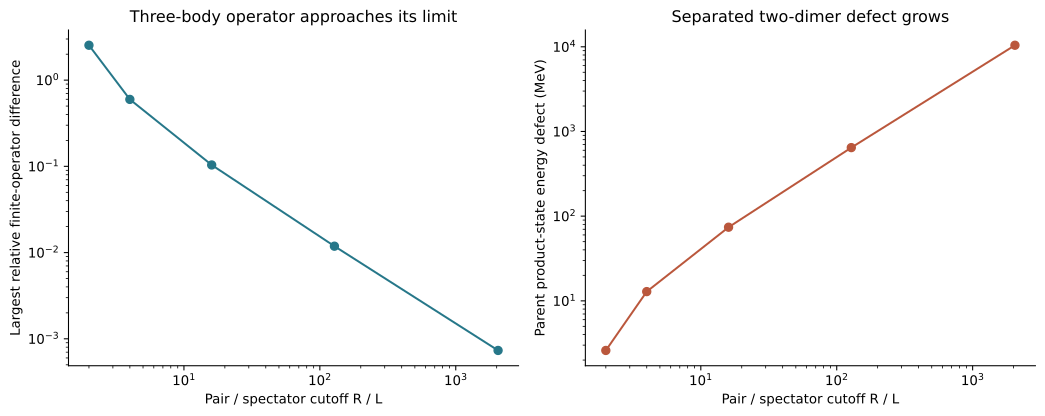
All points use the new conversion-regulated Hermitian model, the inherited 1200 MeV spectator cutoff and Bnn=2.5 MeV. The left panel takes the maximum over all eight declared negative-energy/grid supports. The right panel evaluates the original deuteron and dineutron product state after spatial separation at finite cutoffs, then varies the pair cutoff at fixed spectator cutoff. Its growing energy defect is not an eigenvalue, binding prediction or new threshold. Independent angular-log matrices and high-precision dimer integrals reproduce both trends; finite-regulator matching remains inexact.
Data · Provenance · PNG · SVG
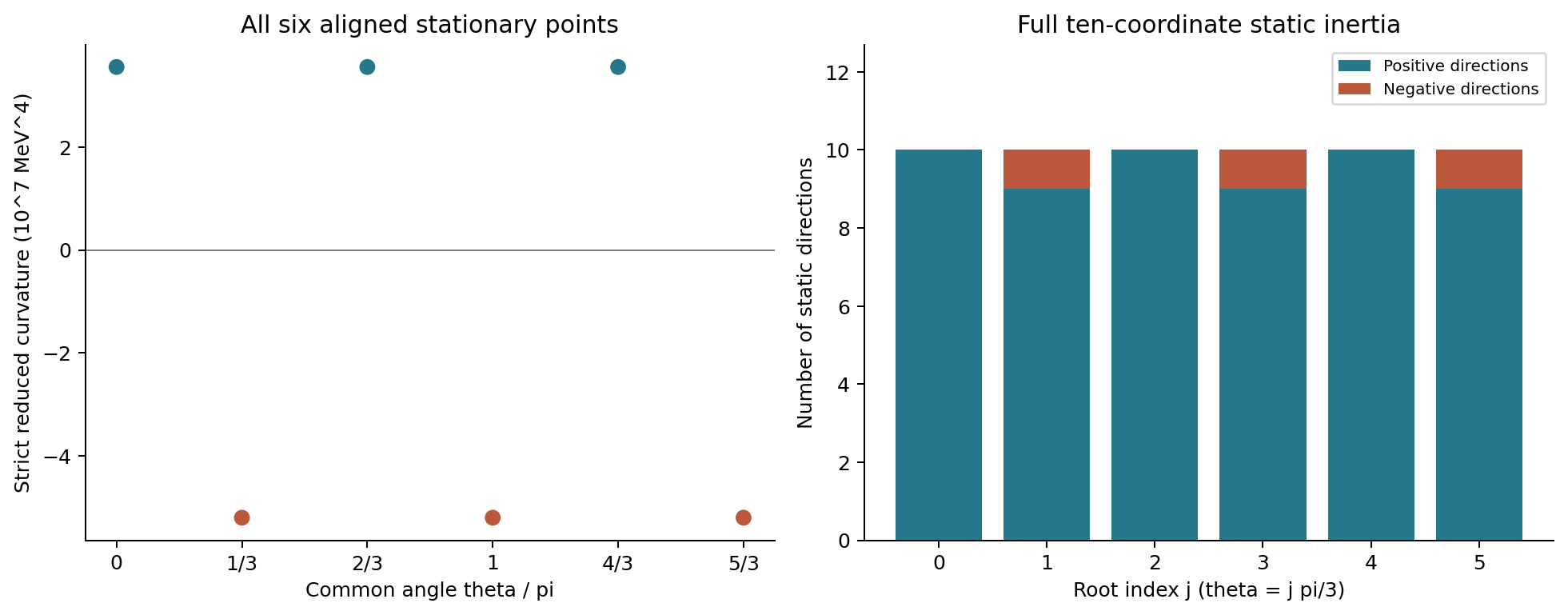
A complete aligned root census distinguishes three positive static points and three saddles
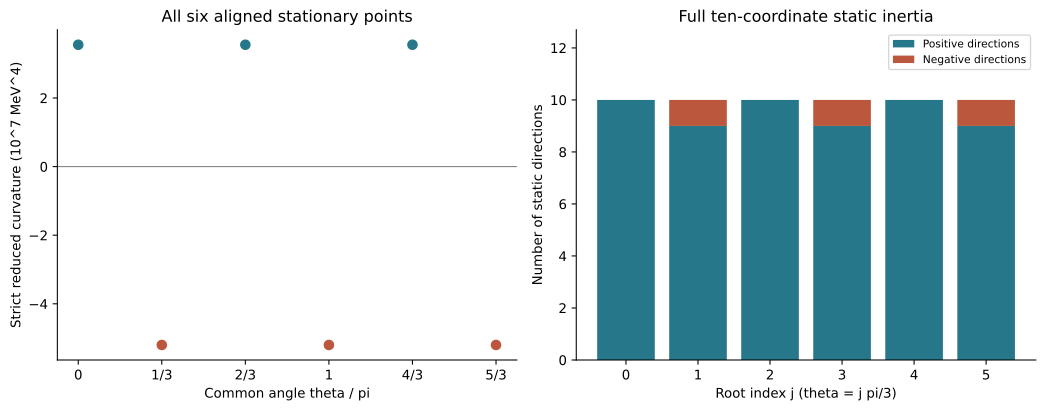
Exact symmetry roots j pi/3 on the three-sector aligned vacuum branch at the fixed inherited QCD input. LO and NLO each have 30 certified interval leaves, with no unresolved coverage. The left panel shows strict NLO reduced curvatures at mu=770 MeV; the 500 and 1000 MeV values agree under the original scale-matching gate. The right panel shows inertia of the unexpanded full ten-coordinate static matrix; strict perturbative curvature and unexpanded Schur values remain separately archived. All nine pion directions are positive. Dots are the complete roots on this branch, not samples of arbitrary angles.
Data · Provenance · PNG · SVG
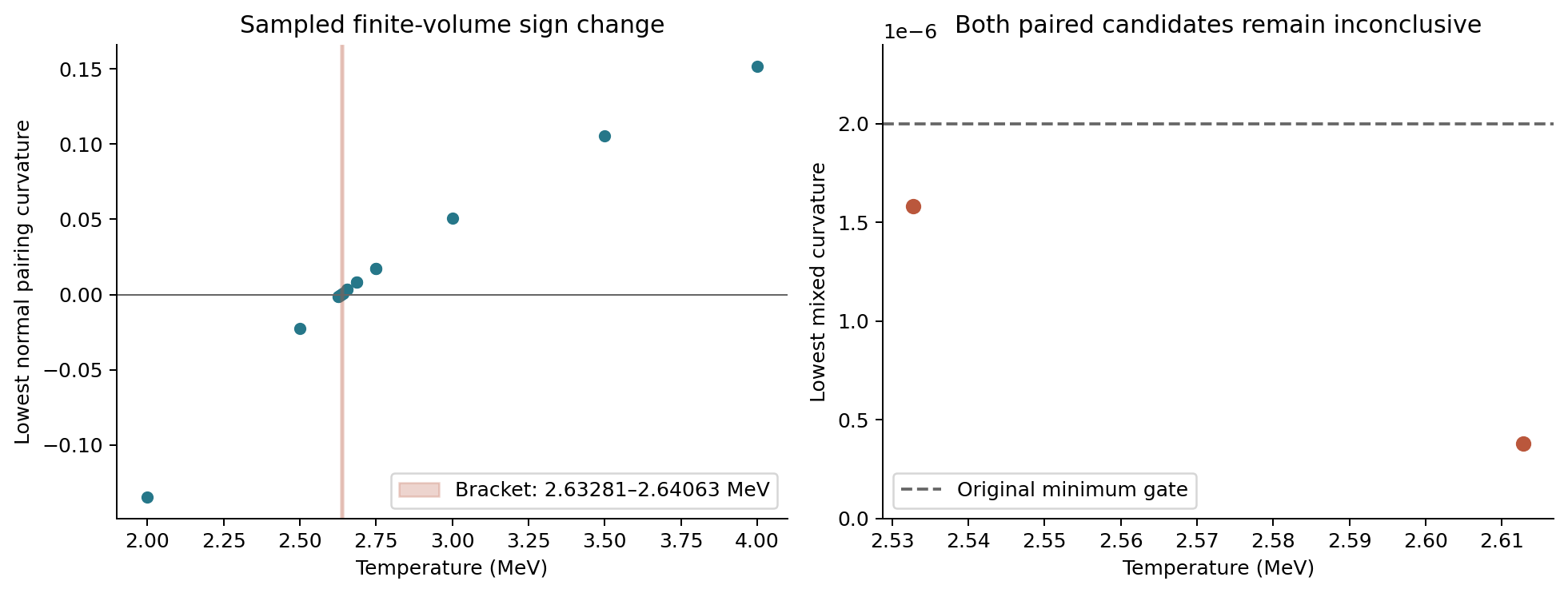
The finite Gaussian schedule resolves a normal curvature bracket, while paired minima remain unproved
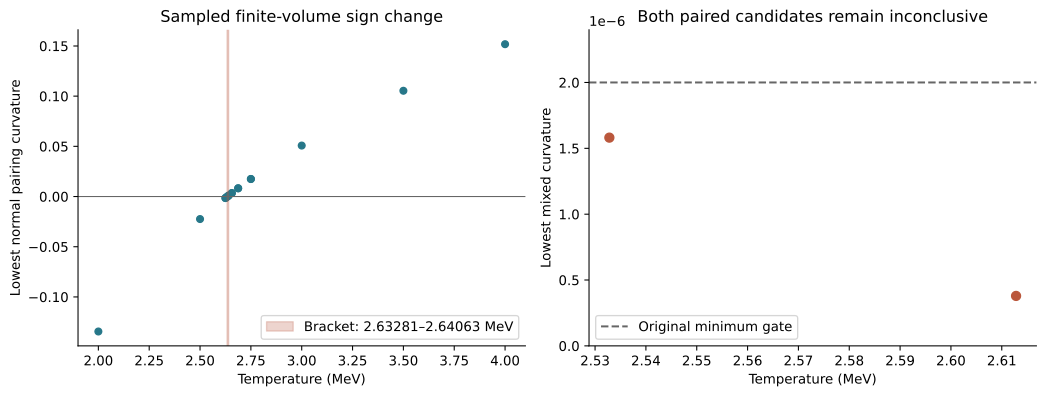
One fixed A Hamiltonian, L=3, spacing 1.973269804 fm, Gaussian mean proton/neutron charges 3.375 each. Normal roots are plotted at computed temperatures only; the shaded interval is the six-step sampled bracket, not a monotonicity or global phase assertion. The right panel retains both smallest mixed-space curvatures below the unchanged minimum-promotion gate. Every declared state has a separate independent review; no line between paired samples or thermodynamic extrapolation is implied.
Data · Provenance · PNG · SVG
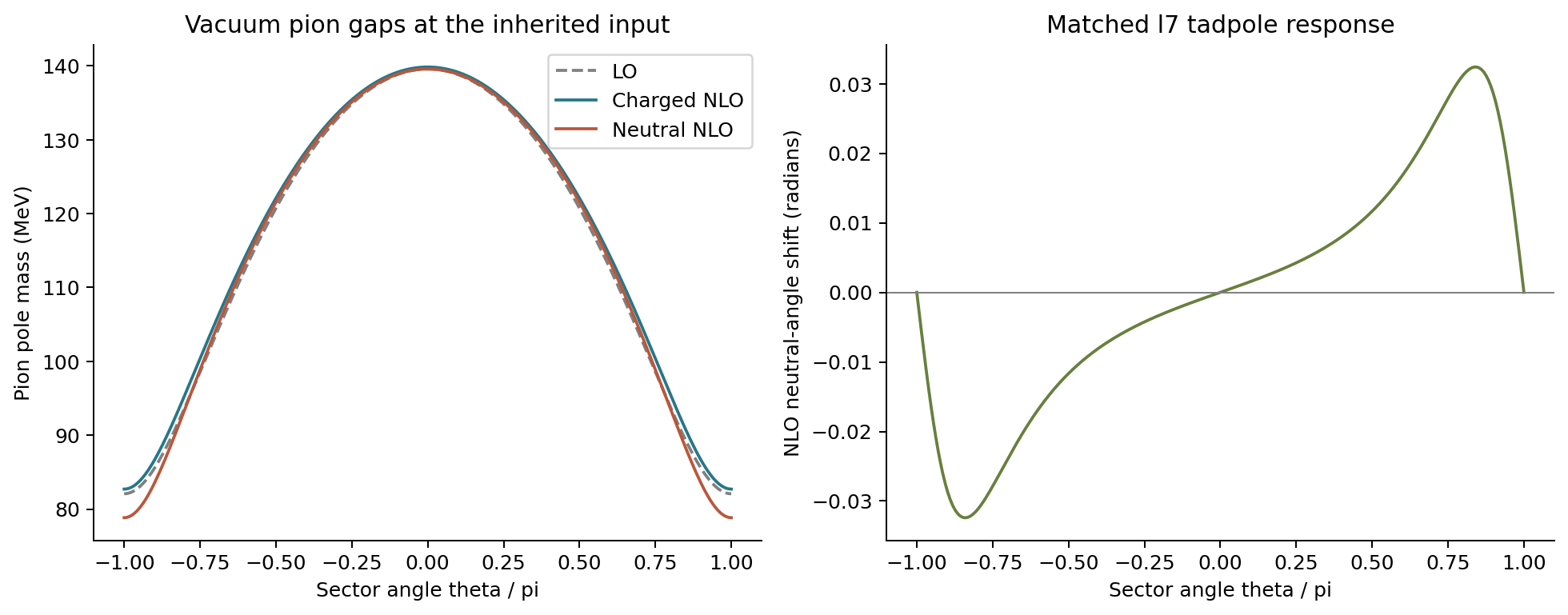
Vacuum pion pole gaps and neutral alignment pass a strict NLO control
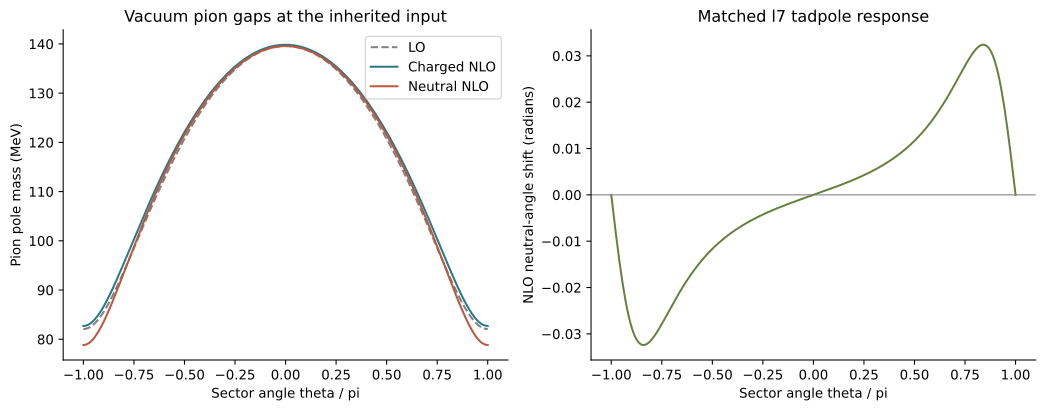
One zero-temperature QCD sector with the exact inherited z=2.27/4.67, m=139.57 MeV, f=92.2 MeV, lbar3=3, lbar4=4 and l7=0.007. All three sectors use the same functions with shifted angles. The neutral-mass normalization convention is matched at strict NLO; the numerical benchmark m is not the empirical neutral-pion mass. Electromagnetism is absent. Curves connect 257 saved points. Separate 16-corner sensitivity data are not a posterior or a full EFT uncertainty.
Data · Provenance · PNG · SVG
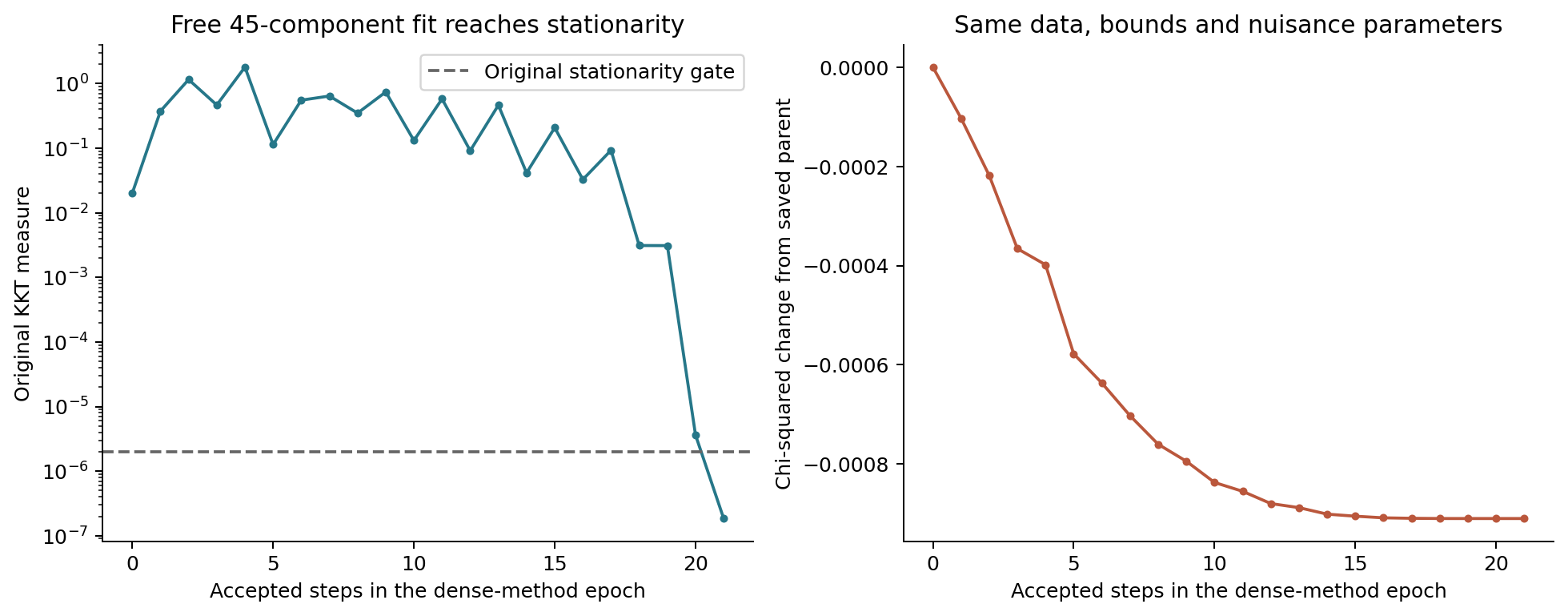
The bounded free spectral fit passes its original stationarity threshold
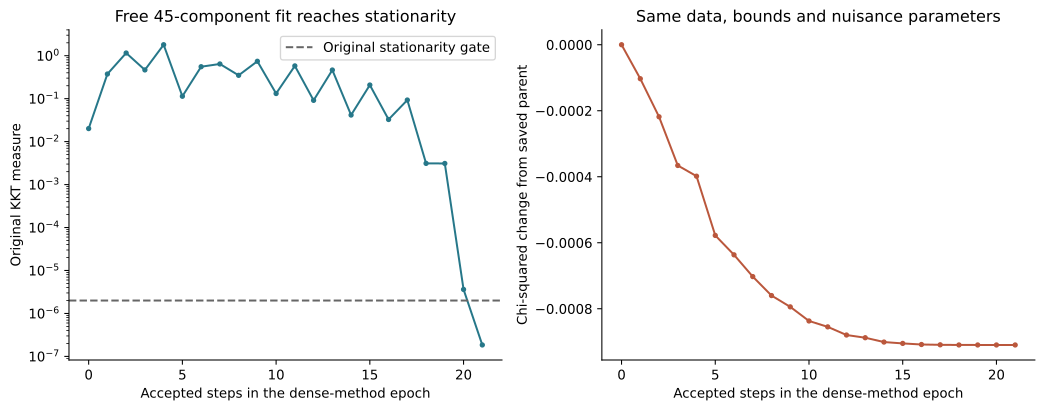
Twenty-one accepted proposals followed by the terminal stationarity check in the exact saved 45-component coadd likelihood. All 154 native parameters and 142 profiled nonlinear coordinates retain their original bounds, priors and nuisance structure. The final original-forward KKT is about 1.846e-7 against 2e-6. Lines connect saved states only. Tiny final objective changes and large acceptance ratios are floating-point diagnostics, not high-precision descent certificates. Full/profile negative curvature and the separate minimum flag remain explicit in the report.
Data · Provenance · PNG · SVG
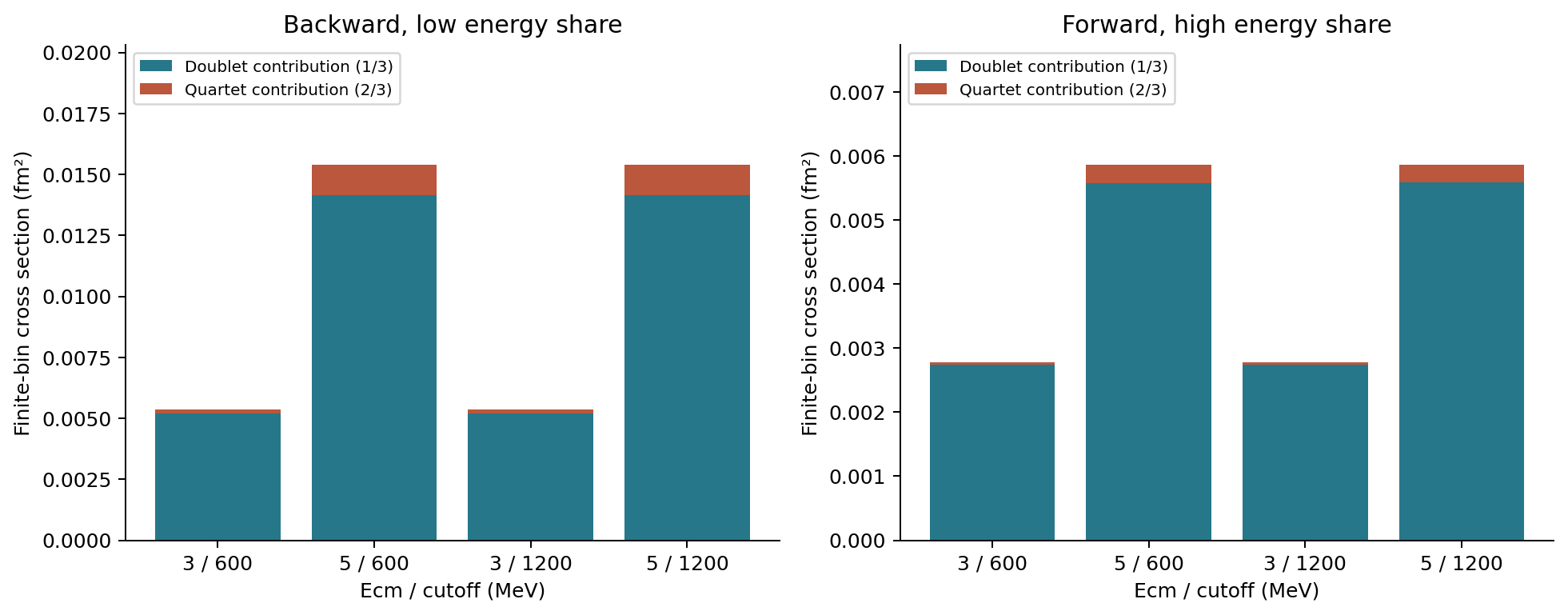
Coherent finite-wave predictions supply both spin sectors of four neutral breakup cases
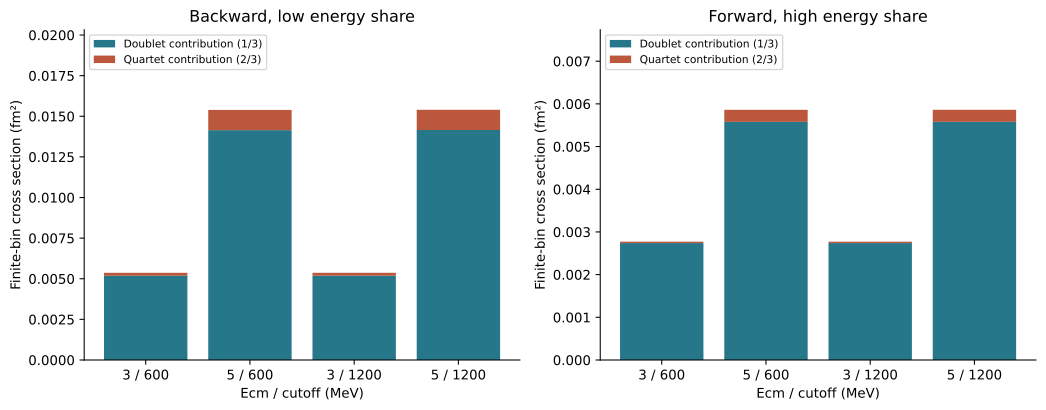
Strict interior ideal centre-of-mass bins at Ecm=3 and 5 MeV, with cutoffs 600 and 1200 MeV. Doublet and quartet use the same neutral LO kinetic masses, two-body inputs and calibrated doublet three-body convention. Partial waves l=0 through 4 interfere coherently within each spin sector; orthogonal incoming spin sectors contribute incoherently with weights 1/3 and 2/3. The bin coordinates and all raw reserved points are supplied in the linked production report. Small grid/product/quadrature changes are observed numerical comparisons, not confidence intervals or rigorous omitted-wave bounds.
Data · Provenance · PNG · SVG
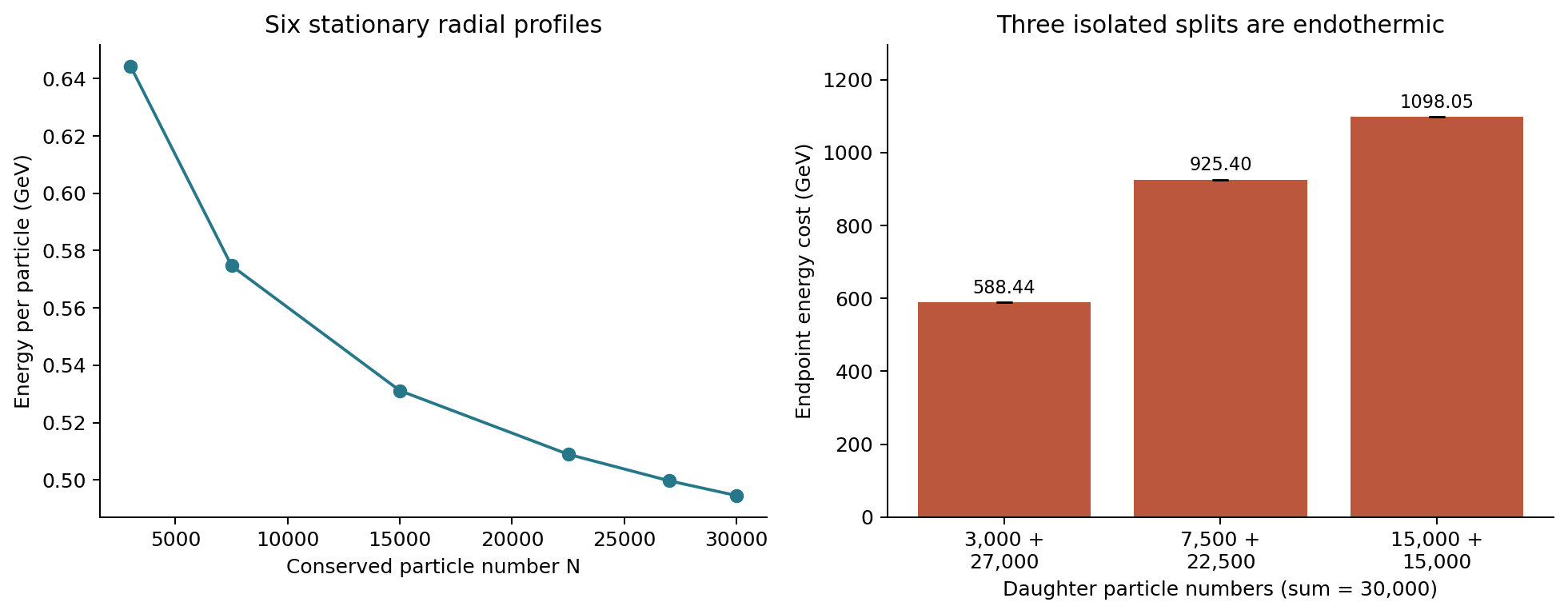
Three declared pocket splits cost energy in one dark-sector model
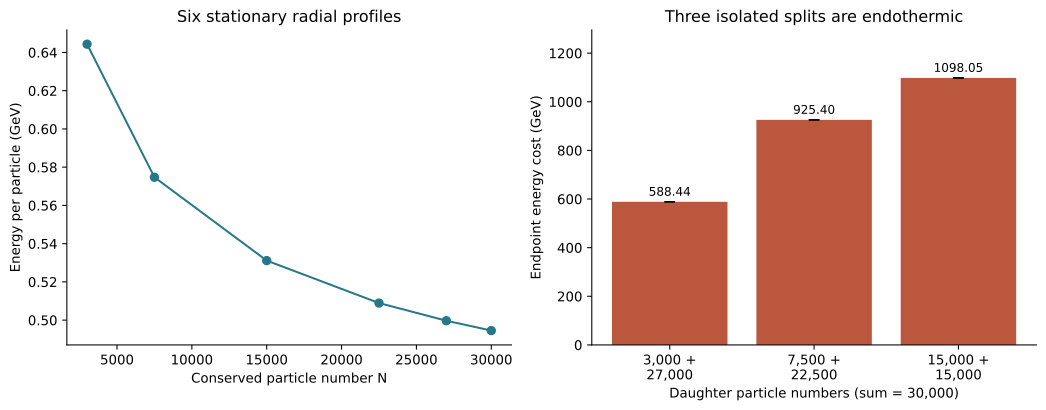
The zero-temperature scalar/Thomas–Fermi functional has w=1 GeV, dimensionless Yukawa coupling y=1, lambda=0.01, bias=1e-4 GeV^4 and spin degeneracy two. Ordinary-matter coupling, Coulomb energy and gravity are absent. Lines on the left connect six saved stationary profiles and assert no interpolation bound. On the right, daughter energies are summed at asymptotic separation and the N=30000 parent energy is subtracted. Error bars show summed observed numerical envelopes of 0.00130, 0.00279 and 0.00611 GeV; they are smaller than the plotted marks and are not rigorous bounds or physical uncertainty. Independent raw-profile integration reproduces all three signs. No finite-separation path or barrier is plotted.
Data · Provenance · PNG · SVG
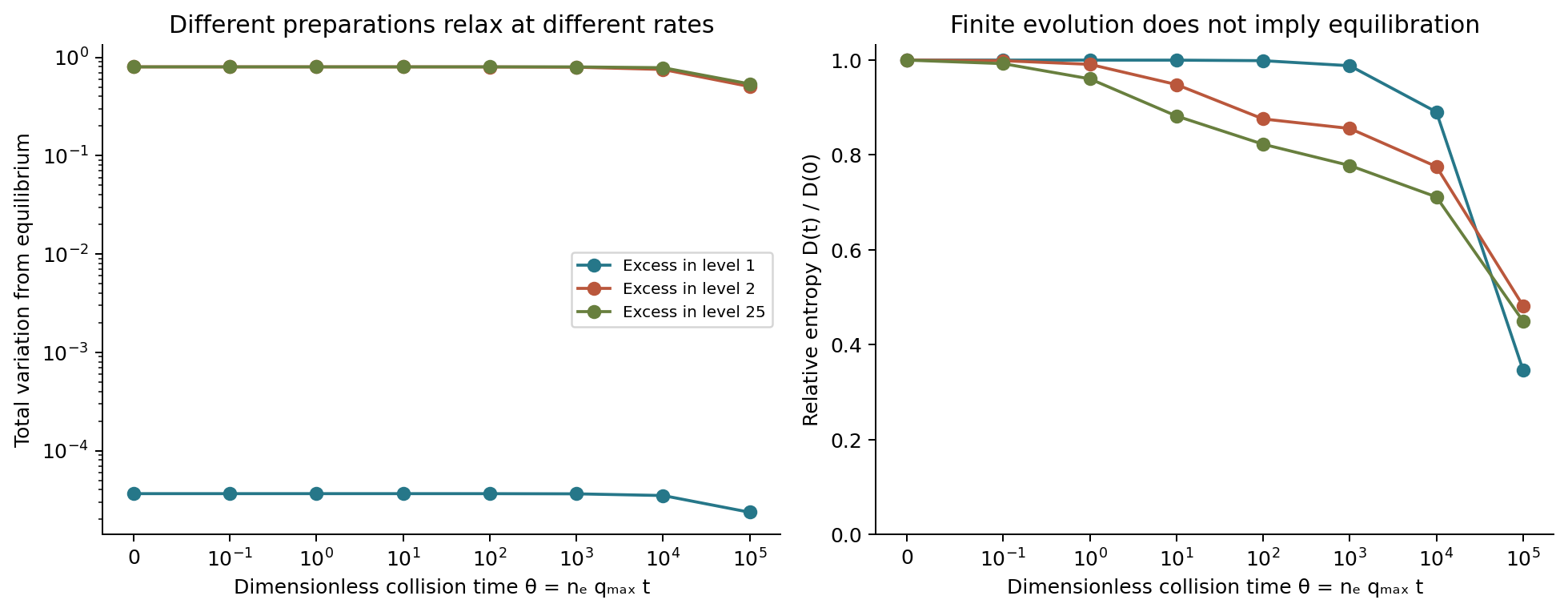
Full collision modes preserve slow relaxation in closed HeII
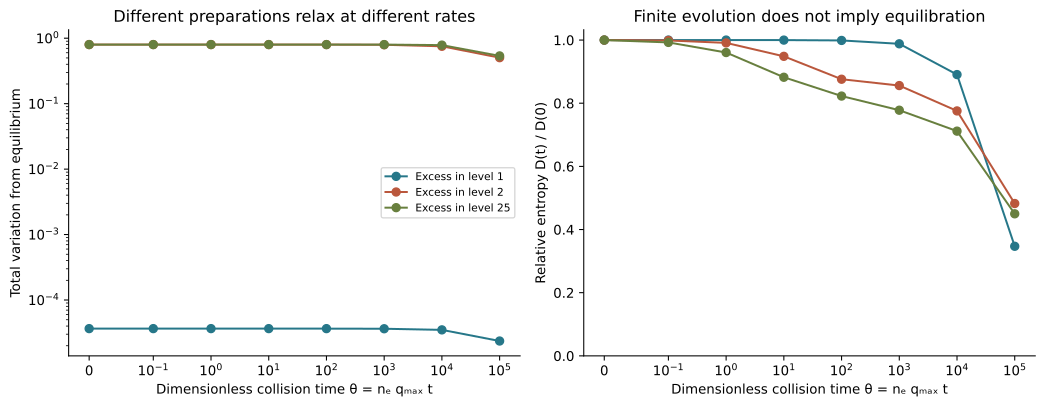
At the printed log10(T/K)=4.6 knot, T=39810.7 K, the NIST energy convention and all25 levels are retained. Each preparation is0.2 times equilibrium plus0.8 in paper level1,2 or25. All8 times are shown; the horizontal axis is linear close to zero and logarithmic above0.1. Total variation is one half of the L1 population difference. The right panel divides each positive generalized KL by its own initial value. Curves connect saved times and are not continuous-time error bounds. Electron densities1,1e4 and1e8cm−3 rescale physical time, not these trajectories. Independent native-precision entropy and augmented heat checks cover all20 source cases. No radiative, ionization or recombination terms are included.
Data · Provenance · PNG · SVG
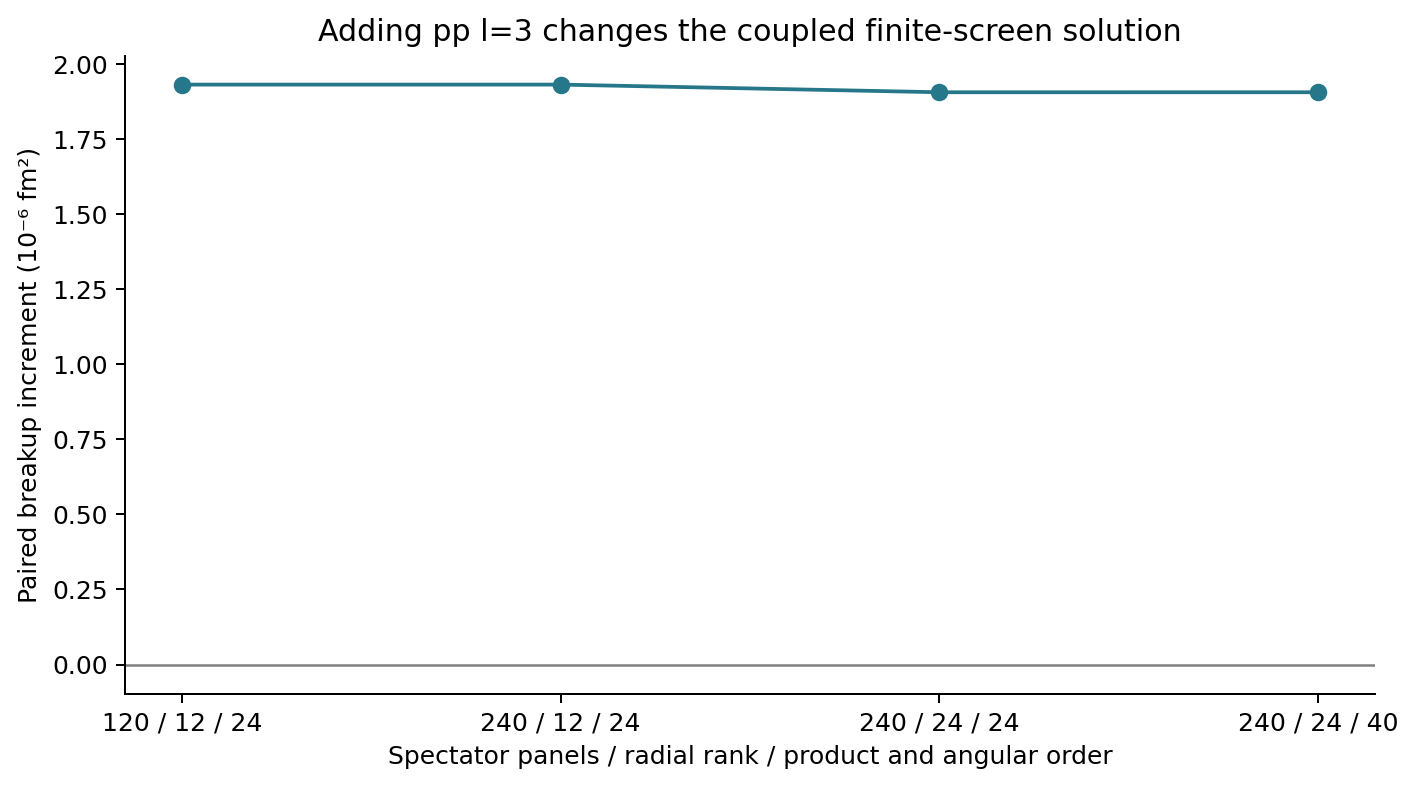
A resolved paired increment within four declared finite-screen discretizations
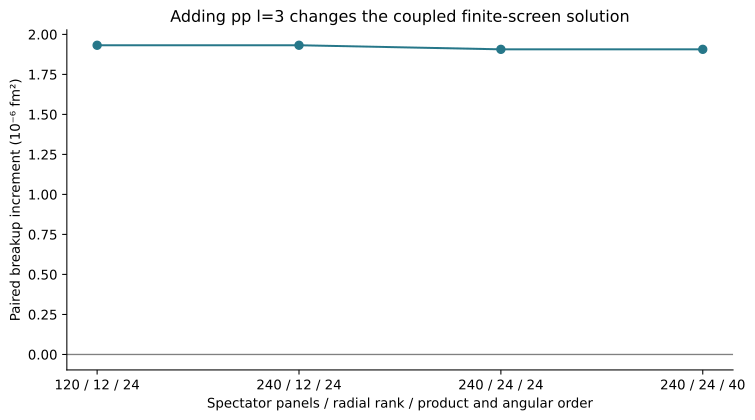
Each point subtracts the l=1 flux from the coherent l={1,3} flux on exactly the same grid at Ecm=5 MeV, cutoff 600 MeV, R=2 fm and total quartet orbital L=0. The last increment is 1.90667e−6 fm²; its saved refinement envelope is 2.55006e−8 fm². Product and angular orders change together. The 120-panel case remains a refinement diagnostic and fails its optical comparator. No error bound on omitted l≥5 or screening removal is supplied.
Data · Provenance · PNG · SVG
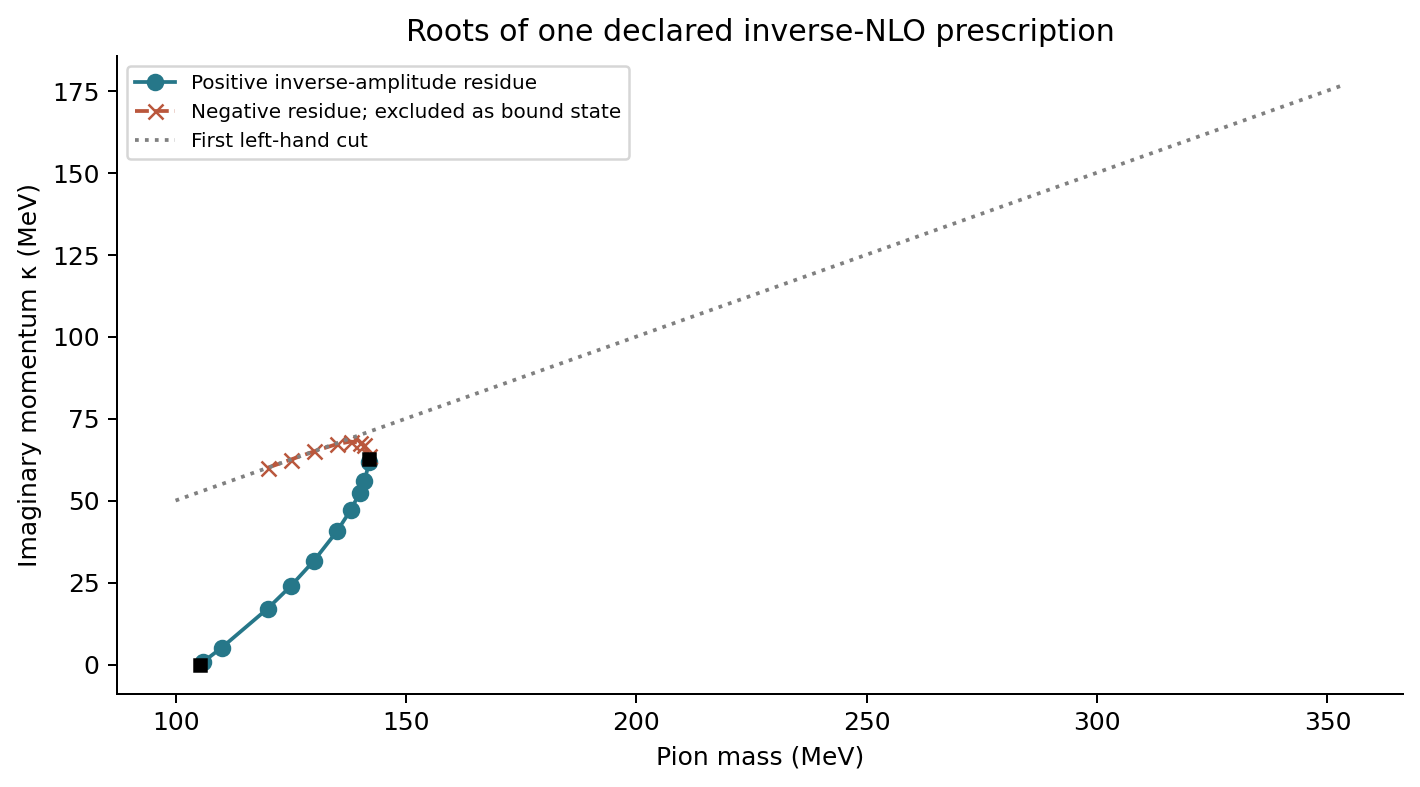
Positive and discarded roots retain the source prescription and cut
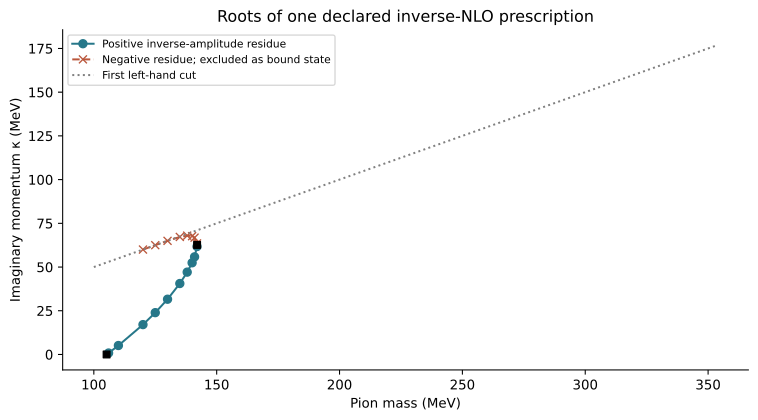
The nominal triplet case uses epsilon=1 and auxiliary mass 750 MeV. Markers are declared finite mass samples, and lines only connect them. Squares mark separately solved zero-binding and coalescence thresholds at 105.19908 and 142.02597 MeV. All negative-residue roots are retained in the data and excluded from the bound-state count. This inverse-NLO resummation differs from strict first-order and effective-range pole prescriptions. Nested finite grids and multiprecision brackets do not prove global completeness or quantify omitted source orders.
Data · Provenance · PNG · SVG
A contact cutoff does not reproduce the global spectator cutoff
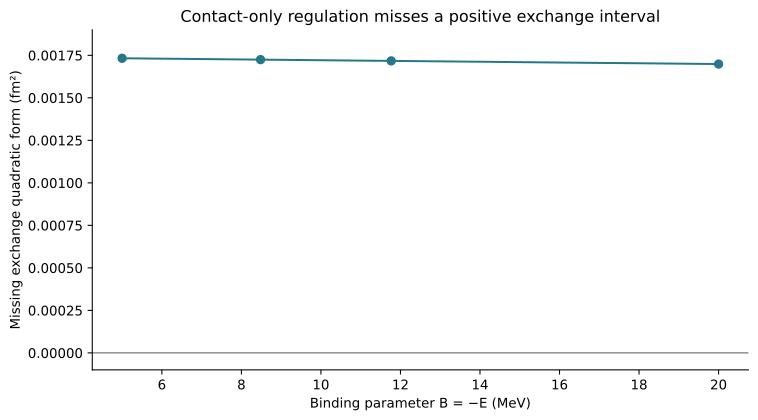
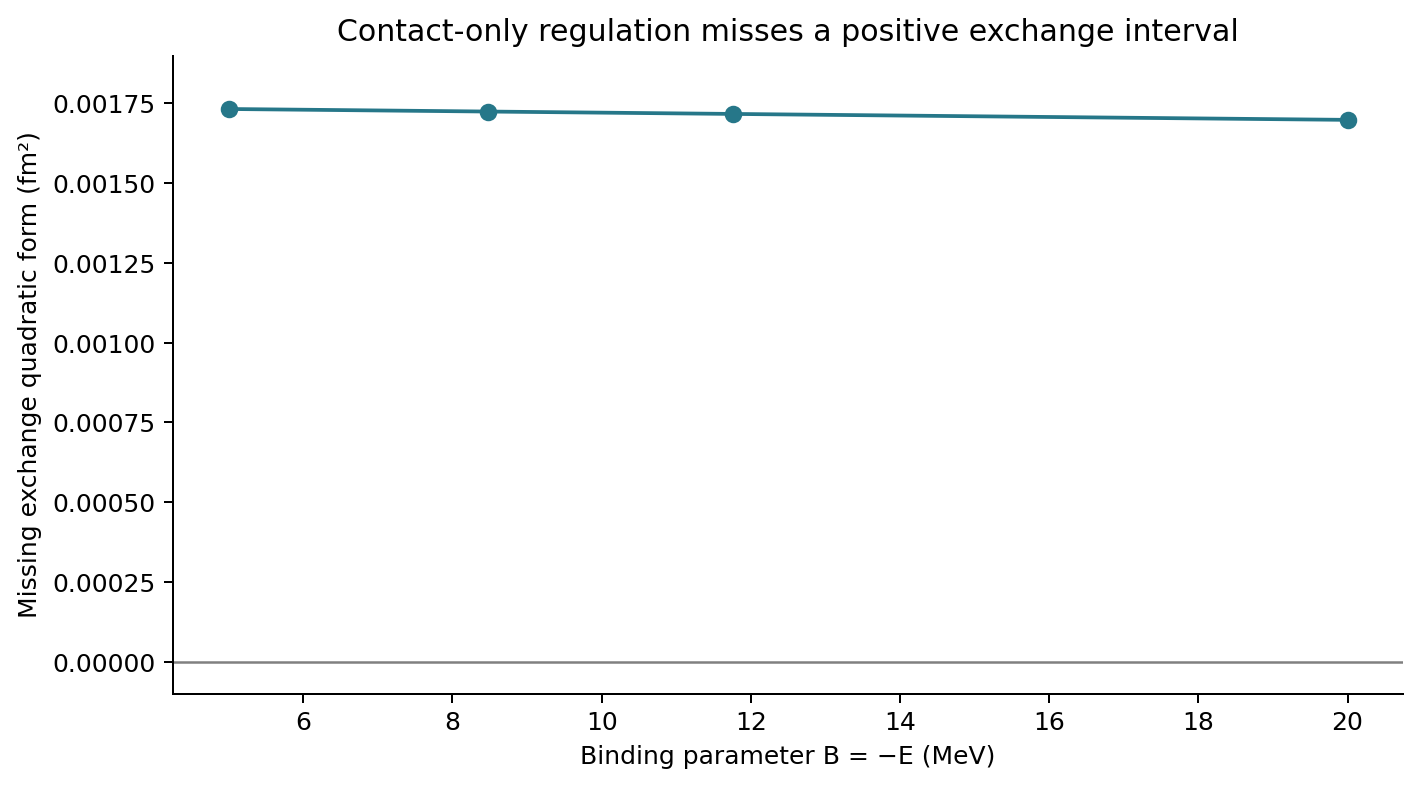
At fixed Λ=1200 MeV and external p=Λ/(2ℏc), this diagnostic integrates only q between Λ/(ℏc) and 1.25Λ/(ℏc). The contact annihilates the chosen external spin direction, so it cannot remove this second-Born exchange difference. All energies are below the dimer thresholds. The values are kernel diagnostics, not scattering observables or complete model differences. Independent 80-digit quadrature reproduces them. The contact-only realization fails full parent matching; a compatible global projection remains to be derived.
Data · Provenance · PNG · SVG
Source scattering and current matching at declared pion masses
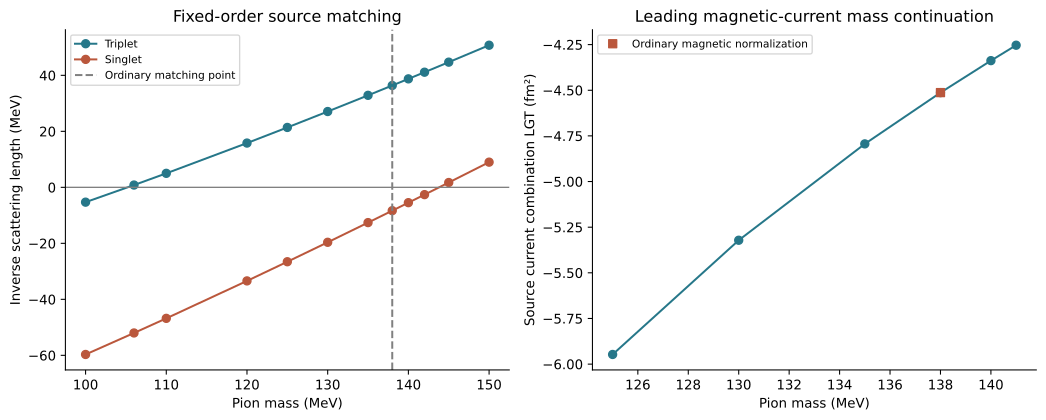
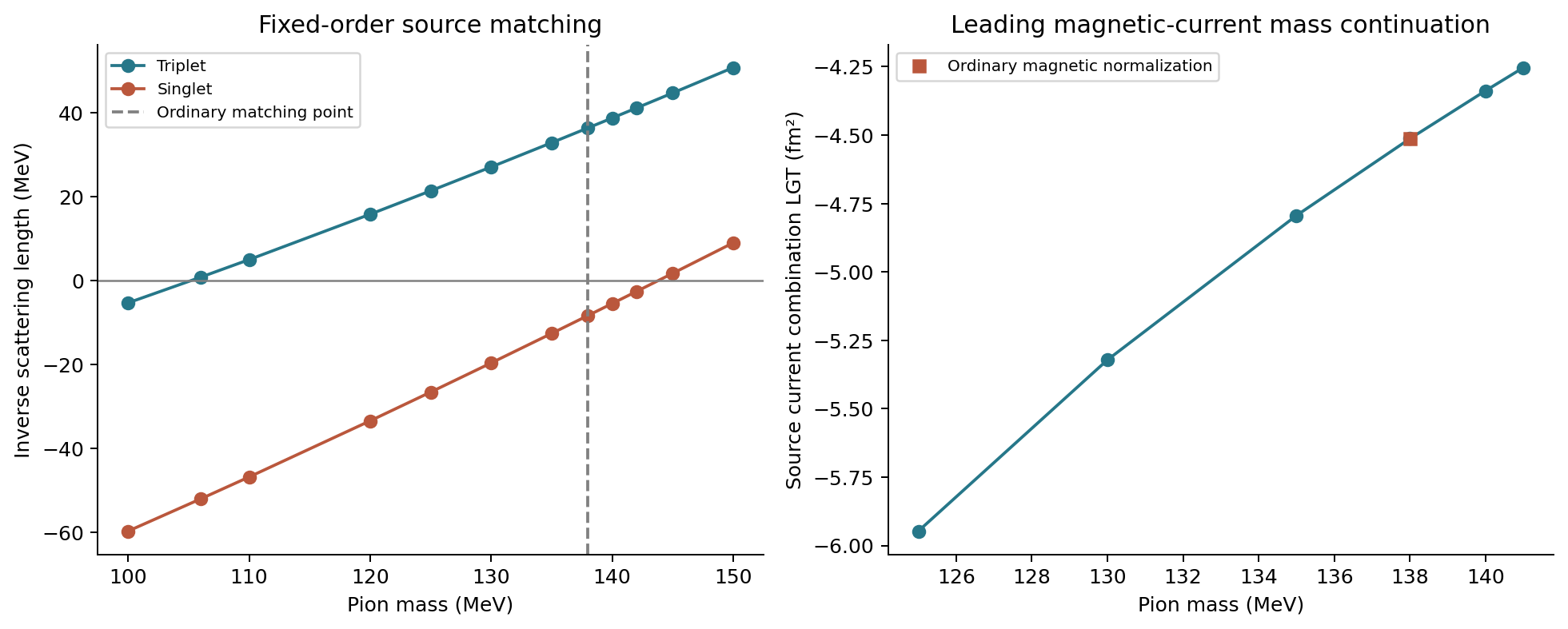
The central curves use the source ordinary scattering lengths/effective ranges and its lattice scattering anchors at 353.7 MeV. The current is normalized to LGT=−4.513 fm² at 138 MeV and uses the source small effective-range pole and single-nucleon coupling. Lines connect declared samples, without a confidence band. The lattice triplet interval crosses zero and no joint covariance is supplied. Unknown mass-expansion errors, full-amplitude poles and finite-angle nuclear matching remain separate. This figure neither inserts a cyclic-field angle nor predicts a lifetime.
Data · Provenance · PNG · SVG
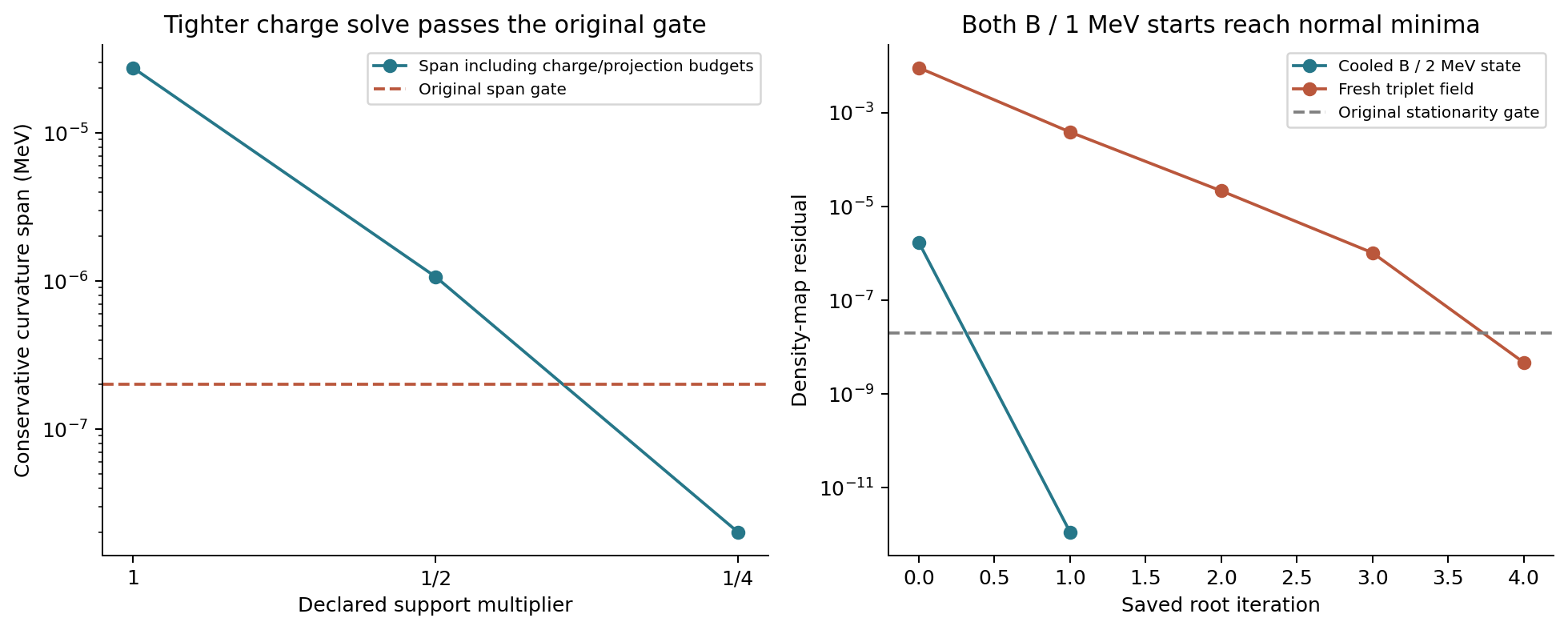
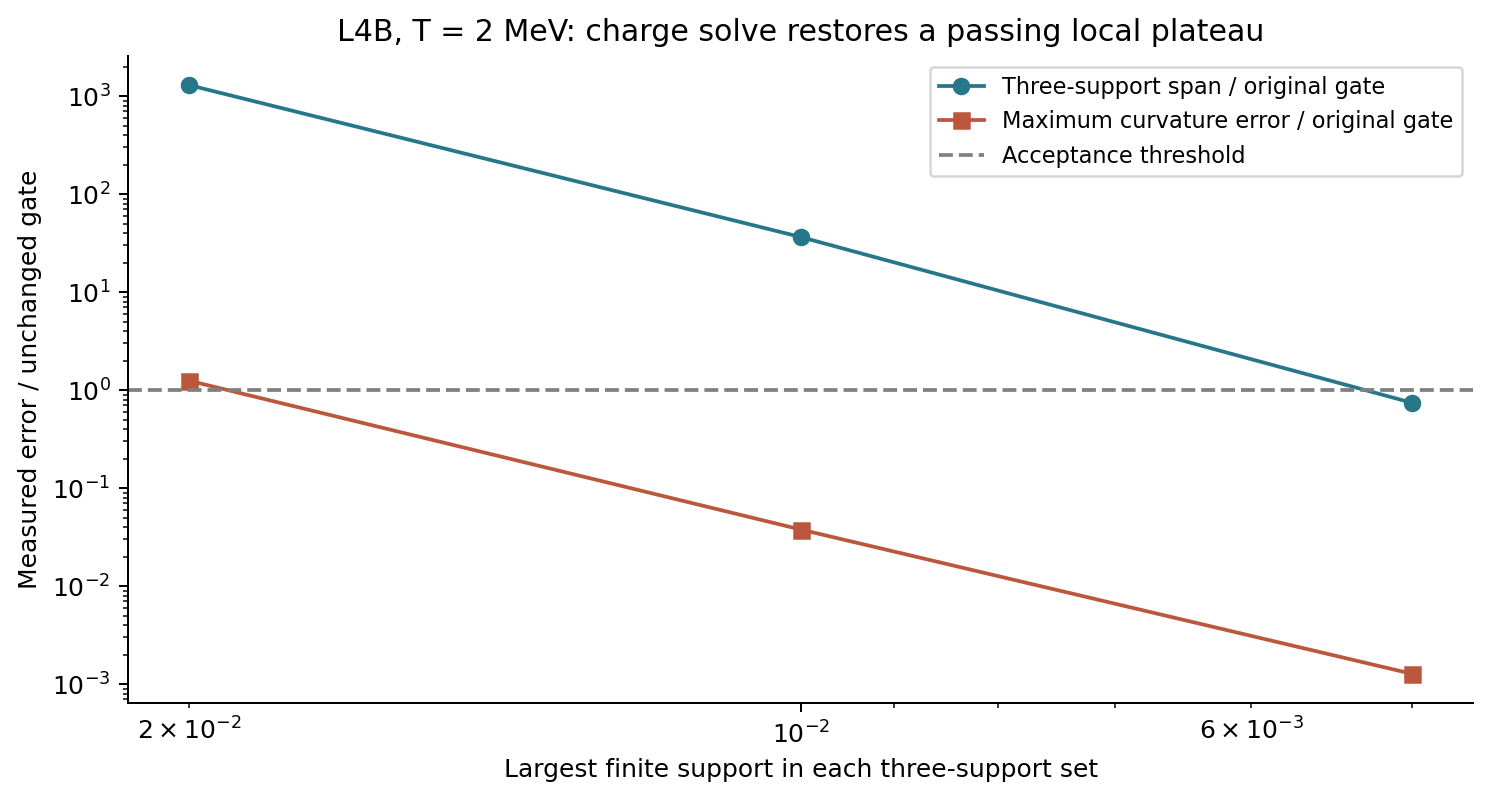
Curvature-aware charge solving completes the declared cold starts
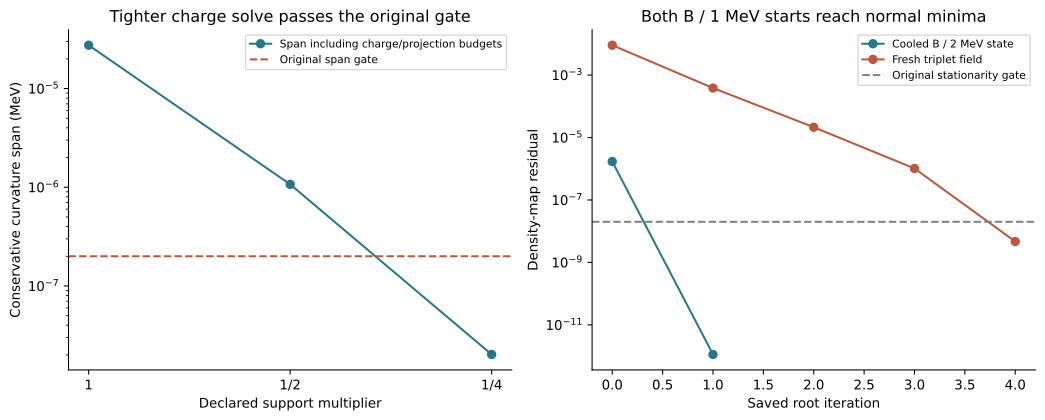
The derived incremental charge tolerance retains actual zero offsets and chemical work. Both coarser support triples remain failed; the finest span is 2.02e-8 against 2e-7. Two original starts pass independent terminal density and enlarged-Hessian controls, with lowest curvatures about 0.462878 MeV. The accepted normal finite path is reused only within the original 2e-8 density-distance criterion. Scalar high precision does not certify the full binary64 eigensystem; no disconnected paired-phase search or thermodynamic limit is supplied.
Data · Provenance · PNG · SVG
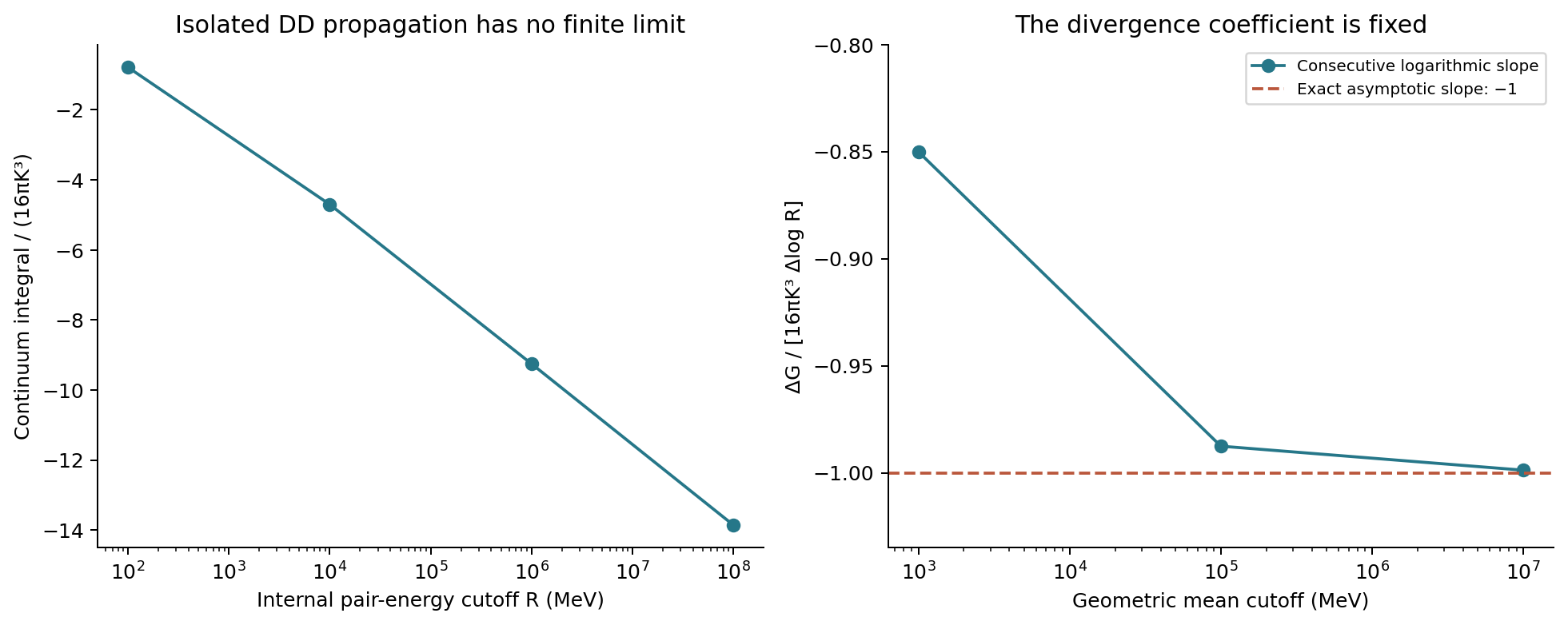
An isolated two-dimer integral diverges logarithmically
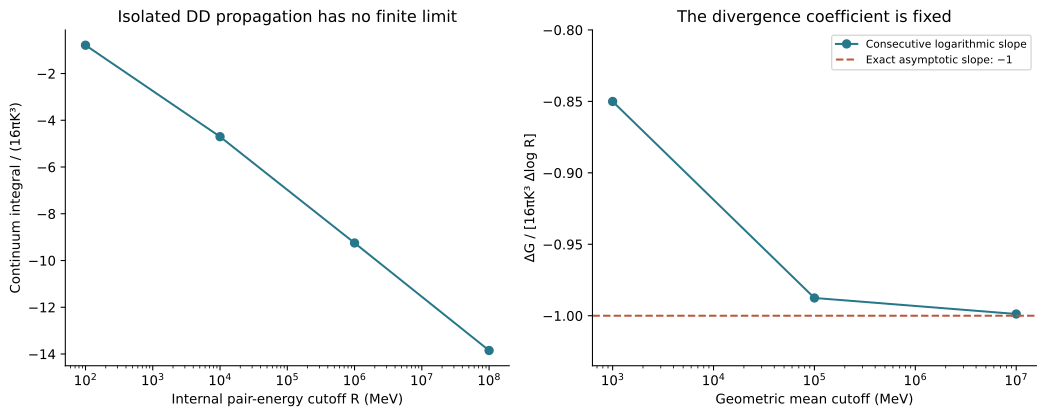
The exact continuum spectral density tends 16πK³. These regulated integrals use the same deuteron and dineutron bindings as the frozen STM model, at relative energy −20 MeV. R regulates the internal pair energy and is distinct from the 1200 MeV spectator cutoff. The displayed failure belongs to isolated amputated propagation with energy-independent endpoints; no full attached four-body kernel or physical counterterm is inferred. An energy subtraction is finite but leaves an undetermined constant. Independent continuum quadrature checks every value.
Data · Provenance · PNG · SVG
Cross-wave interference in finite neutral breakup bins
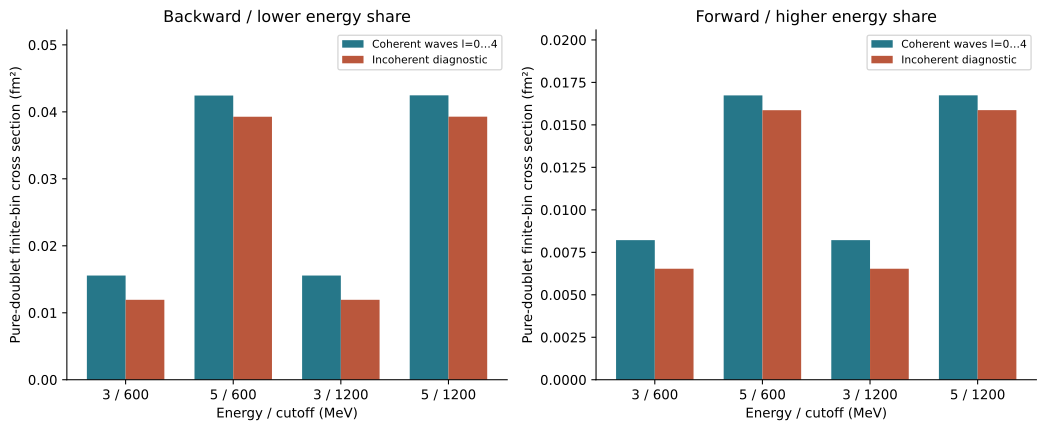
Two preregistered five-dimensional center-of-mass bins integrate the same neutral LO doublet amplitudes, coherently combining l=0 through 4. Every new point is evaluated from the direct cut-split source equation; a separately interpolated total flux is only a normalization regression. The incoherent bars intentionally omit cross-wave interference. Multiply by one third for the doublet contribution to an unpolarized incident beam; the complete quartet differential contribution is absent. Numerical refinements do not establish an infinite-wave bound, physical EFT uncertainty, charged prediction or detector efficiency.
Data · Provenance · PNG · SVG
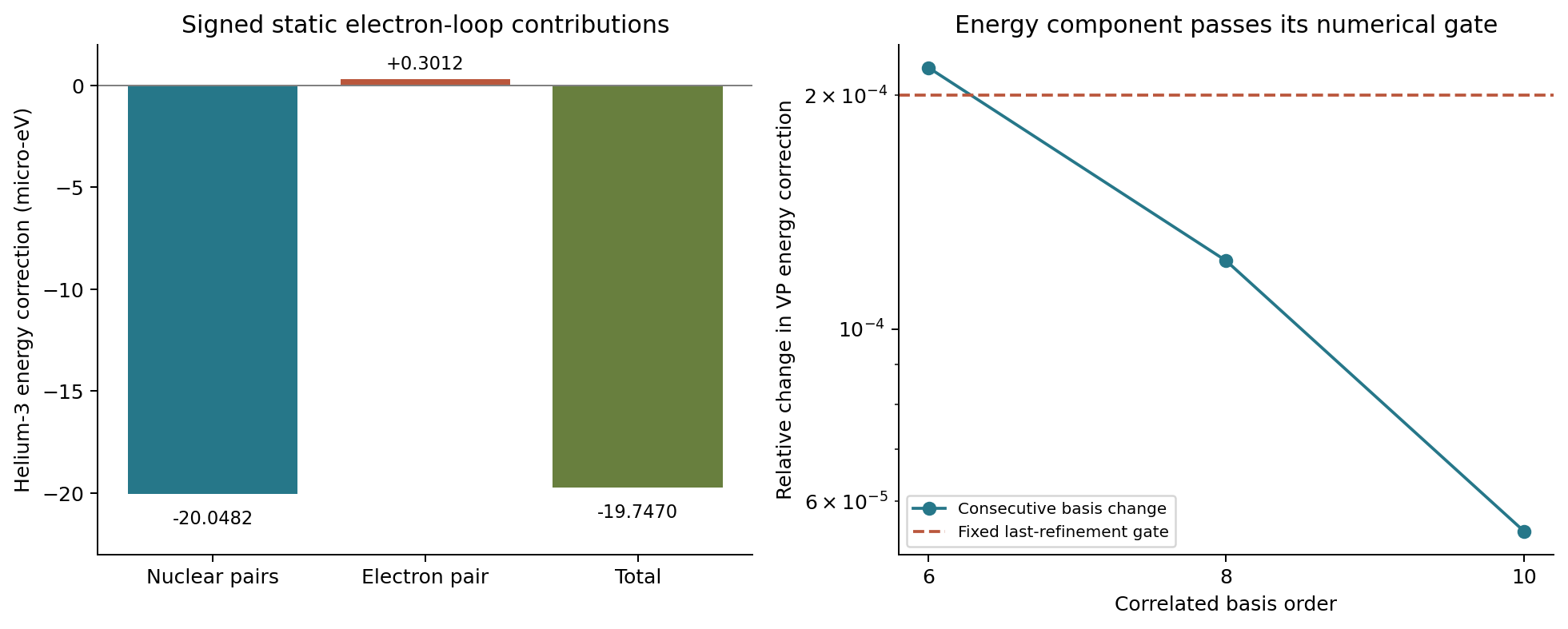
Static atomic energy correction and finite-basis control
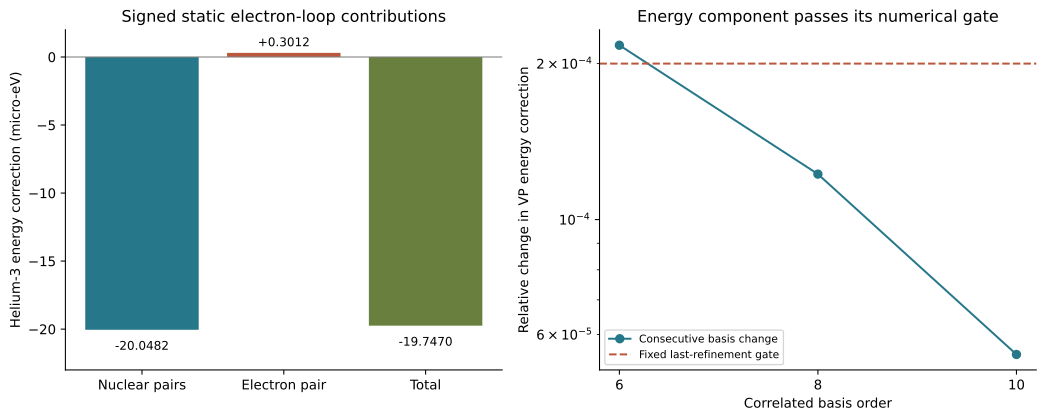
The left values are first-order corrections in the same finite-mass correlated helium-3 state, with two nuclear pairs and one electron pair. The right sequence need not be variational; it resolves this potential expectation, not omitted physical operators. Independent analytic polynomial moments and an infinite-loop integral reproduce the complete correction. The separate contact response fails its basis gate and has unresolved overlap conditioning. No complete QED threshold, corrected contact amplitude or weak lifetime follows.
Data · Provenance · PNG · SVG
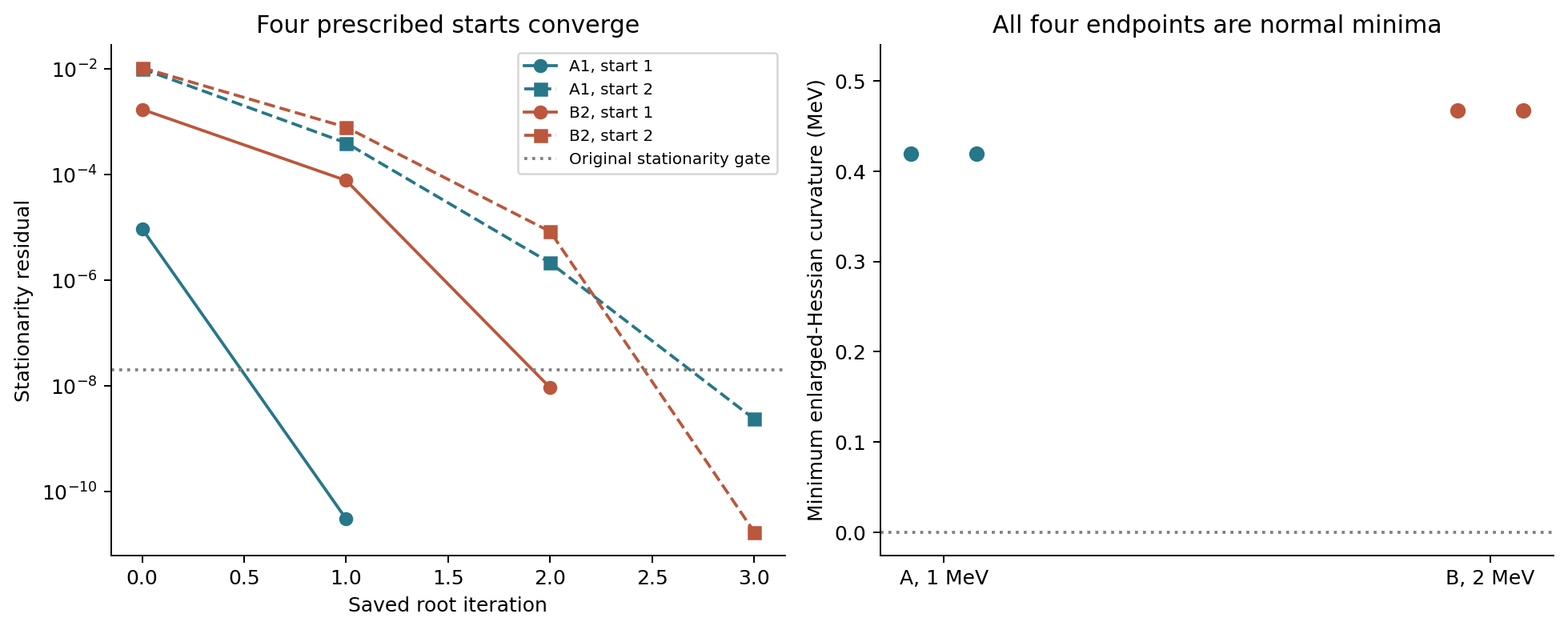
Finite larger-volume starts reach normal local minima
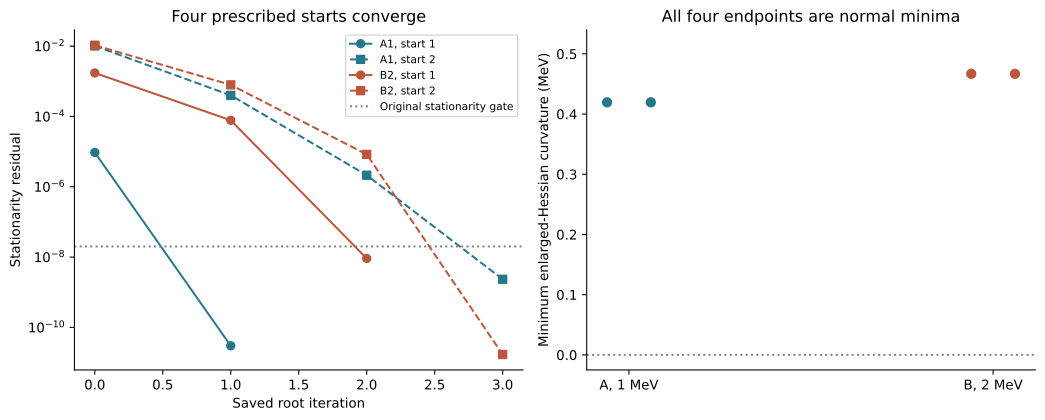
Each L4 case fixes separate mean proton and neutron counts at eight and tests two declared starts in the same finite Gaussian ensemble. Every candidate passes stationarity and a full enlarged normal/pp/nn/np Hessian control. Pair norms vanish within the finite convergence gates, so these are normal local minima. The earlier B-at-1-MeV attempt failed before either seed and is absent from this four-start figure; the subsequent accepted B-at-1-MeV census is shown separately. No disconnected paired-root search, global minimum, exact-number thermal phase or thermodynamic extrapolation is supplied.
Data · Provenance · PNG · SVG
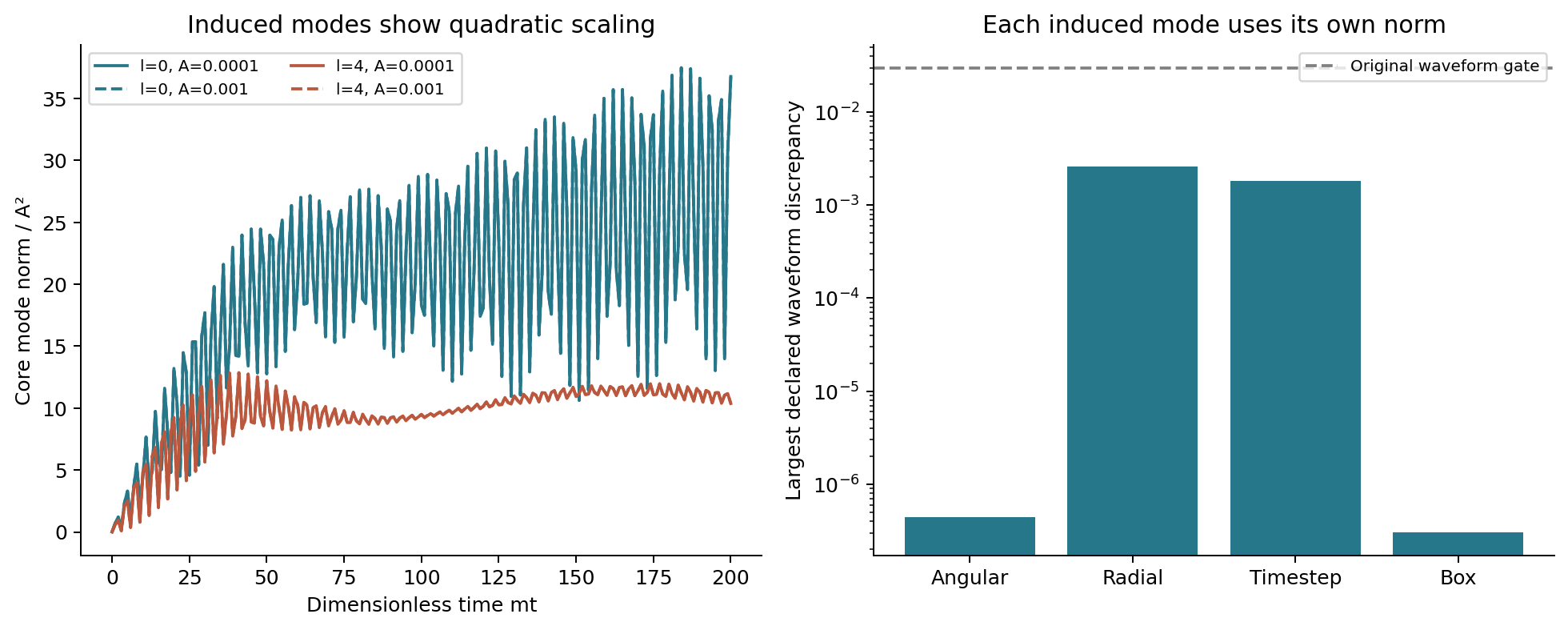
Resolved nonlinear angular feedback in a finite field evolution
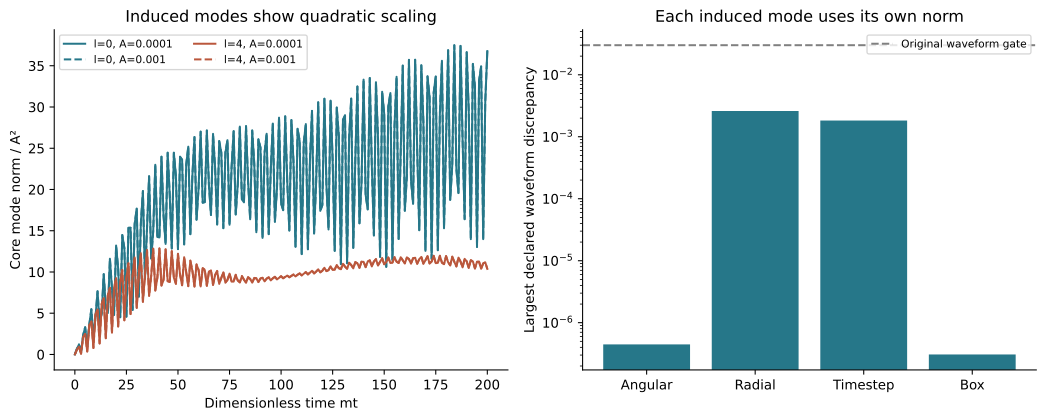
The canonical phi6 field starts from the same radial envelope with quadrupole amplitudes A=1e−4 and 1e−3. Solid and dashed curves nearly coincide after division by A²; the independently measured l0/l4 scaling discrepancies are 0.00150 and 0.00337. The right panel takes the worst all-snapshot core waveform discrepancy over both amplitudes and l0/l2/l4, normalized to each reference mode rather than the large spherical background. Angular truncations reach lmax8. Fixed-boundary and damping energy ledgers pass separately. This is a finite-time even-axisymmetric control, not a general three-dimensional lifetime or outgoing-radiation prediction.
Data · Provenance · PNG · SVG
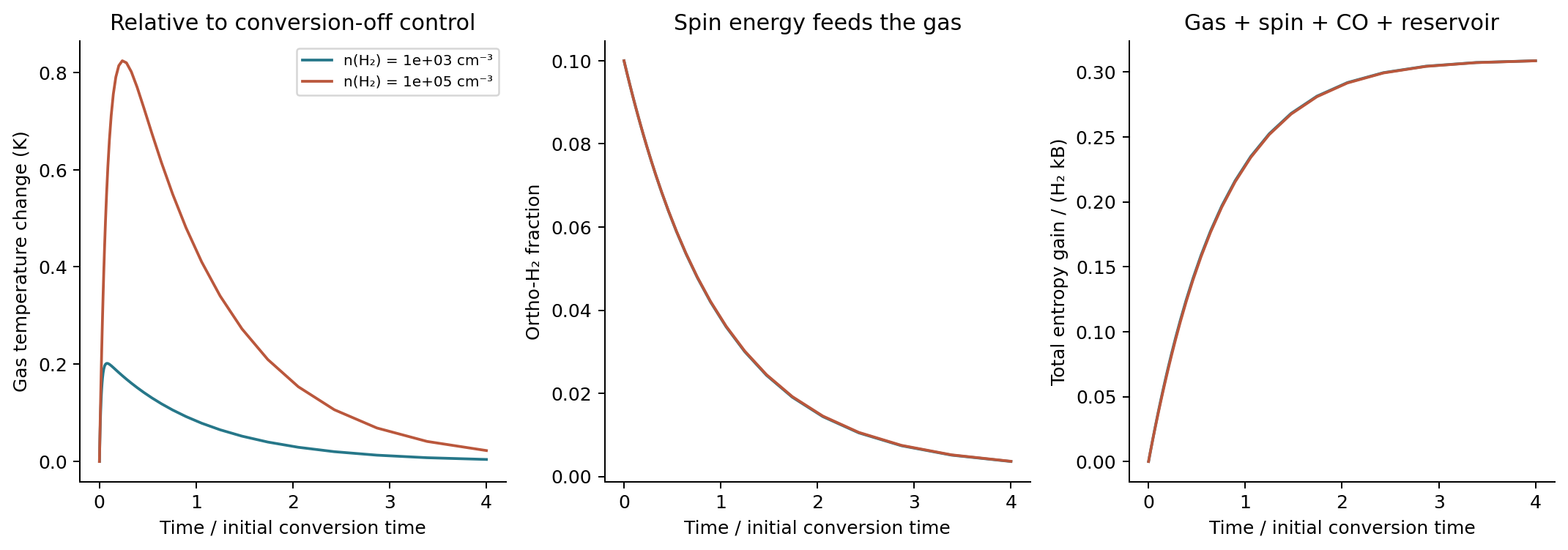
Conditional molecular kinetics with spin-conversion heating
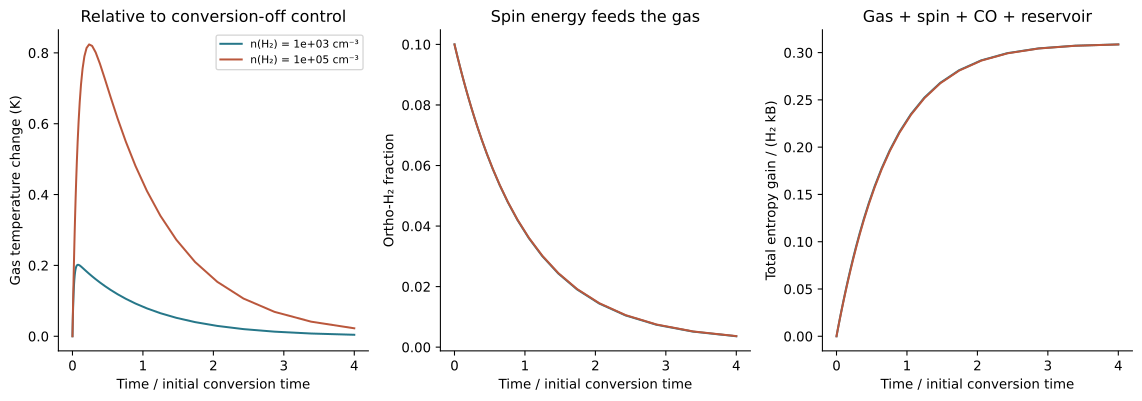
Both selected cases start with gas and prescribed radiation at 20 K and ortho fraction 0.1. CO/H₂=1e−4 and proton/H₂=1e−6 remain fixed; electrons neutralize the catalyst. Each horizontal axis uses that case’s initial conversion time, so equal dimensionless times are not equal physical durations across densities. The reference disables only spin conversion while retaining all populations and the same heat capacity. All retained CO departures remain dynamical. The entropy ledger includes the external Planck reservoir. Source-fit, two-state hydrogen and fixed-abundance limits prevent a complete cloud or chemical-network interpretation.
Data · Provenance · PNG · SVG
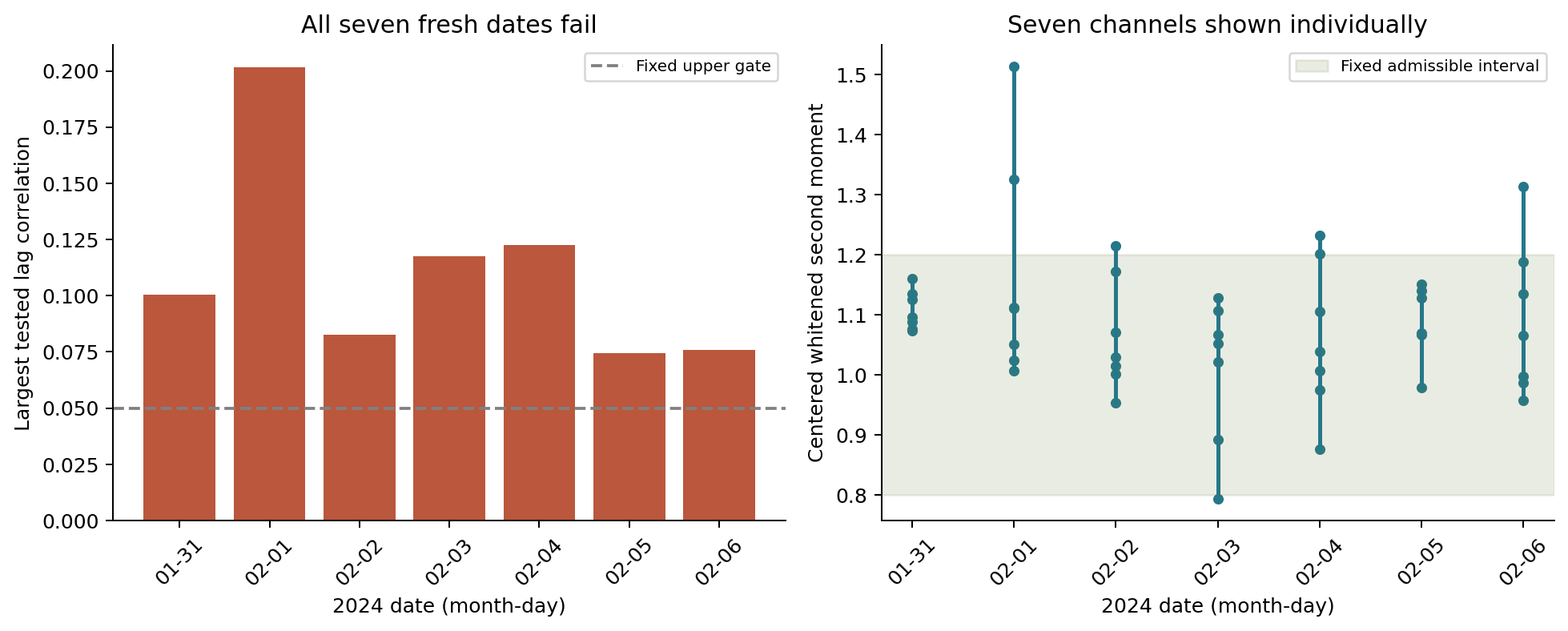
Unchanged clock model fails seven new daily adequacy tests
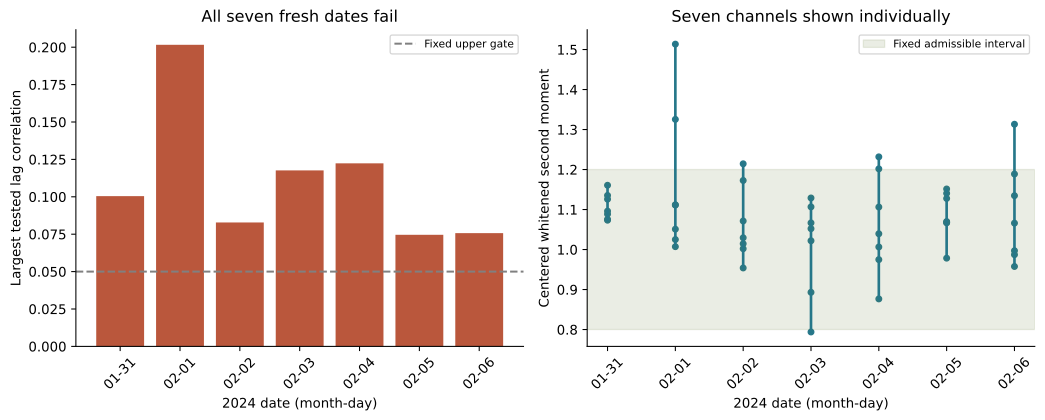
The dates, eight satellites, fixed January 28–29 coefficients/covariance, templates and gates were declared before acquisition. No fresh-day fitting or replacement occurs. All days pass input/processing controls, but every maximum across the seven tested cross-channel lags exceeds 0.05. Five dates also place at least one channel moment outside the strict 0.8–1.2 interval. These basis-dependent descriptive checks do not assume independent days or supply an event probability; failed noise adequacy prevents physical significance claims.
Data · Provenance · PNG · SVG
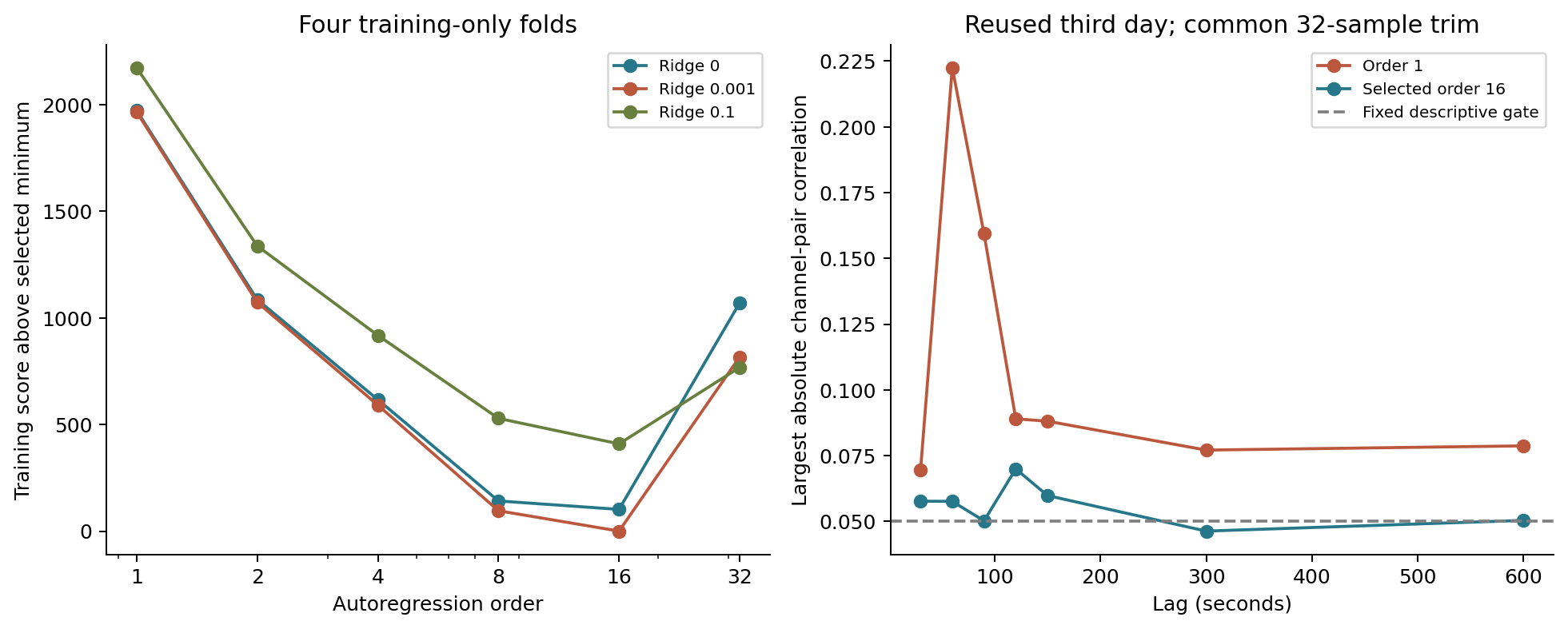
Training-selected clock filtering and a retained adequacy failure
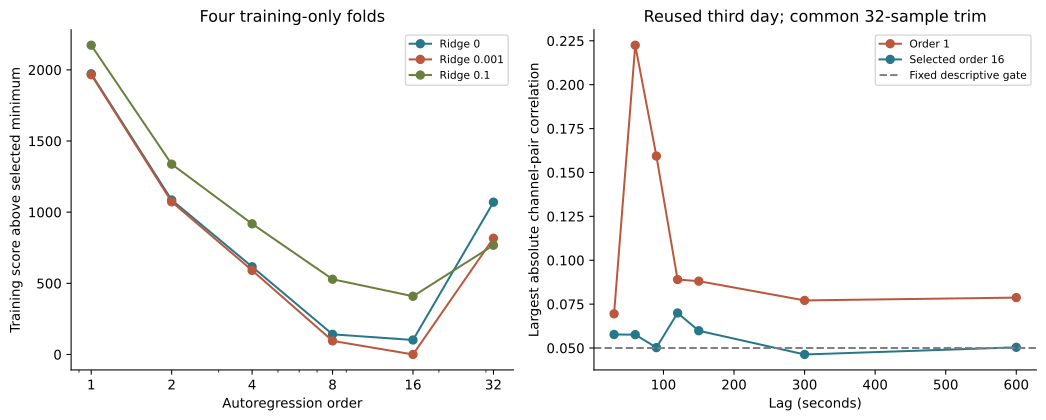
The left score includes filtered affine-nuisance determinants and identical conditioning intervals. Selection uses only the first two days; the third day was already inspected in the earlier analysis. The right curves show maxima across all channel pairs in the fixed contrast basis at seven declared lags, not an all-lag or basis-independent whitening certificate. Selected order 16 still exceeds the 0.05 correlation gate; a centered second moment of 1.20325 separately exceeds 1.2. The improved filter provides no calibrated event significance or physical exclusion.
Data · Provenance · PNG · SVG
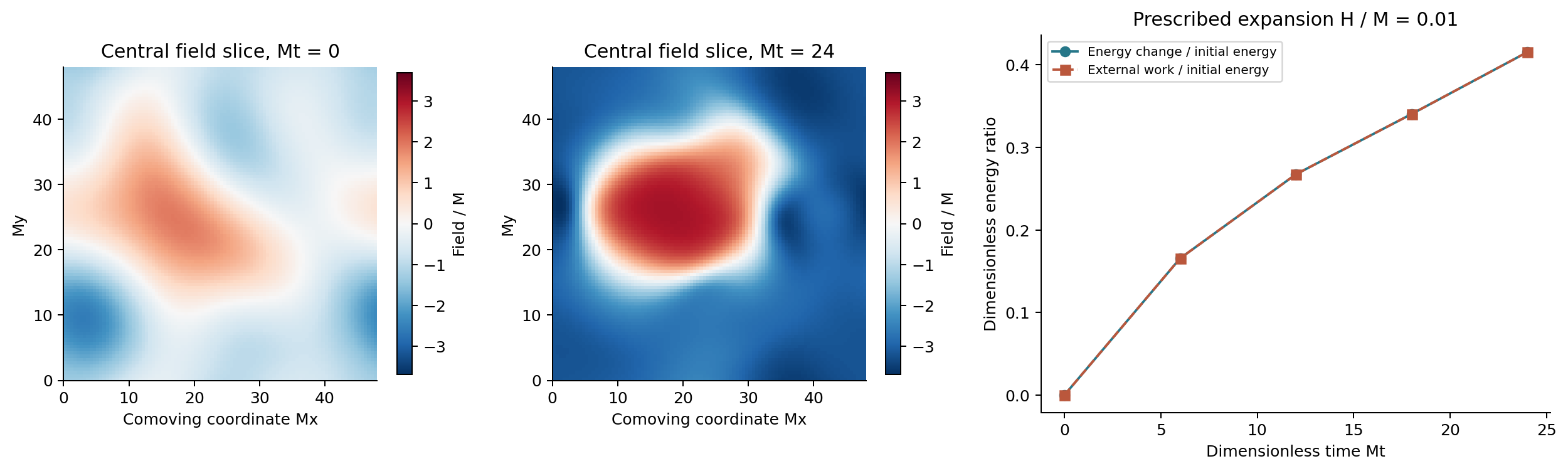
Conditional spatial wall dynamics and background work
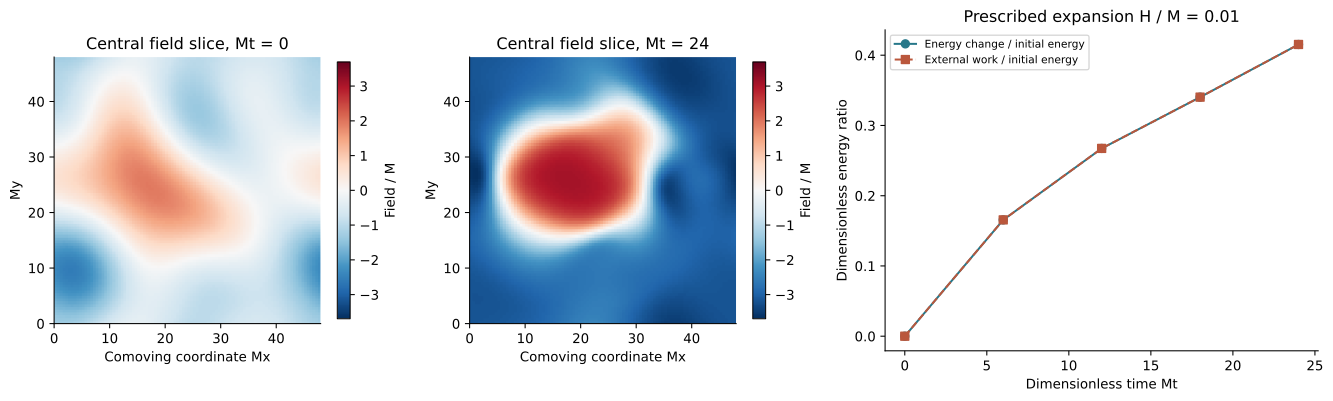
The two panels share one color scale and show the same comoving slice of a 96³ periodic field with prescribed a=exp(0.01 Mt), fixed reference mass M and zero initial canonical momentum. The right panel shows the finite-box energy rise supplied by external background work; the nearly overlapping curves do not indicate an isolated conserved scalar energy. All five cases have independent spatial/time controls. Initial fields are declared smooth realizations, not samples from a matched cosmological formation law. No outgoing radiation, physical abundance, reheating or infinite-volume prediction is supplied.
Data · Provenance · PNG · SVG
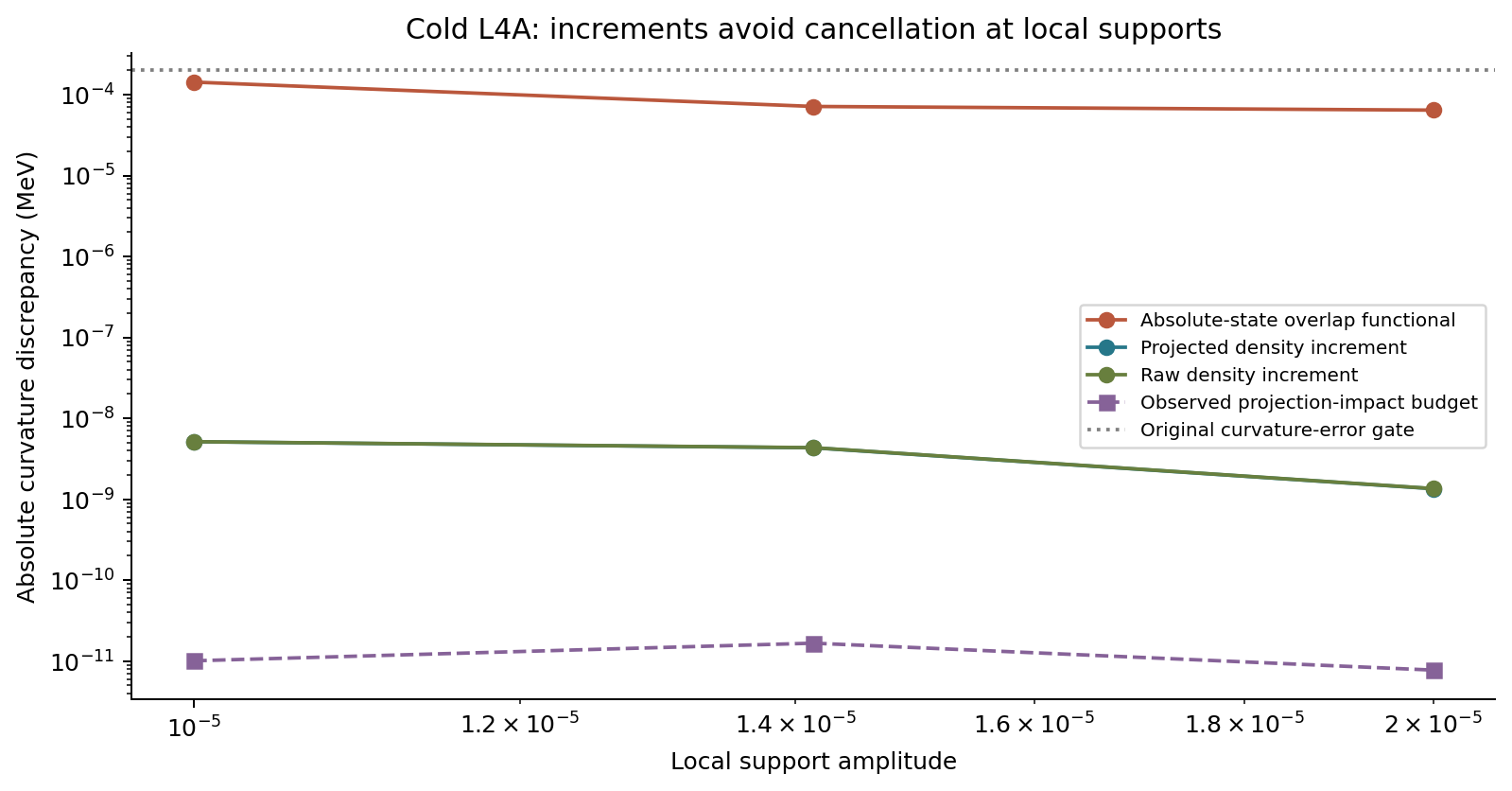
Precision-controlled local cold-state curvature
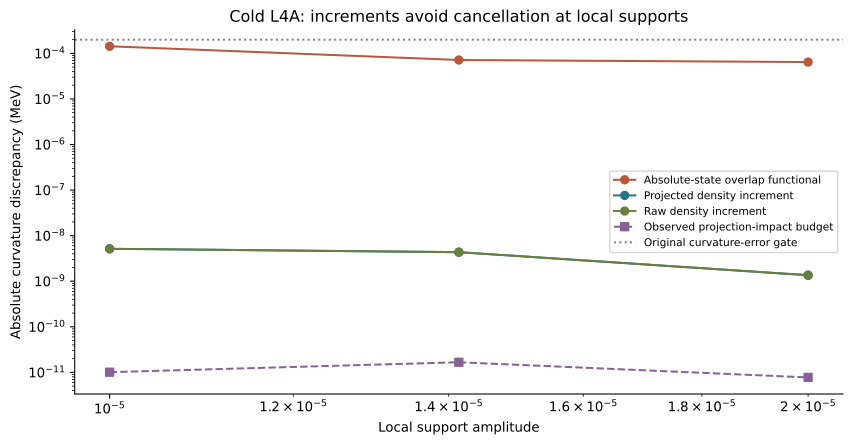
All methods use the same saved states and actual zero-support charge offset. The raw and projected increment curvatures separately pass the unchanged error and three-support-span gates, including a conservative budget for their observed difference. The older absolute-state overlap functional retains cancellation. The relative zero-node projection diagnostic remains failed; the plotted budget covers the measured projection effect, not every binary64 eigensolver error. No paired-root census or canonical phase follows.
Data · Provenance · PNG · SVG
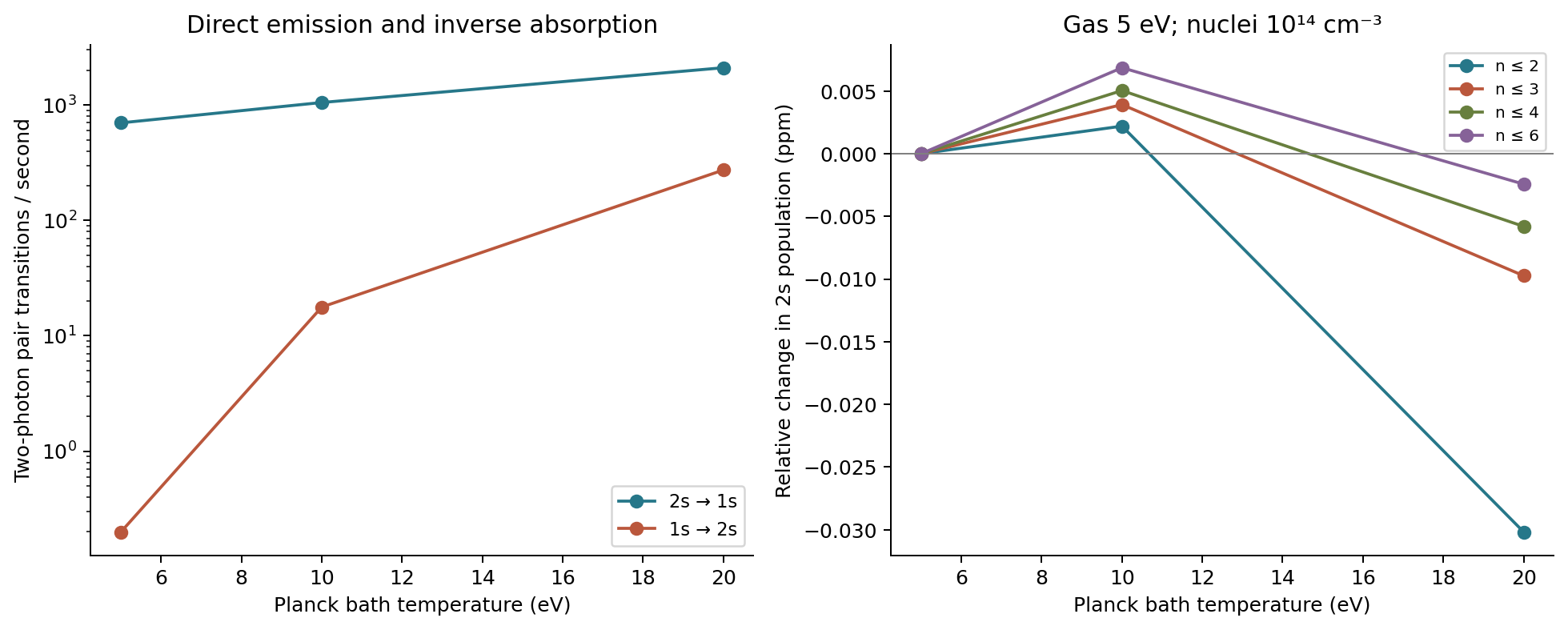
Two-photon balance and finite-network population changes
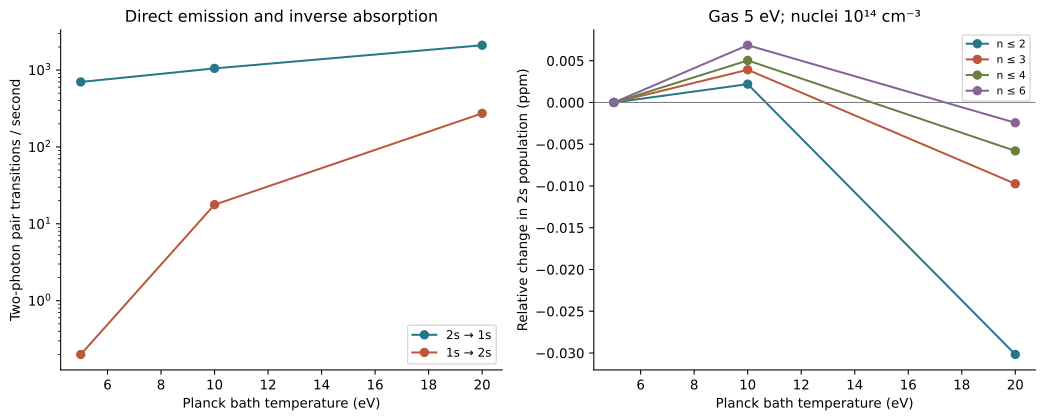
The approximate source spectrum is normalized to the quoted hydrogen rate and scaled by Z⁶ at infinite nuclear mass, matching the frozen E1 model. Direct integrals count photon pairs once and satisfy the independently checked Planck detailed-balance ratio. Lines connect only declared bath temperatures. The right panel compares finite equilibria with and without this channel; equal gas/photon temperature gives the same LTE population. Numerical quadrature precision does not bound spectral-fit or omitted atomic/plasma physics. Tiny transient changes below solver differences remain unresolved; no finite-ceiling convergence or closed radiation transport is claimed.
Data · Provenance · PNG · SVG
A repaired local curvature test at larger volume
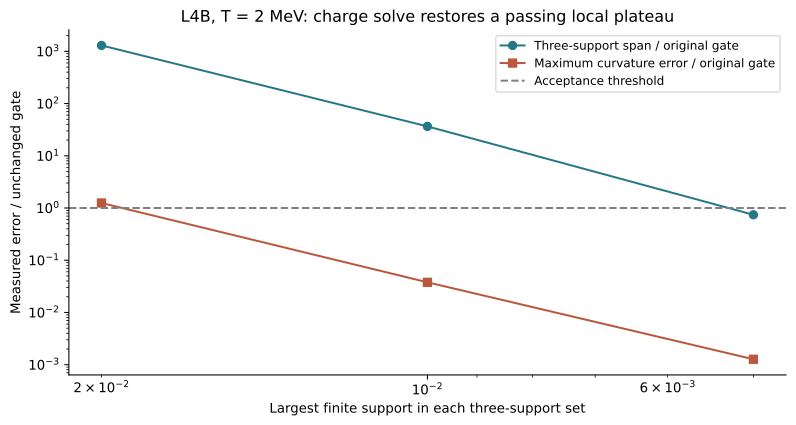
Only the analytic coupled mean-charge solve changes. Every coarser attempt, actual chemical work and original Hessian remain. At the finest accepted set the three-support span is 1.4837e-7 below 2e-7, and maximum curvature error is 2.5418e-7 below 2e-4. Smaller supports run from left to right. This is the L4B normal state, not a complete phase census. The colder L4A absolute-subtraction failure and later increment repair have separate records.
Data · Provenance · PNG · SVG
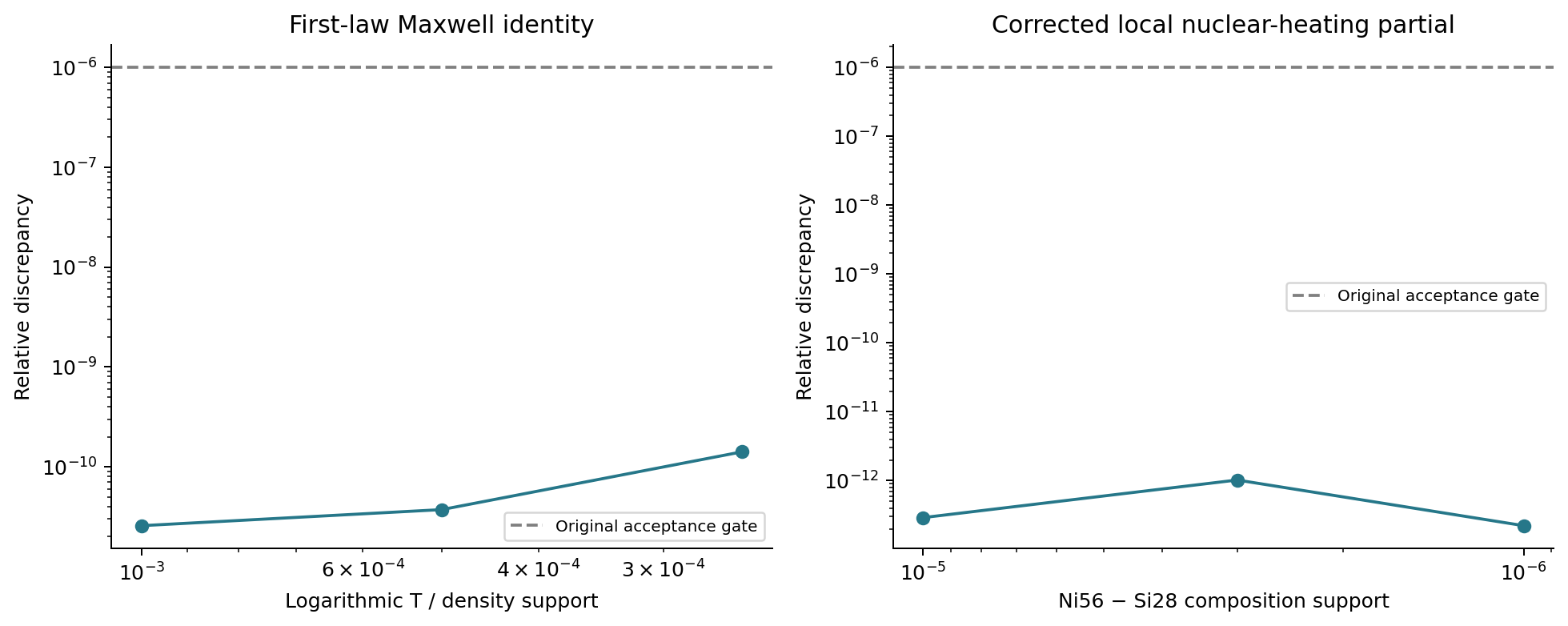
Ordinary thermodynamic and nuclear-energy controls
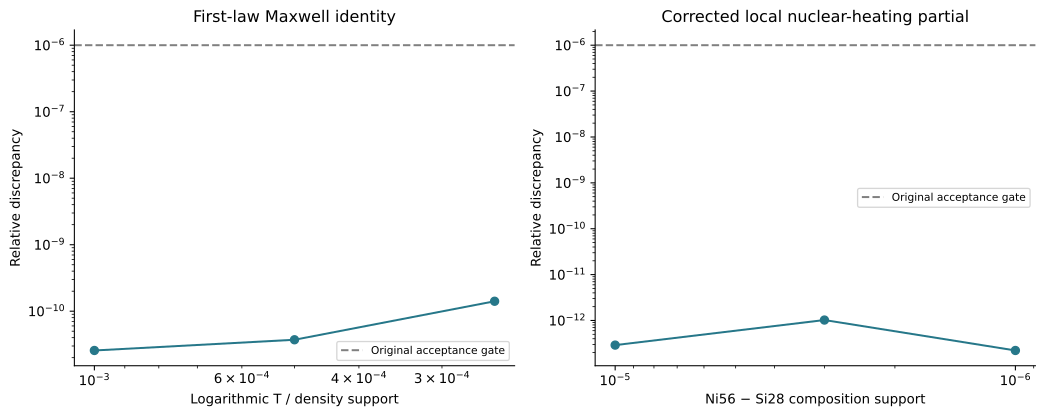
Fresh native values at one captured ordinary composition supply the Maxwell stencils; gas pressure is supplemented with radiation pressure to match total thermal energy. The nuclear partial uses the corrected native network with screening fixed and retains the Ni56 nuclear-neutrino loss derivative. These are distinct finite-support controls, not the full stellar Jacobian. The captured thermal-neutrino value is not differentiated, and no field-dependent microphysics or endpoint is supplied. Decreasing support exposes roundoff but remains well within the fixed gates.
Data · Provenance · PNG · SVG
Ordinary weak-current recoil and a separate muon benchmark
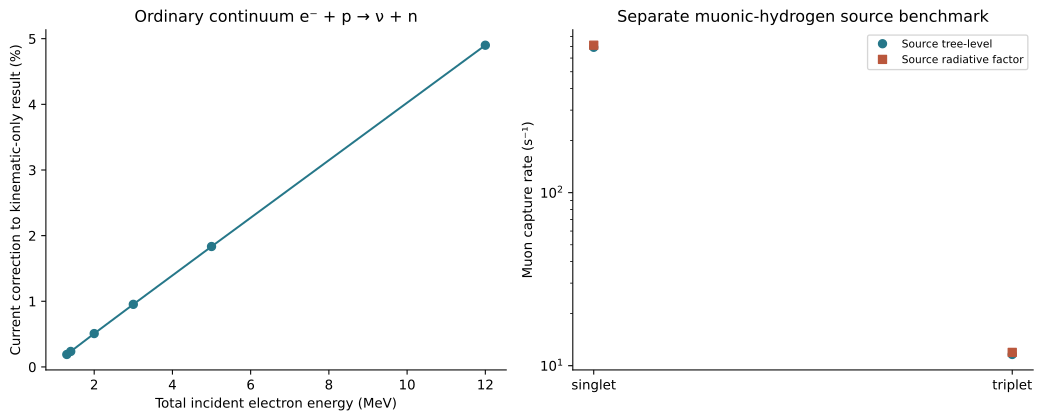
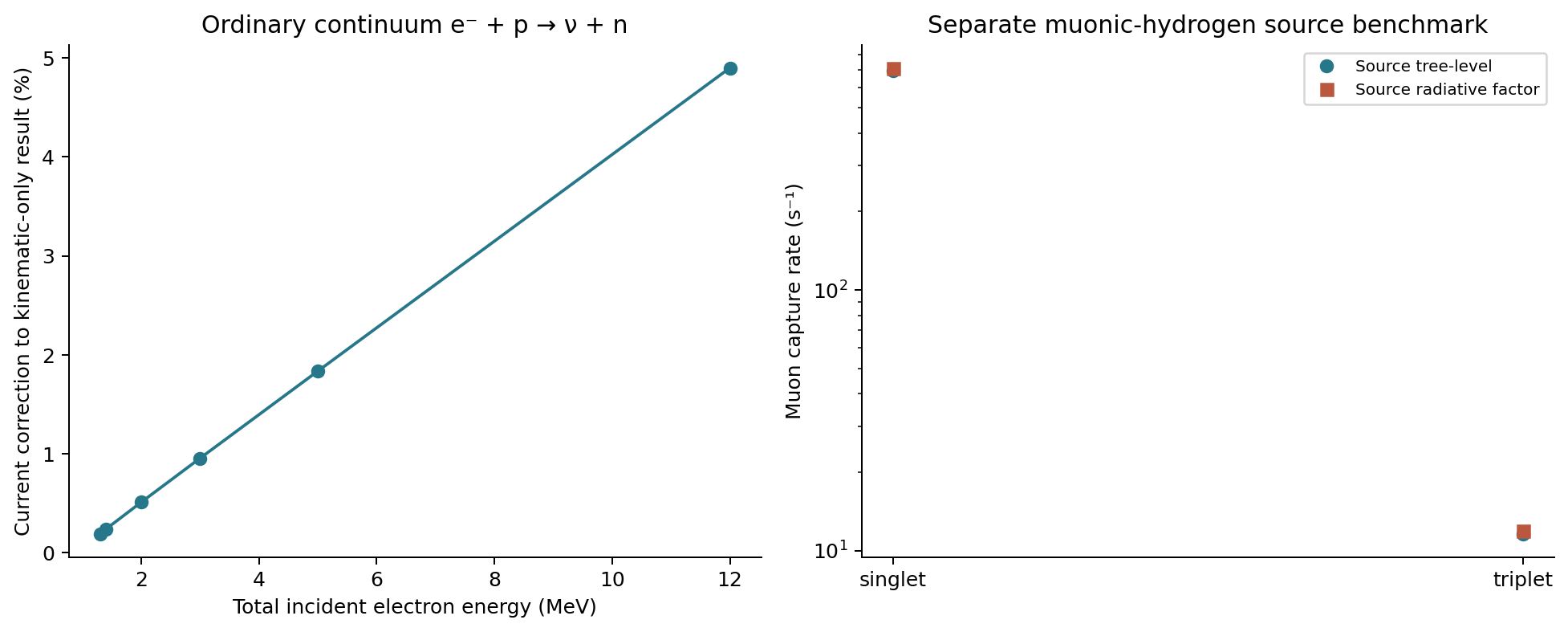
Electronic rates use a constant point-current f1/g1/f2 benchmark with no induced pseudoscalar, atomic wavefunction or QED correction. Exact tree-level recoil includes currents and external-state normalization, not only the phase-space Jacobian. The muon panel separately uses the published finite-q current, finite-size contact and rounded1.028 radiative factor; it reproduces a source calculation rather than computing new loops. None of those muon corrections is borrowed for the electron/trinucleon atomic lifetime.
Data · Provenance · PNG · SVG
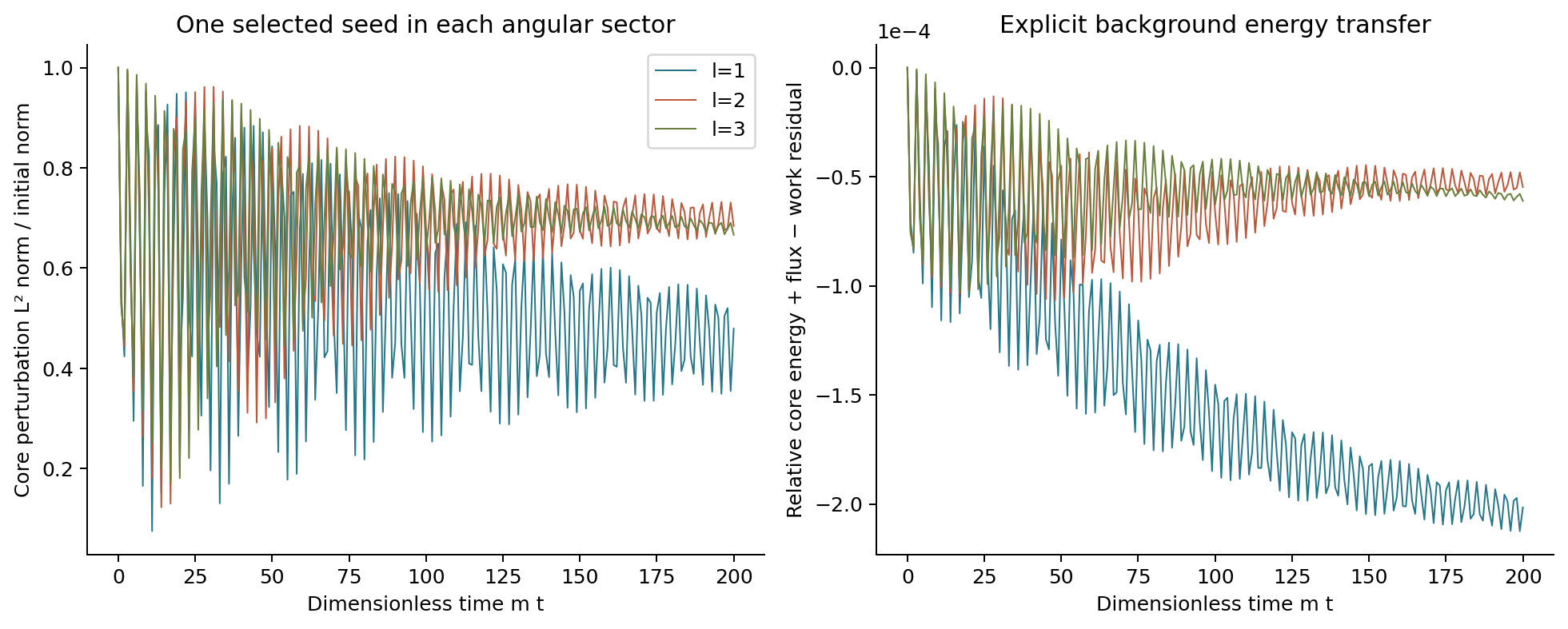
Finite-time angular field perturbations with work and flux accounting
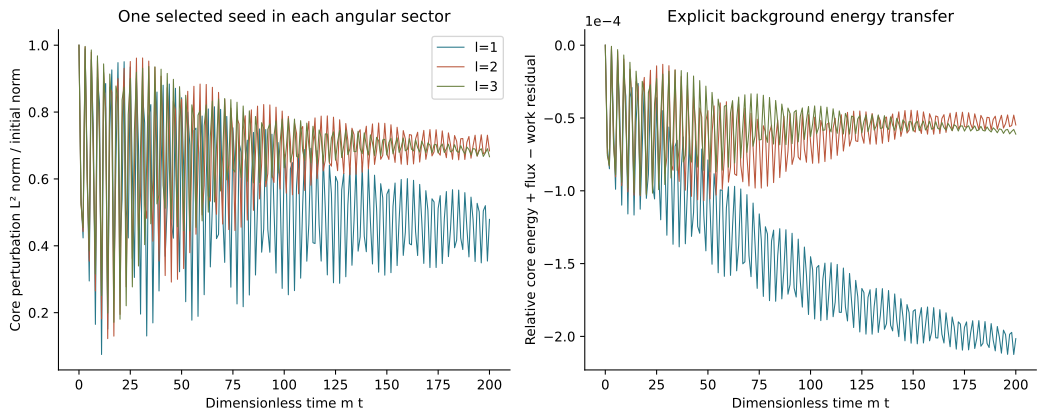
Linear l=1,2,3 perturbations evolve on a radial canonical phi-six background for200 inverse-mass units. Unit angular norm and the canonical radial core-energy boundary convention are explicit. The l=1 seed tests translations; l=2/3 are particular finite seeds. Independent adaptive integration and grid/time/box controls verify these curves. Work from the time-dependent background is retained. Boundary absorption does not yet define a radiation lifetime. Finite-time seeded behavior supplies neither full nonlinear/Floquet stability nor physical formation, abundance or a gravitational signal.
Data · Provenance · PNG · SVG
A coupled screened charged three-body outgoing-flux calculation
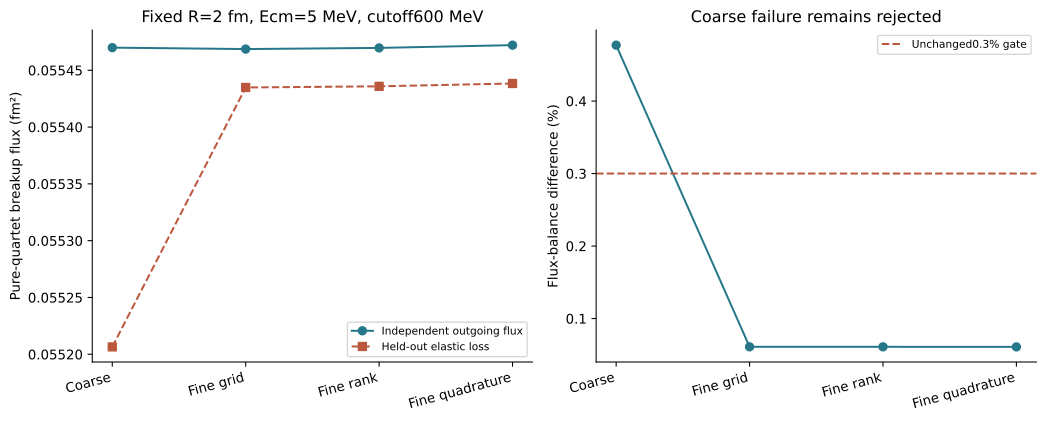
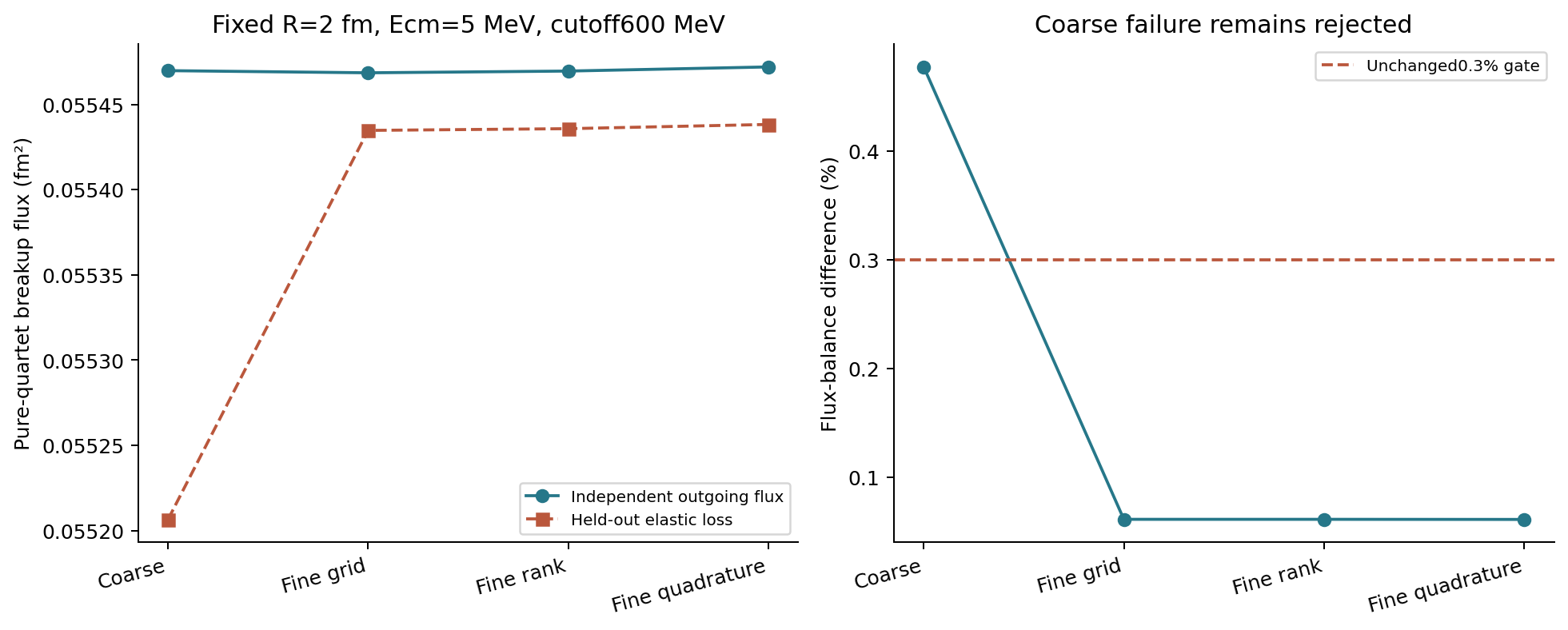
Actual off-shell pp Coulomb scattering and reciprocal npS/ppP Faddeev components supply the outgoing amplitude, including antisymmetric proton exchange. The normalization is not fitted to elastic loss. The failed coarse comparison is shown as a refinement control, never accepted evidence. The final finite-screen model passes unchanged numerical gates; pp higher odd waves, screening removal, spin-doublet channels and corresponding three-body forces are absent. This is not full unscreened proton–deuteron breakup or an EFT error estimate.
Data · Provenance · PNG · SVG
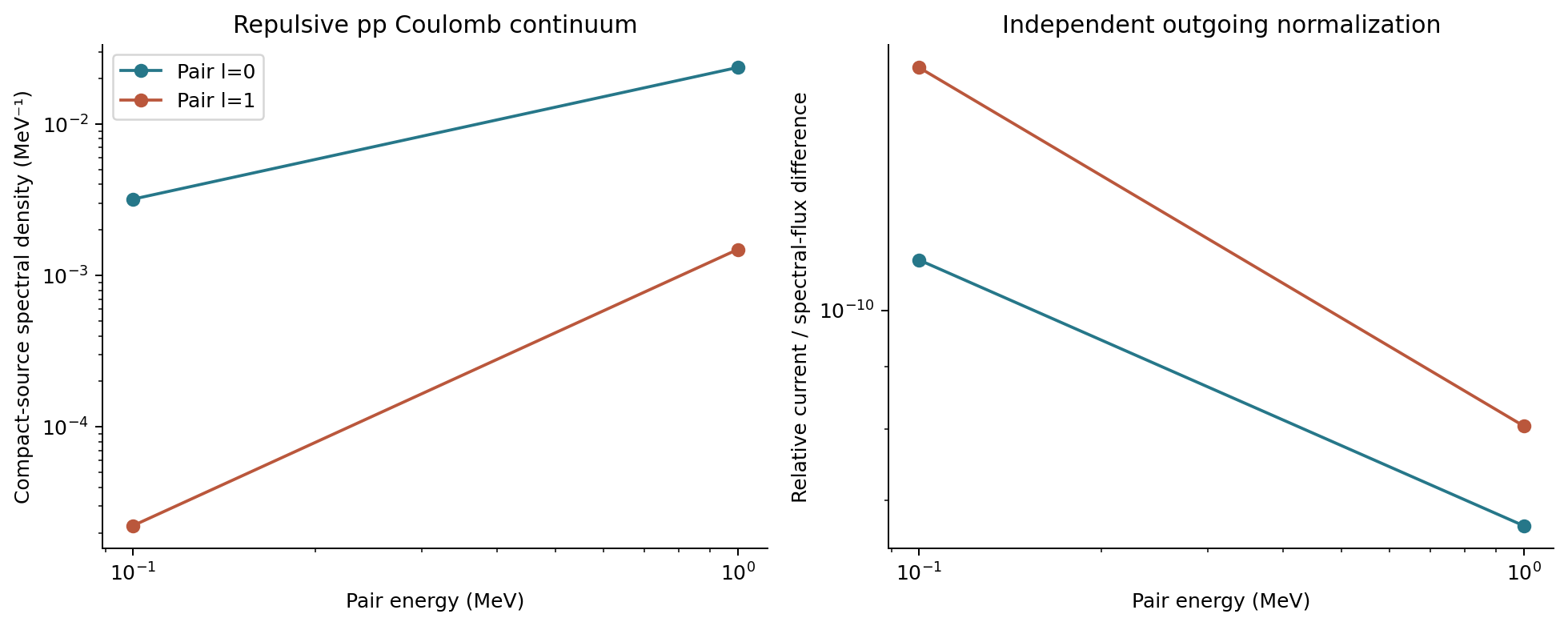
Charged two-body outgoing flux and spectral cut
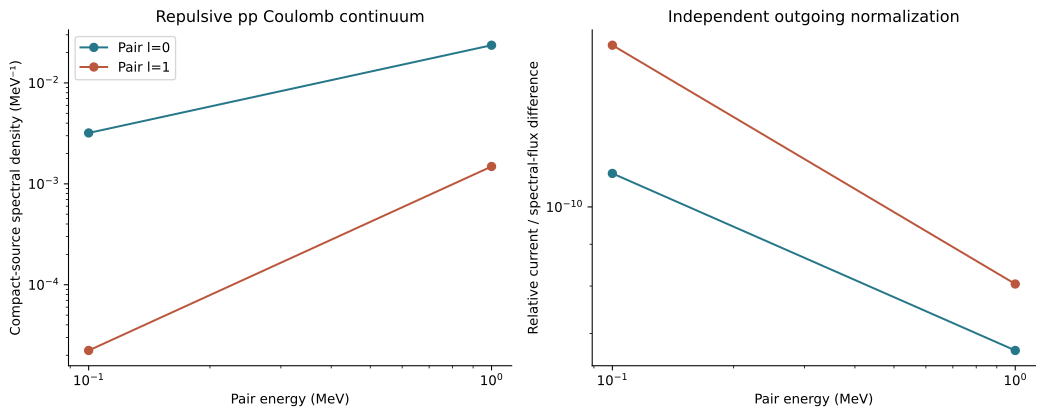
A unit-normalized compact radial source drives the repulsive pp Coulomb Hamiltonian with no pp nuclear interaction. Independent driven-wave current, resolvent cut and regular-Coulomb spectral density agree. l=0 and l=1 have distinct Pauli spin contexts. Screening radii through 320 fm control the flux; a separate phase supplement requires 2560 fm. This supplies a two-body building block, not a proton–deuteron breakup cross section or a physical formation rate.
Data · Provenance · PNG · SVG
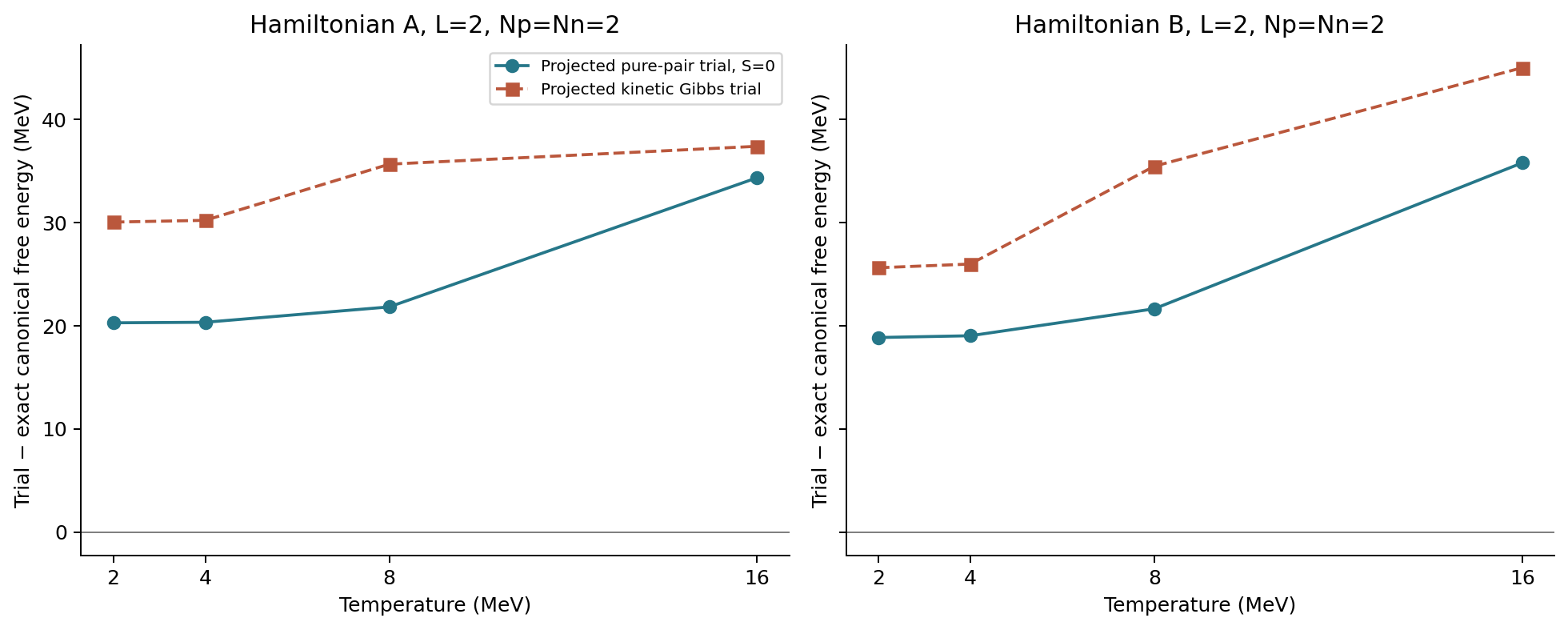
Exact particle numbers and compatible variational comparisons
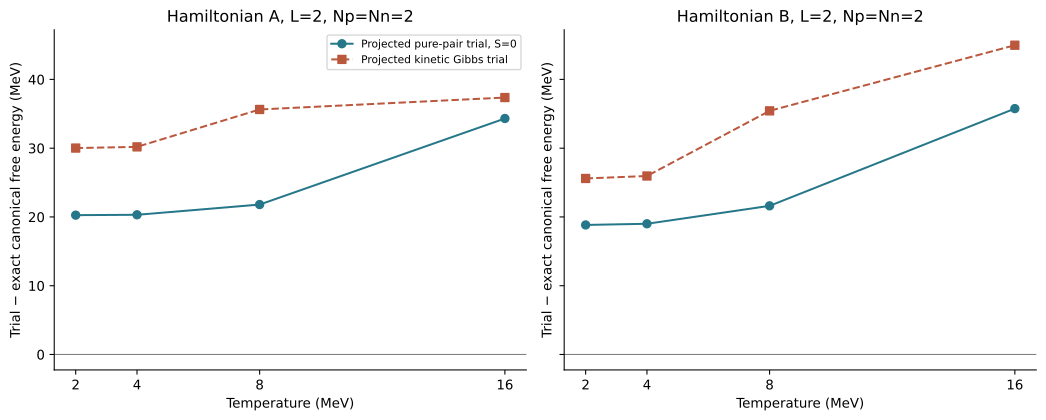
Every curve uses the same finite-box Hamiltonian and exact proton/neutron numbers as its canonical reference. Four-particle Pfaffians project pure Gaussian trials; their entropy is zero. The displayed pure-pair state is the lowest valid sampled trial, with a nonzero optimization gradient; it is not a stationary minimum. Complete fixed-charge traces provide the exact canonical baseline. These upper bounds and internal-ground projectors do not give projected mixed-state pair entropy, a thermodynamic phase boundary or a comparison with the different L=3 mean-number ensemble.
Data · Provenance · PNG · SVG
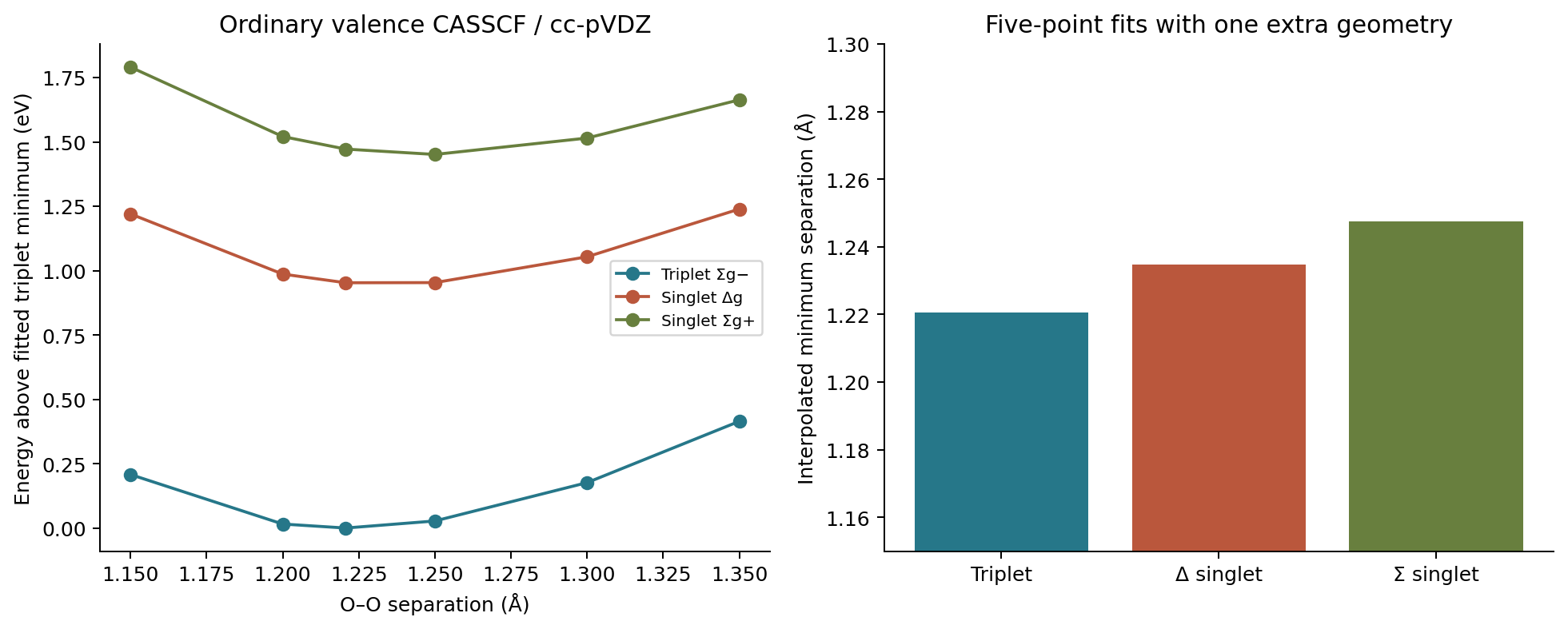
Ordinary oxygen state ordering with multireference controls
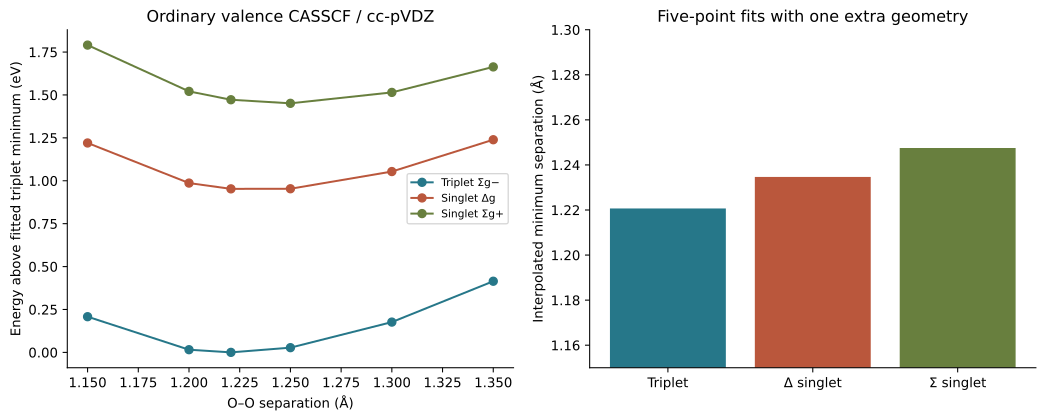
The nonrelativistic clamped-nucleus Hamiltonian uses frozen-core CAS(12e,8o)/cc-pVDZ. Triplet orbitals are optimized separately; two Δ components and the Σ singlet share equal-weight optimized orbitals. Independent minimal-basis all-electron FCI and explicit determinant/spin checks reproduce the ordering. Smaller-active-space gap shifts remain substantial; dynamic correlation and basis convergence are unestablished. The bond fits do not supply a general reaction path, finite-field response, spin–orbit or thermal population model.
Data · Provenance · PNG · SVG
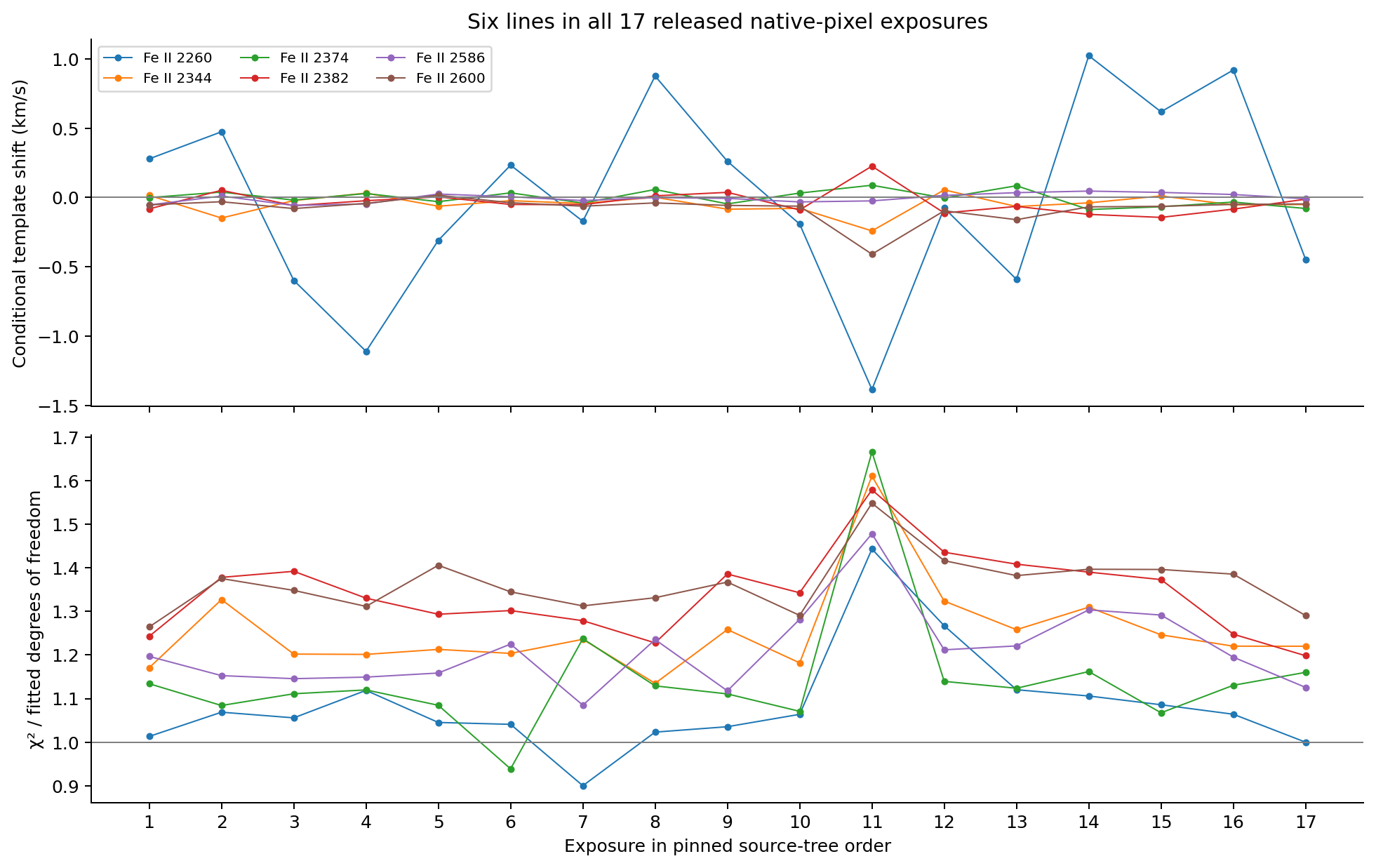
Native-pixel registration across the complete released exposure set
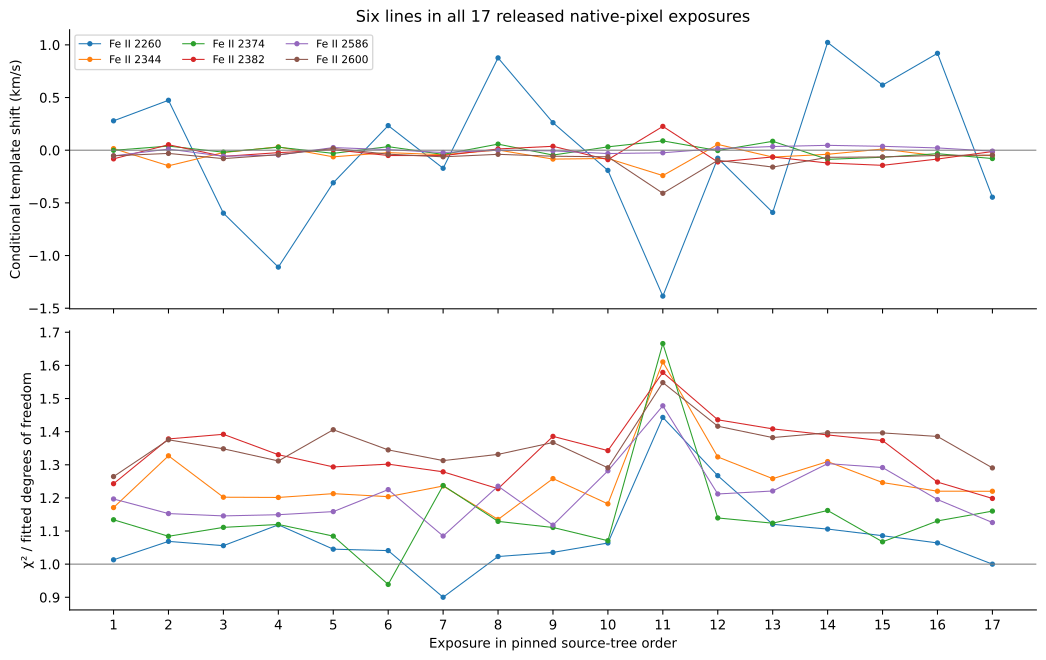
Each fit holds all 45 source components, terrestrial isotopes, alpha and the declared Gaussian coadd LSF fixed; trace/order quadratic continua are profiled. The template integrates in delivered vacuum barycentric wavelength without resampling or a second barycentric correction. Independent template, raw-pixel, weighted-integral and nuisance-projection controls pass. Shifts combine source-template and instrumental effects; conditional Fisher precision omits their covariance. Lines join exposure indices only. The nonstationary free-component fit supplies no new alpha interval.
Data · Provenance · PNG · SVG
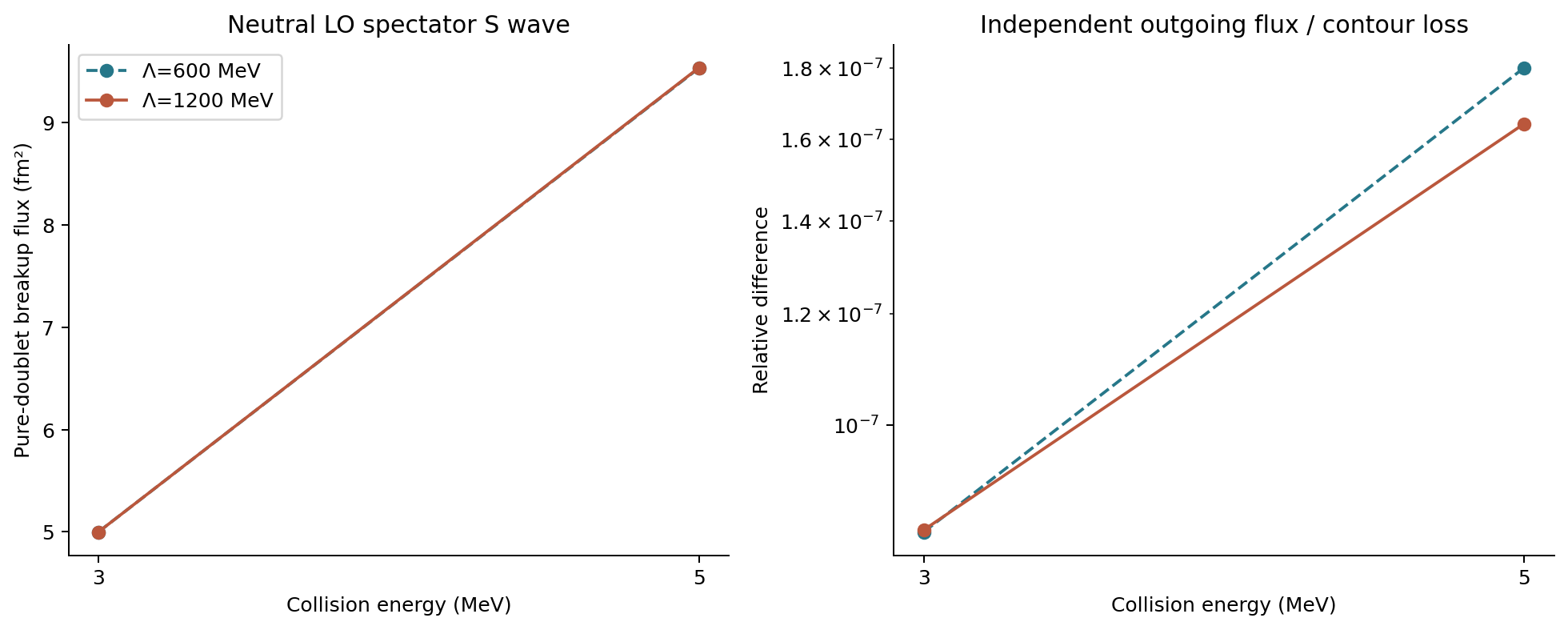
An independent outgoing doublet breakup calculation
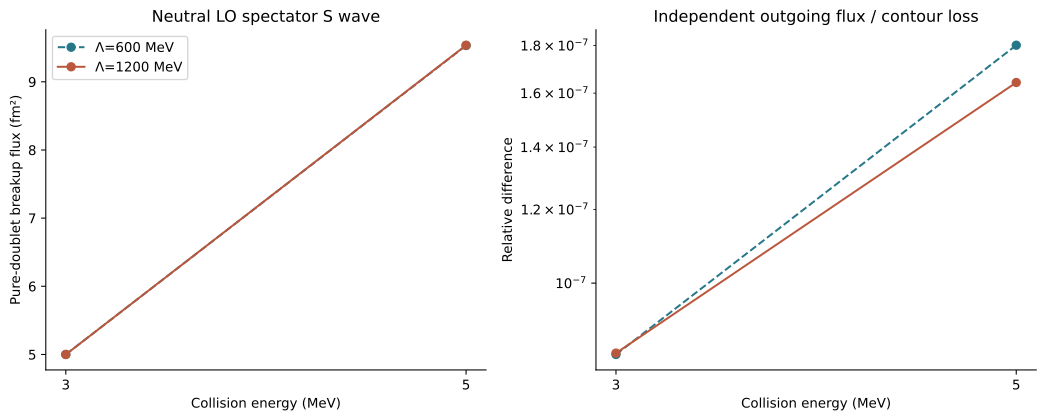
Explicit antisymmetric charge/spin amplitudes and the independently calibrated three-body force determine the neutral LO l=0 flux. Multiply pure-doublet values by 1/3 for an unpolarized cross section. The right panel compares a separately solved contour elastic loss; normalization was not fitted to it. Nearly coincident cutoff curves are not an EFT uncertainty band. Higher doublet waves, complete wave remainders and unscreened spin-complete charged flux remain unfinished.
Data · Provenance · PNG · SVG
Cold paired local minima with a coupled stability certificate
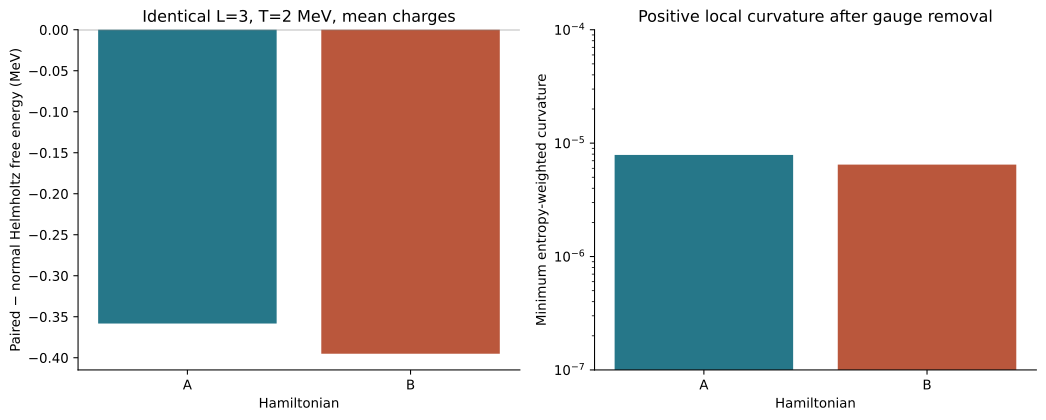
Both roots use mean Np=Nn=3.375 and exclude pn-coherent normal densities. A positive enlarged all-channel entropy-weighted Hessian with zero pn-normal interaction is sufficient for positivity on the restricted tangent space; it is not a new physical interaction. The single broken pair gauge is removed with its covariant field response. Independent finite paths resolve the small positive soft curvatures. Local finite-box Gaussian stability and free-energy lowering do not establish exact-number or thermodynamic phase competition.
Data · Provenance · PNG · SVG
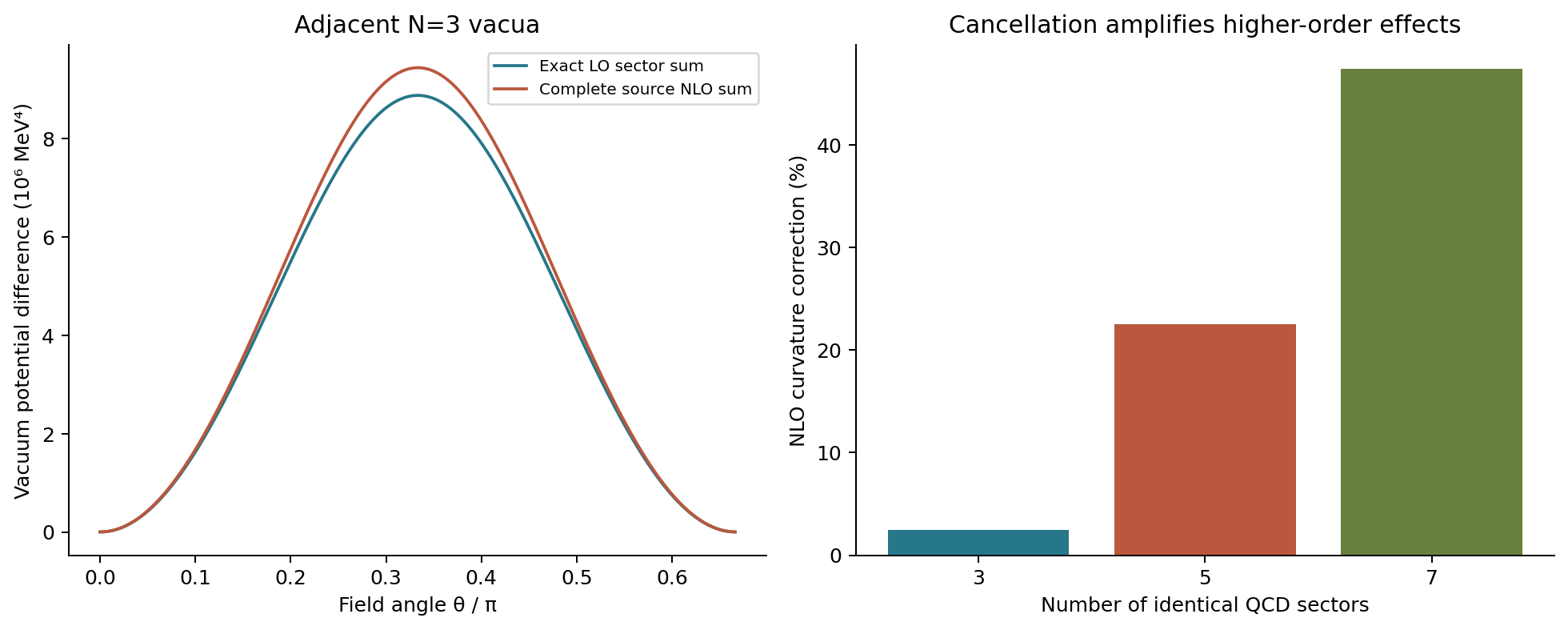
Discrete-sector vacuum matching and quantum corrections
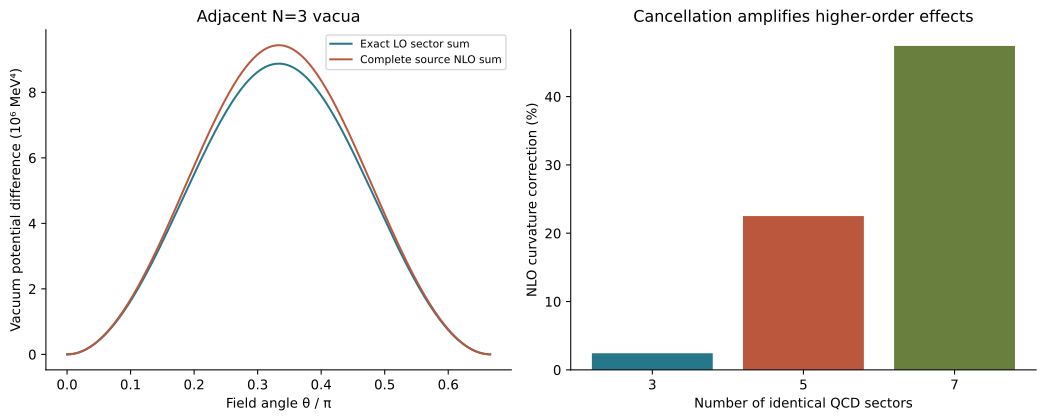
Exact cyclic sector sums use one fixed set of declared chiral inputs. No added tilt or vacuum cancellation is fitted. Renormalization-scale and h-combination terms cancel from potential differences, while the l7 and pion-loop contributions remain. The N=3 correction is modest; N=5 and 7 require further order control. The plotted vacuum quantities do not provide interacting dense matter, formation, abundance, nuclear currents or an observationally viable object.
Data · Provenance · PNG · SVG
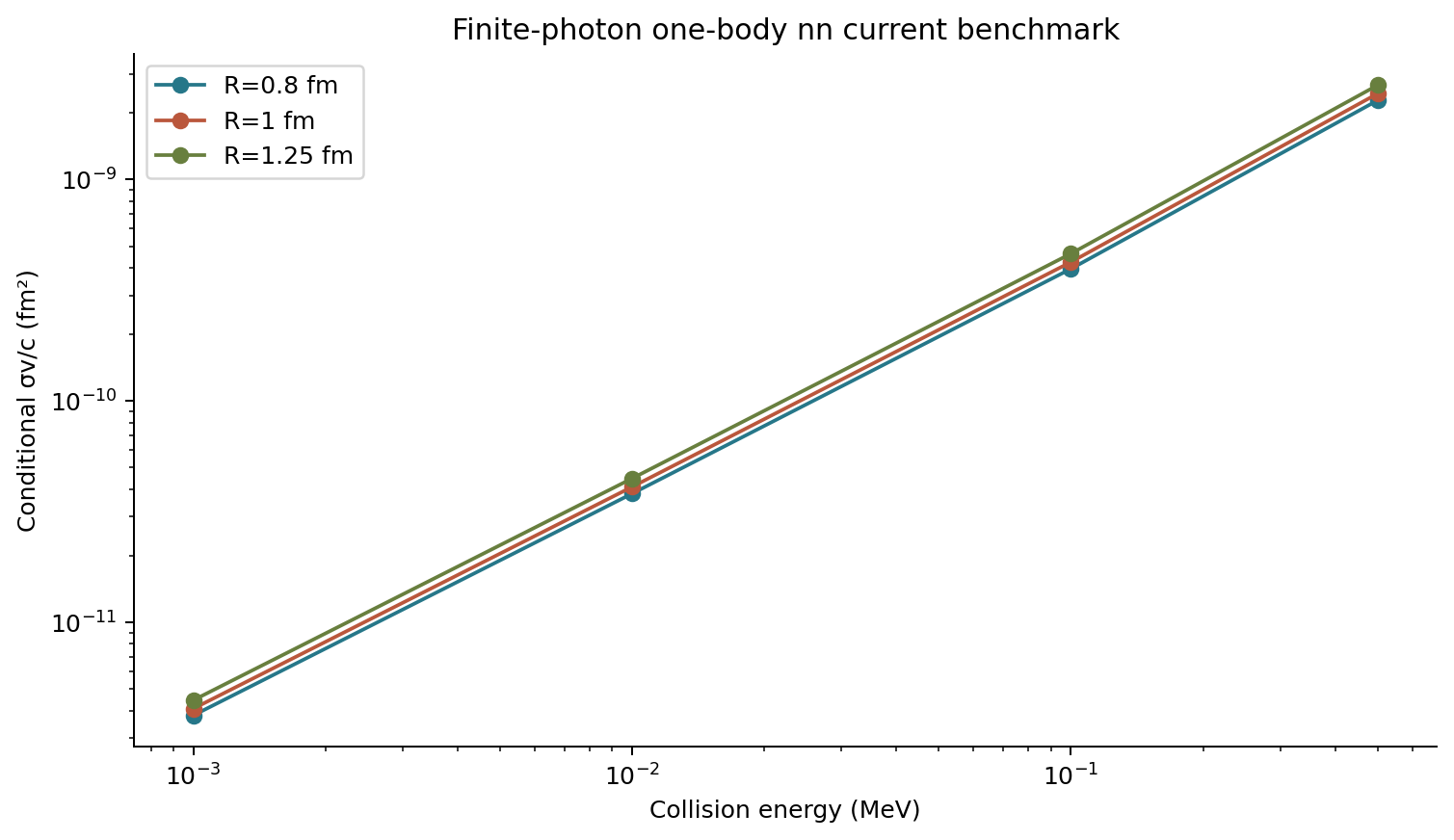
Conditional finite-photon dineutron capture with independent normalization
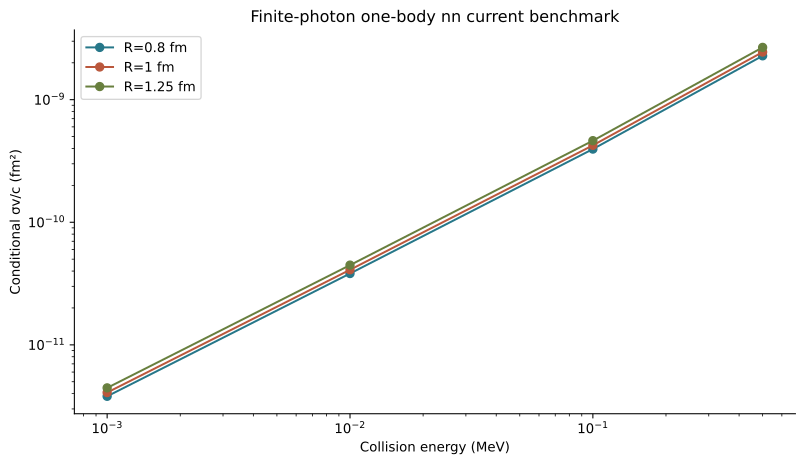
Hypothetical Bnn=2.5-MeV projected singlet-S Gaussian Hamiltonians and free odd-triplet incidence; the ordinary neutron magnetic moment enters a transverse one-body Pauli current. Identical incoming-state normalization, initial spin averaging, photon recoil, radial and angular/multipole controls are explicit. Values are fixed-energy σv/c in fm², not Maxwell-averaged rates. Range dependence is a model comparison. Relativistic electric spin-orbit operators, two-body currents, physical odd-wave forces and finite-field coefficients remain unestablished; no matched total capture prediction or network insertion is justified.
Data · Provenance · PNG · SVG
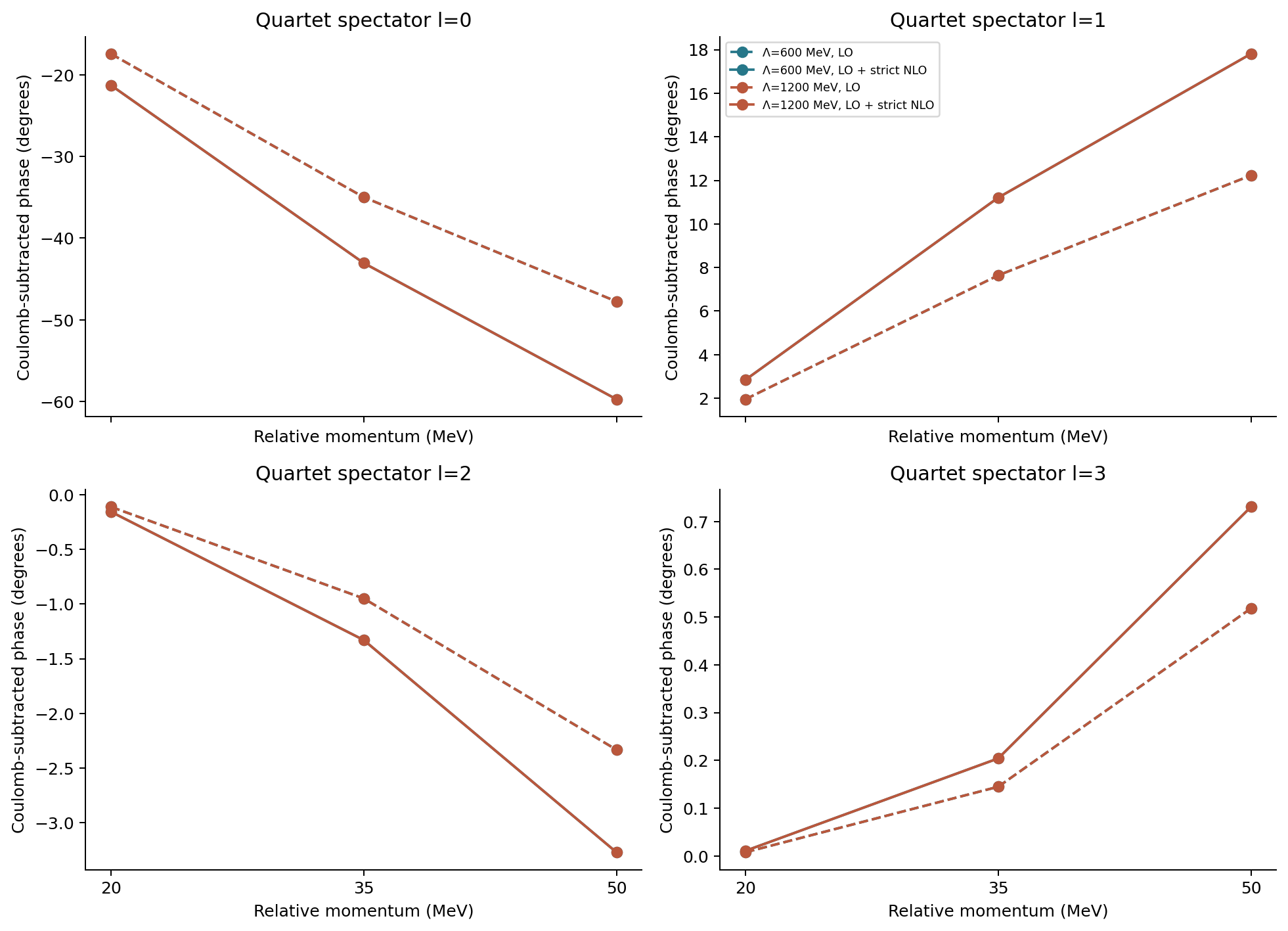
Charged quartet elastic waves through F wave below breakup
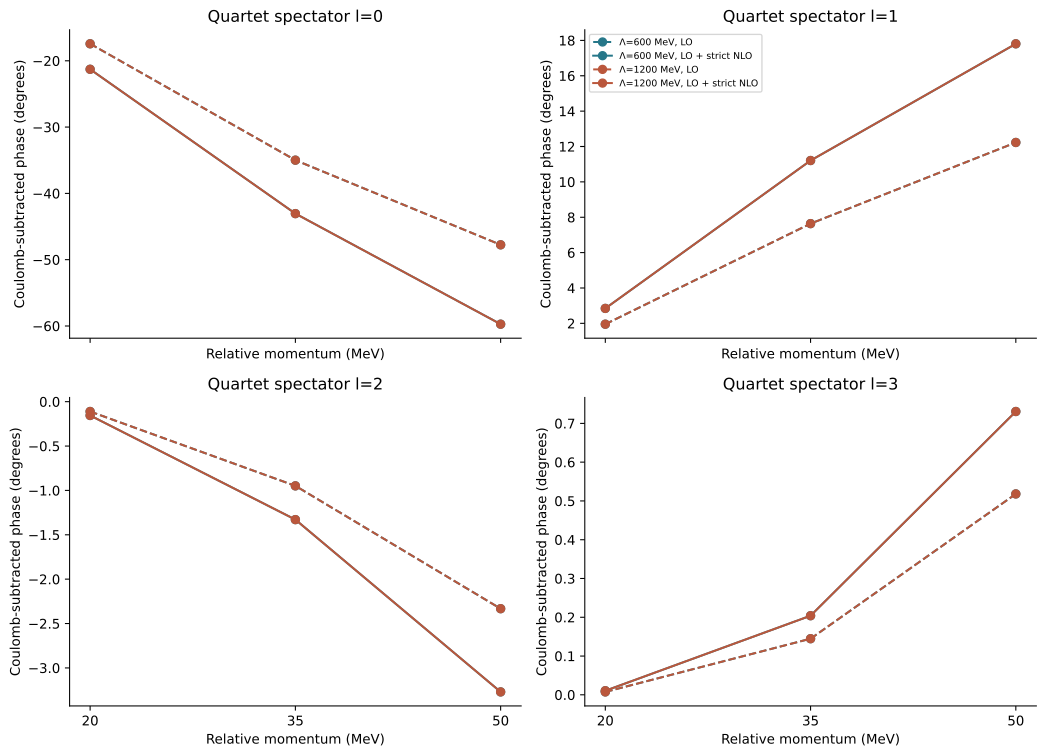
Scalar spin-quartet S/P/D/F spectator equations use independently projected exchange, photon bubble/box and one strict range/gauged-range insertion. NN pair forces remain S wave. Pure composite-deuteron Coulomb is subtracted at identical grids and photon masses. The last three of four finite-screen results define the linear intercept; all four test fit-window sensitivity. Two cutoff curves nearly overlap; this is not an EFT uncertainty estimate. All shown k lie below three-body breakup. No charged breakup flux, spin-orbit splitting, higher-photon accuracy or complete formation rate is supplied.
Data · Provenance · PNG · SVG
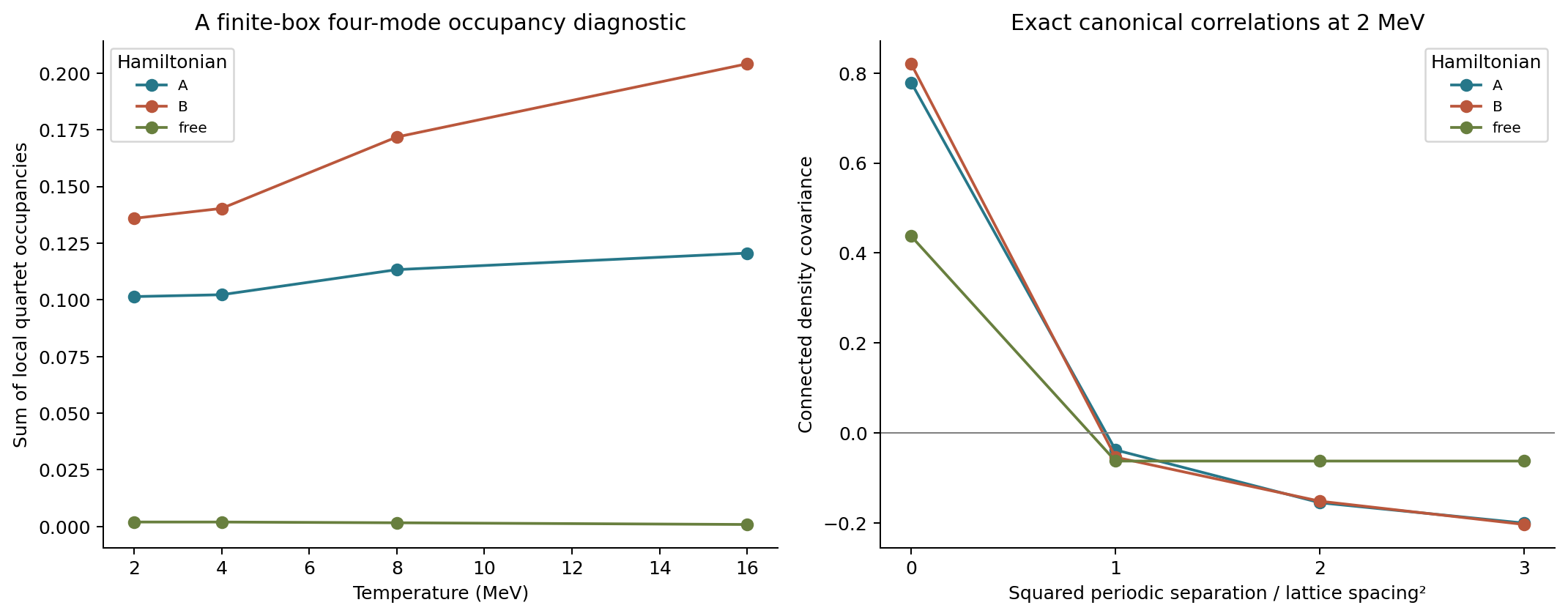
Exact four-nucleon thermal density and quartet correlations
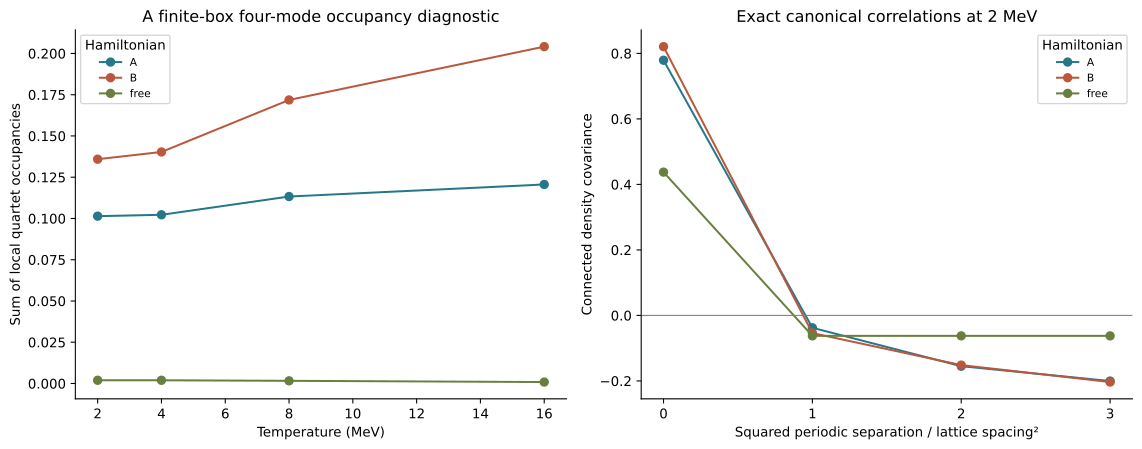
All 14,400 fixed-charge states at L=2, Np=Nn=2 contribute, including all eight momenta and spin sectors. A/B interactions reproduce complete frozen parent spectra; free means the same kinetic Hamiltonian without interactions. Connected covariance is dimensionless and has a zero multiplicity-weighted sum from exact number conservation. The quartet projector counts occupancy of all four local modes; it is not an alpha-state overlap, abundance or multi-alpha phase order parameter. Temperature dependence in one small box supplies no thermodynamic phase boundary.
Data · Provenance · PNG · SVG
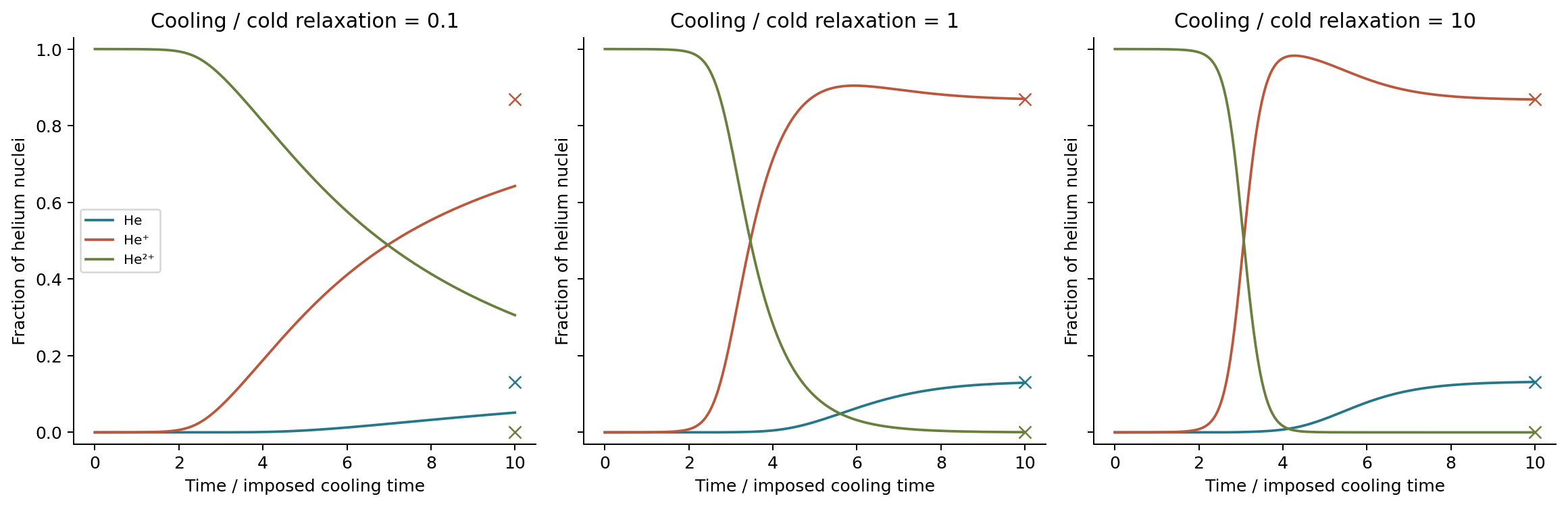
Helium charge populations lag a prescribed rapid cooling history
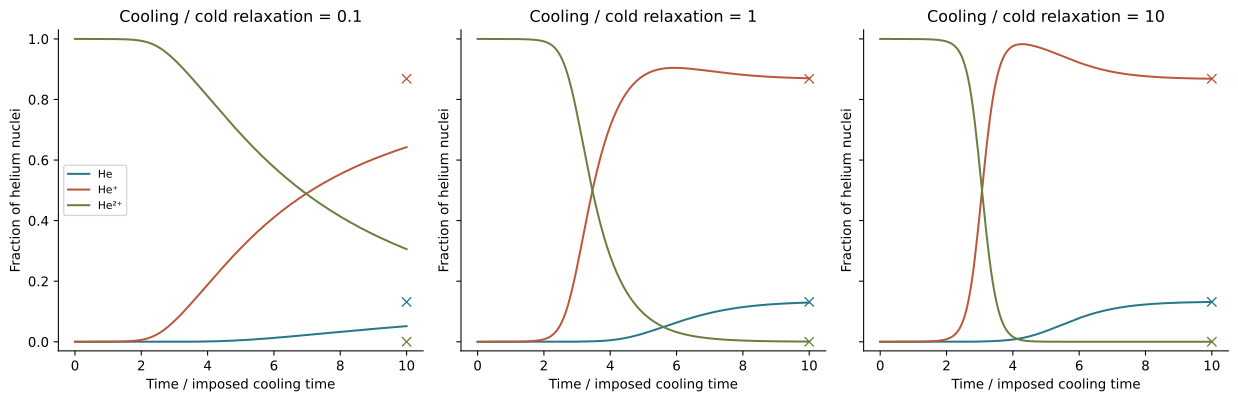
Published ordinary ground-state Maxwellian CI/RR/DR fits at fixed helium density 10¹¹ cm⁻³. Electron density follows charge neutrality; temperature is prescribed as 3+77 exp(−t/t_env) eV. Crosses at the final time mark instantaneous coronal equilibrium, not Saha equilibrium. The three time axes are separately scaled. No clipping or population renormalization is used. Source-fit differences exceed integration error; omitted metastables, radiation transfer and density corrections remain unquantified. No weak capture or field-specific history is supplied.
Data · Provenance · PNG · SVG
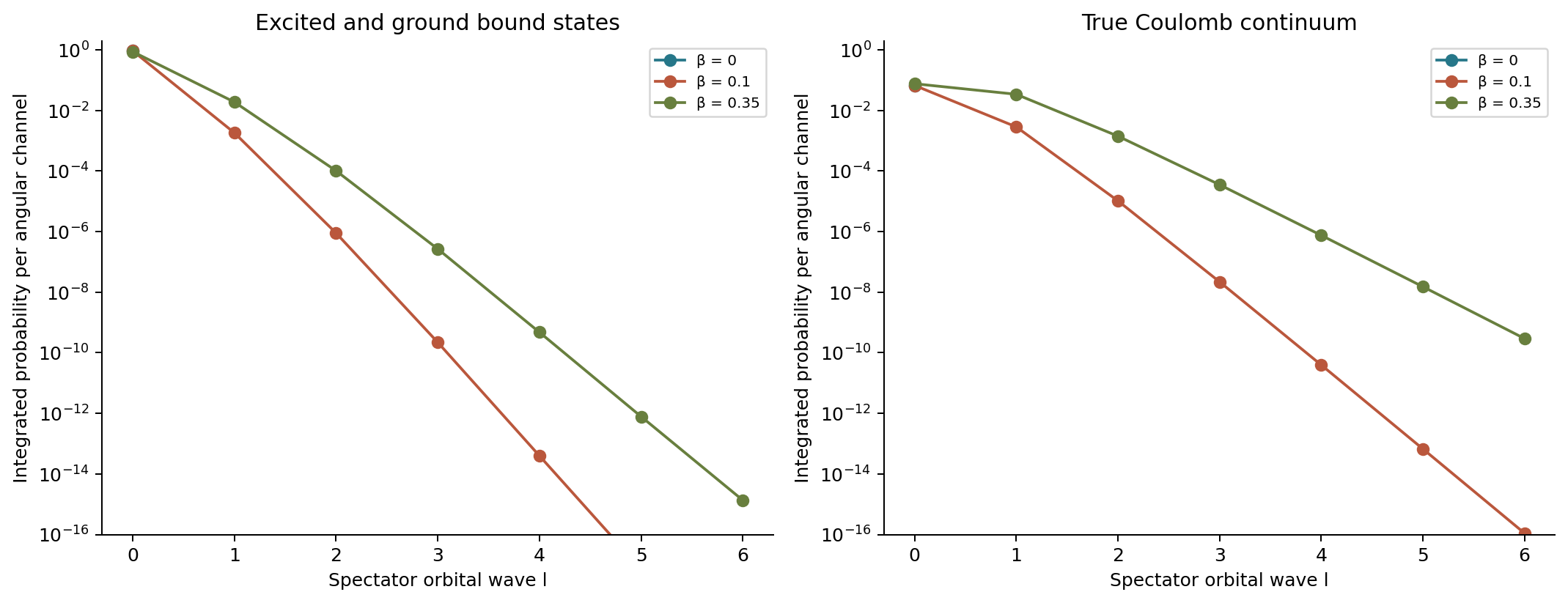
Boost redistributes spectator probability across bound and continuum channels
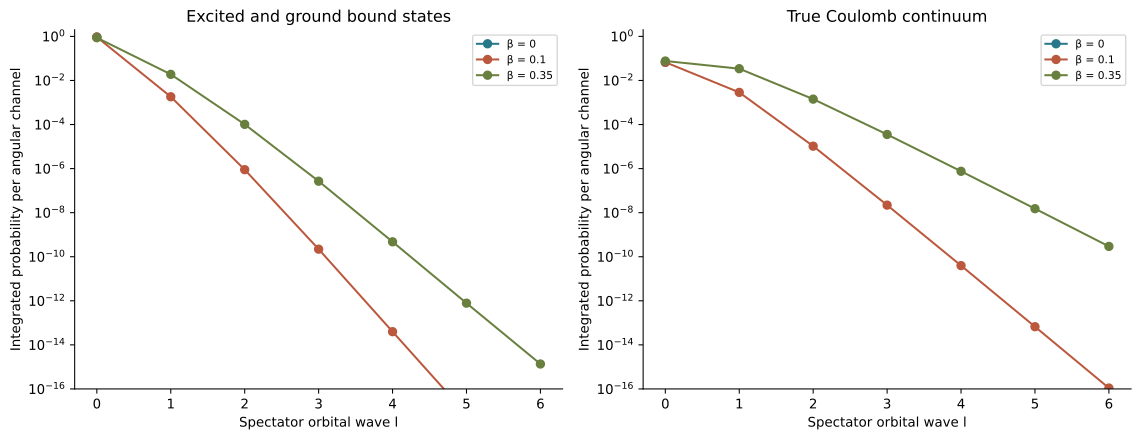
The unitary operator exp(iβz) acts on the normalized inherited coalescence state; β is in inverse Bohr radii and l-channel probabilities include all magnetic orientations. Bound states run to n=800; delta-k Coulomb continua use 512 points. Zero probabilities are omitted on the log axis. The maximum displayed normalization deficit is below 2e-7 and is not renormalized. β=0.35 is a spectral stress control. This is an atomic normalization and kinematics calculation, not a weak lifetime or a measured spectrum.
Data · Provenance · PNG · SVG
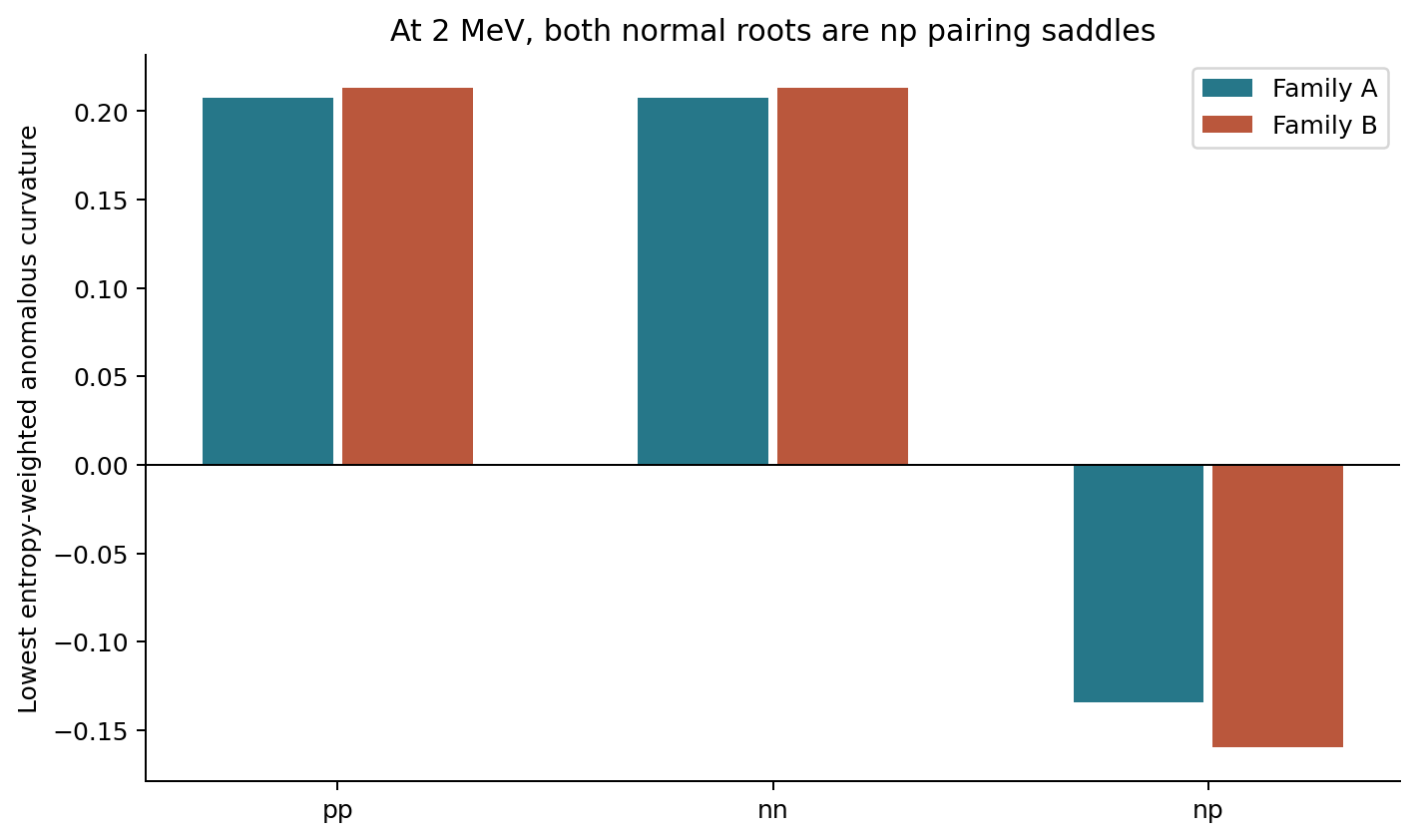
Independent cold normal-root pairing audits find an np instability
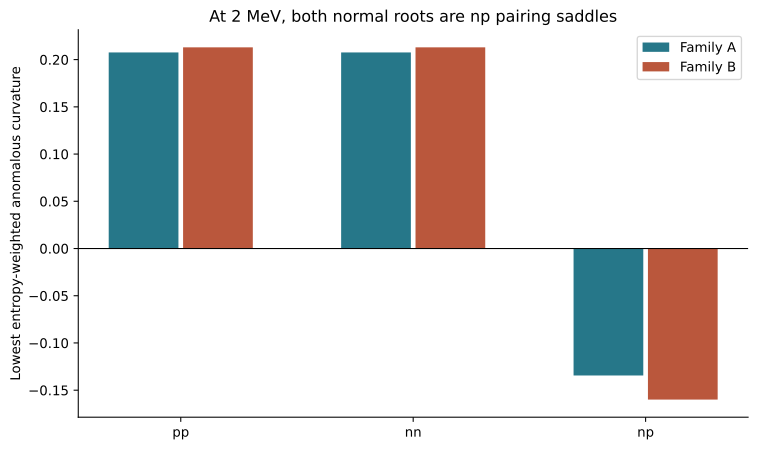
Dimensionless entropy-weighted local curvatures of finite-box Gaussian states at L=3, filling 0.25 and mean Np=Nn=3.375. Each family uses its own unchanged charge-conserving Hamiltonian. All pp/nn directions shown are positive; the lowest np direction is negative. Fixed-mean-charge Helmholtz paths independently reproduce the curvatures, and normal-sector tests are separately positive. Nonstationary finite-amplitude searches are not plotted as paired solutions. No exact-number, thermodynamic, field-response or phase-boundary claim follows.
Data · Provenance · PNG · SVG
Independent exclusive quartet breakup through spectator l=4
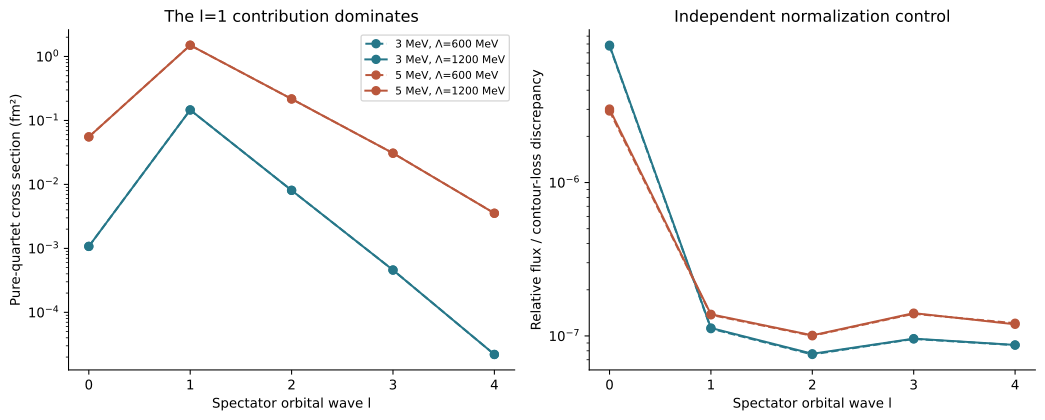
Orientation-integrated single-wave flux follows the Legendre addition theorem and an independently normalized dimer residue and three-body phase space. Elastic loss is used only as a separate comparator. Pair forces remain S wave; spectator l=0…4 are shown at two energies and cutoffs. Cutoff differences and numerical discrepancies are not EFT error bars. Multiply pure-quartet cross sections by 2/3 for their unpolarized contribution. This quartet component supplies no rigorous infinite-wave bound or validated coherent differential spectrum. The subsequent doublet S-wave component has separate evidence; charged three-body breakup remains unfinished.
Data · Provenance · PNG · SVG
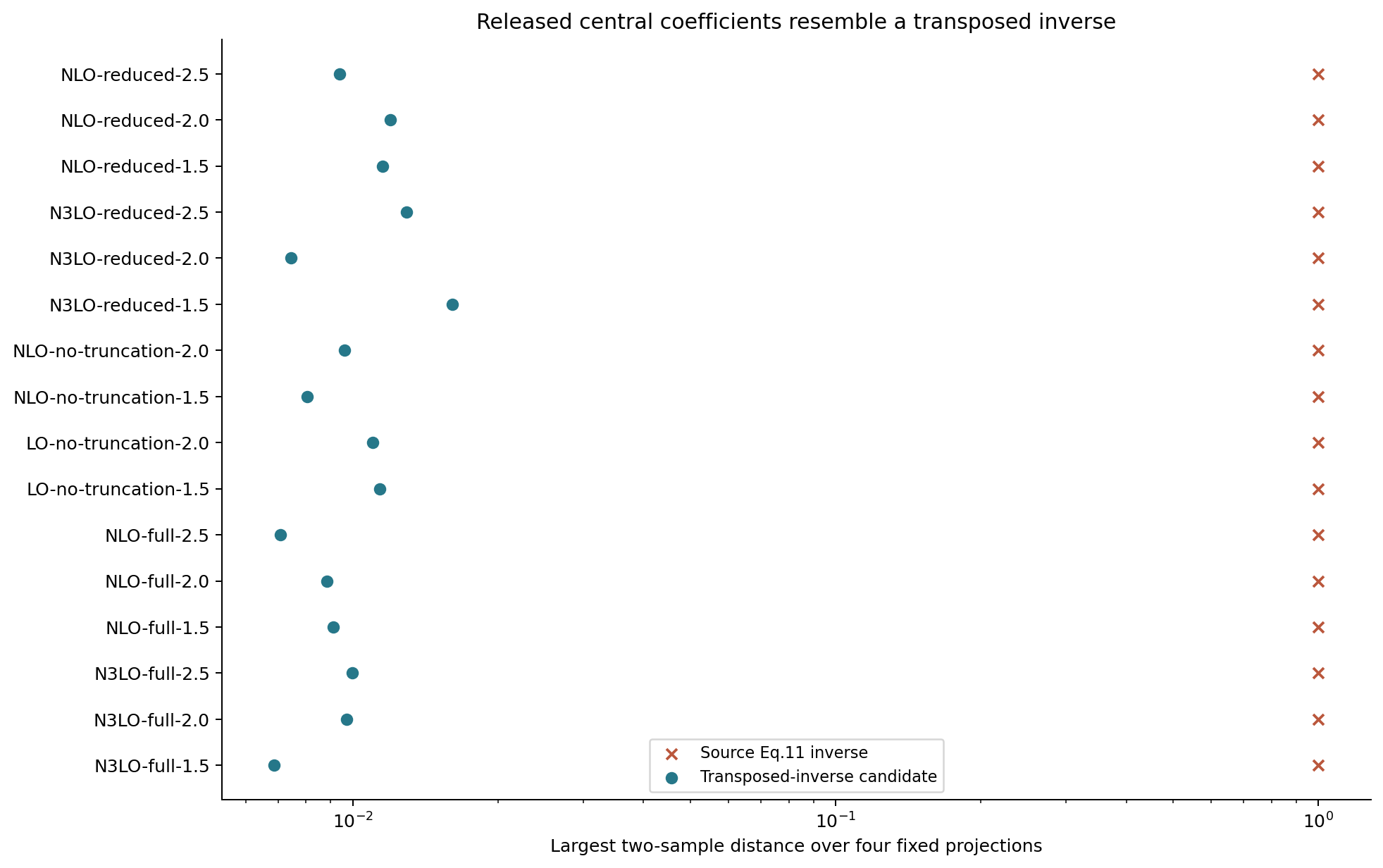
A distributional clue to the released posterior basis discrepancy
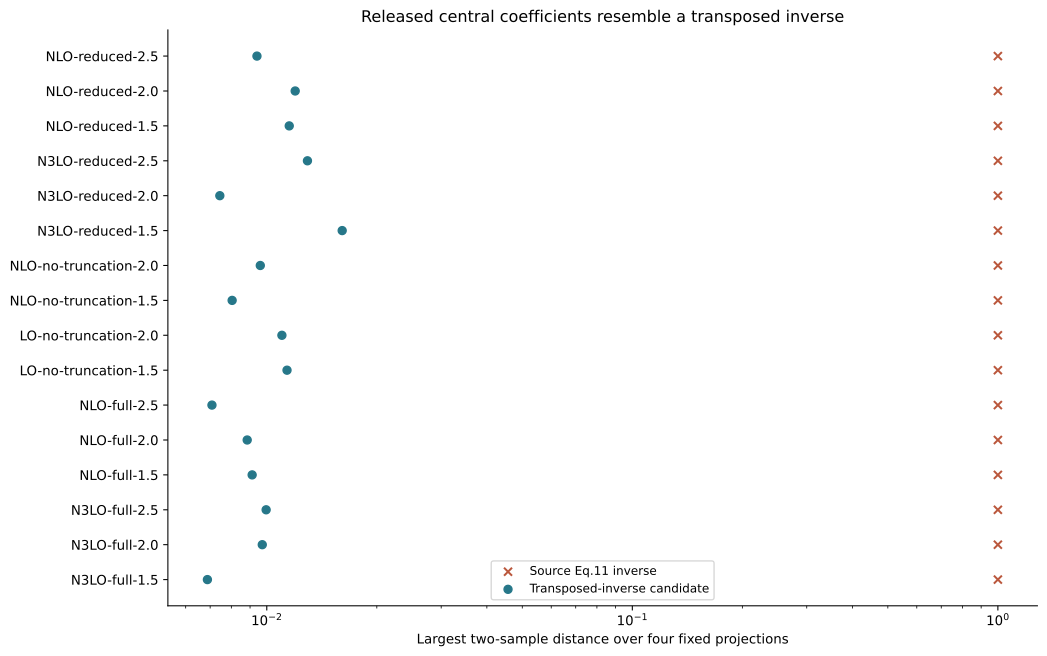
All 16 released standard/channel table pairs are compared without assuming paired CSV rows. The correct source Eq.11 inverse produces maximum projected distribution distance 1 in every table; transposing that inverse gives 0.00688–0.01608. These descriptive distances support a diagnostic candidate only: four projections neither establish full multivariate equality nor reveal upstream implementation. No p-value, corrected source posterior, new calibration or finite-field response is claimed.
Data · Provenance · PNG · SVG
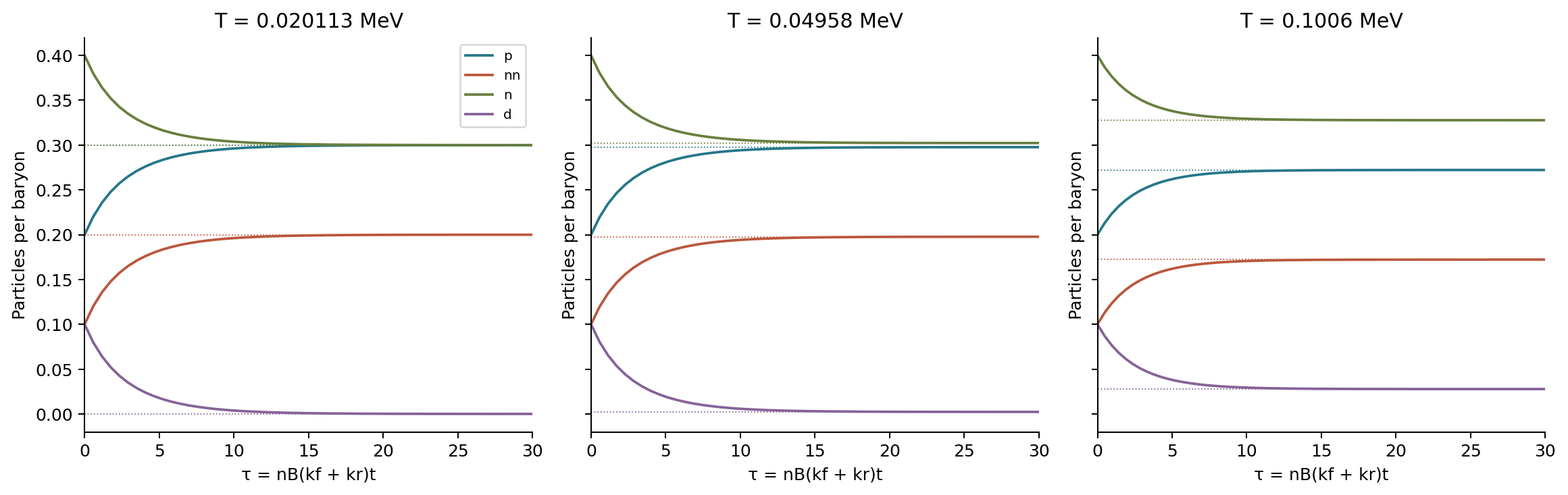
A compatible four-species transfer control reaches detailed-balance equilibrium
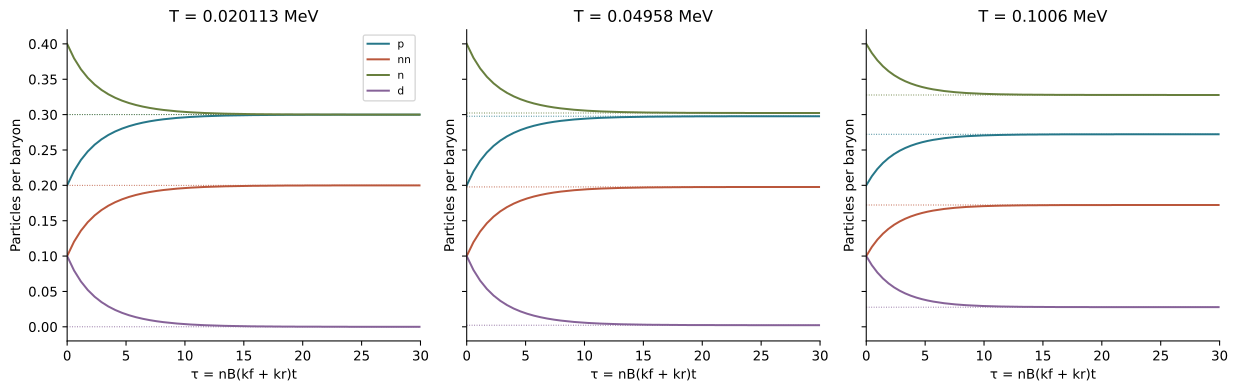
Frozen LO p+nn to n+d forward rates with independently recomputed reverse rates evolve a constant dilute Maxwell gas. Dotted lines are independent reaction-extent equilibrium roots. Dimensionless time is explicitly normalized separately at each temperature. The zero-tail closure is plotted; the unitarity S-wave tail changes dimensional time while preserving this equilibrium. Tritium is absent because its old network mass fails the contract. No complete BBN abundance, thermal-tail error bound, field history or cosmological inference is supplied.
Data · Provenance · PNG · SVG
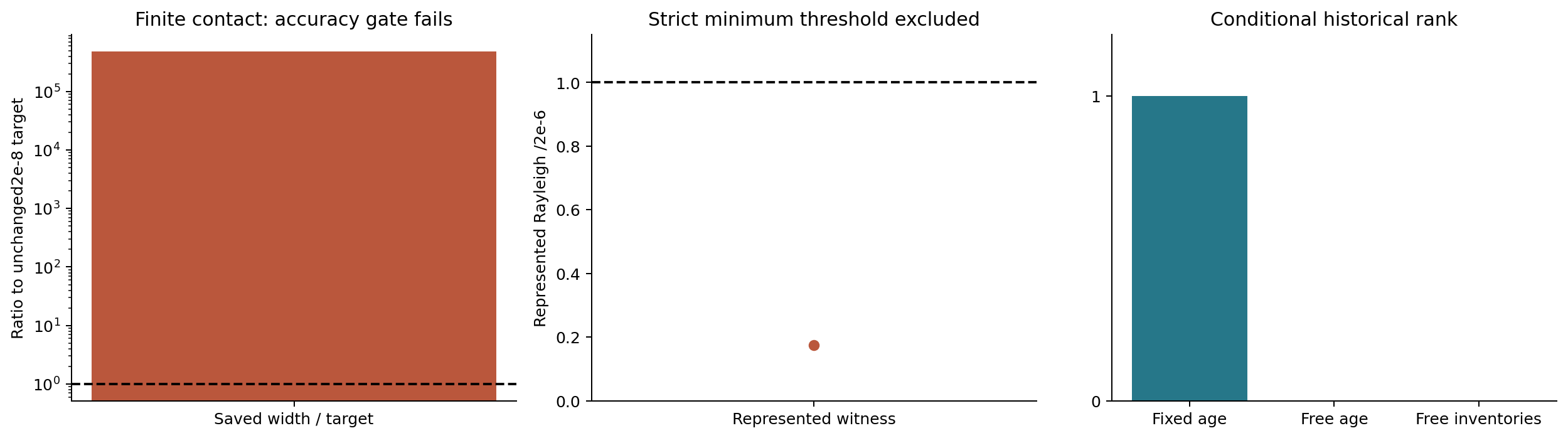
Checkpoint21: reviewed calculations retain failed gates and non-identifiability
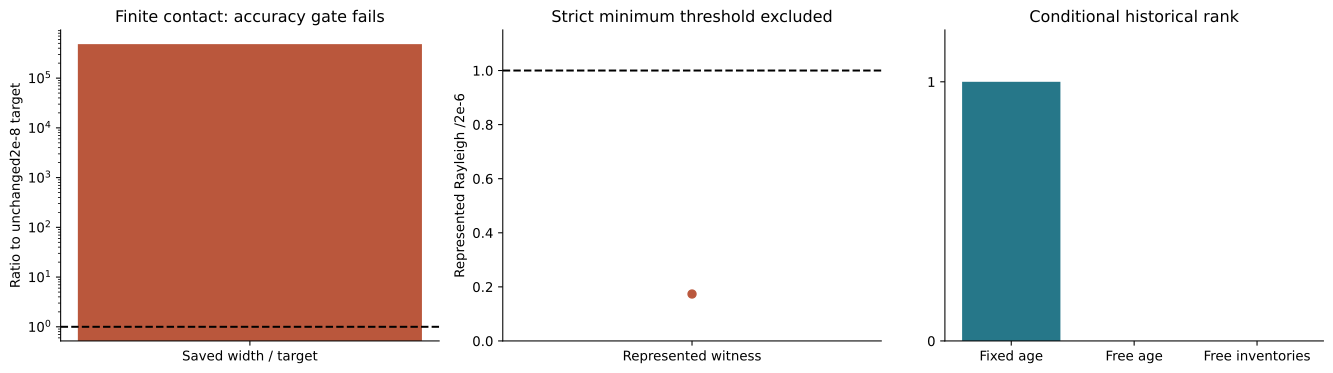
The finite screened-contact source width exceeds its unchanged accuracy target. An exact represented raw-block Rayleigh upper enclosure falls below the unchanged strictminimum threshold, excluding that represented promotion; no physical negative eigenvalue or root/operator error certificate follows. Re-only rank vanishes when chronology or initial inventories are free. These are separately scoped results, not a viable field or matched astrophysical prediction.
Data · Provenance · PNG · SVG