Reproducible component calculations and analytic controls. No matched stellar history, new measurement, or explanation of missing peers is established.
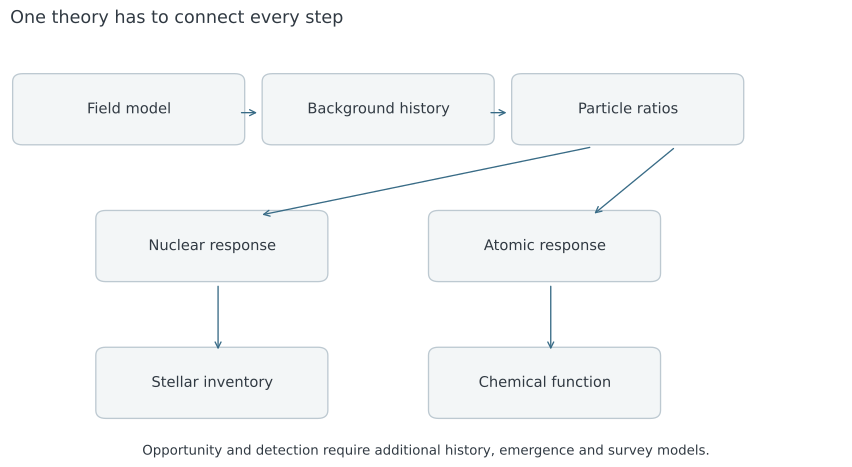
Conceptual schematic. Nuclear production and present-day chemistry are separate branches; observations constrain their shared model.Inputs, units and provenance · PNG · SVG
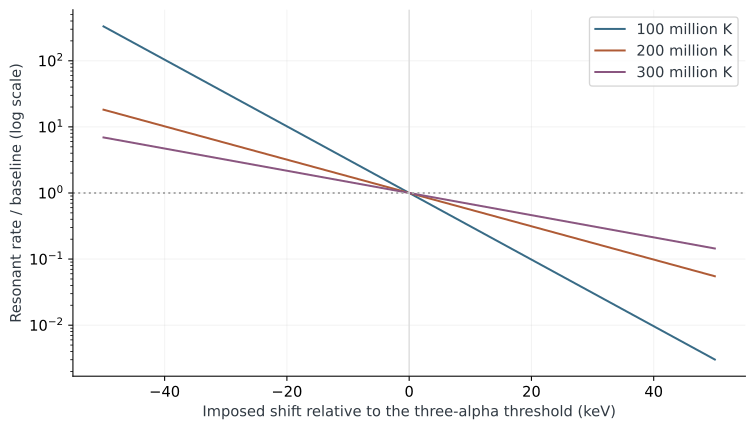
Sensitivity before a star responds
Analytic control: exp(−ΔEᵣ/kBT) at three fixed temperatures. Only the resonant component is shown; the historical total rate is retained in the data.Inputs, units and provenance · PNG · SVG
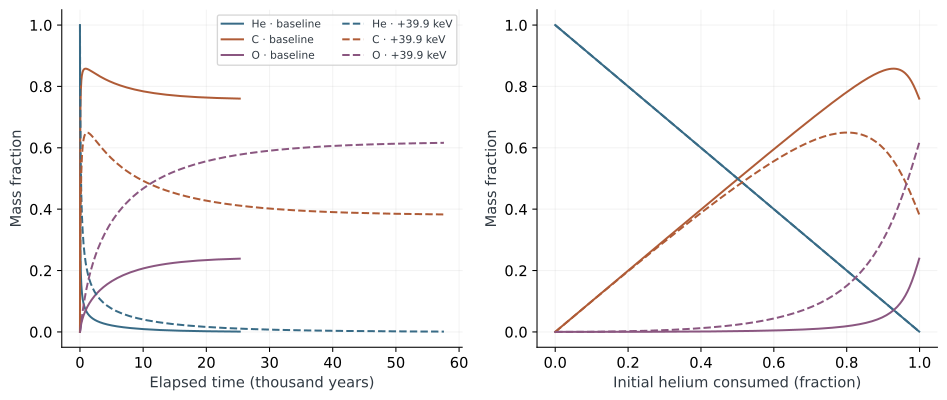
Composition and time answer different questions
New integration of a fixed-temperature parcel: 200 million K, 10,000 g/cm³. Solid: baseline; dashed: imposed +39.9 keV. Lines end at 99.9% helium consumption.Inputs, units and provenance · PNG · SVG
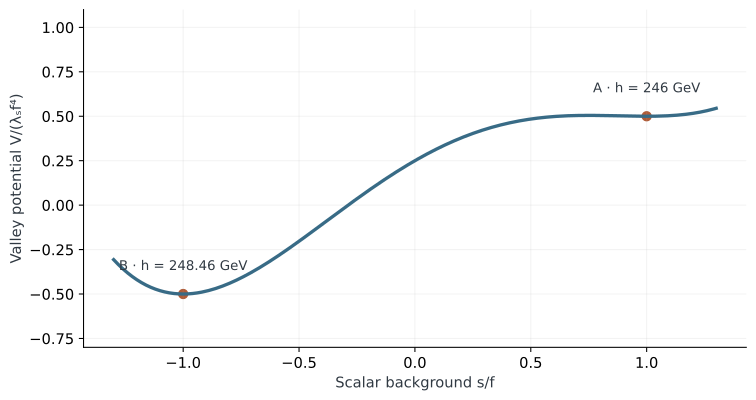
Two backgrounds in one classical model
Stipulated scalar–Higgs potential along its Higgs-minimizing valley; f=100 GeV, λₛ=0.125, ε=1. The energy difference is 1.25×10⁷ GeV⁴.Inputs, units and provenance · PNG · SVG
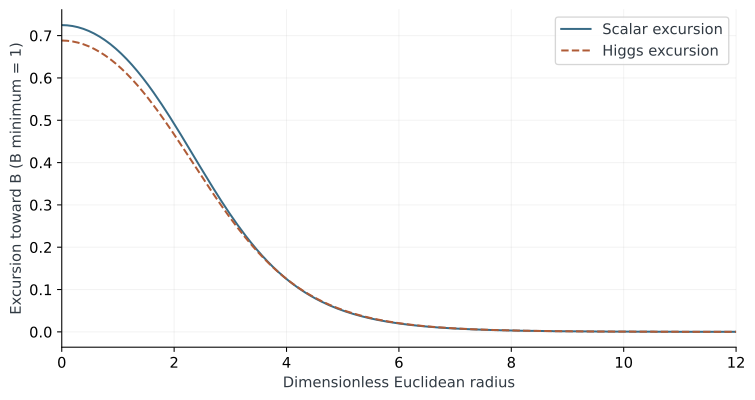
A reproduced tunneling profile
Reproduced tree-level, zero-temperature, flat-space two-field bounce. Euclidean radius is not elapsed time; the profile is never animated as a crossing.Inputs, units and provenance · PNG · SVG
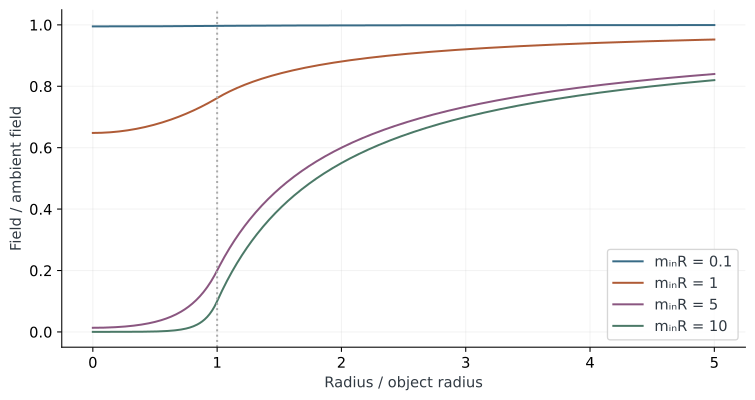
Screening can remove the interior contrast
Linear spherical screening control, checked against a boundary-value solver. The core fraction is sech(mᵢₙR). These are idealized objects, not stellar profiles.Inputs, units and provenance · PNG · SVG
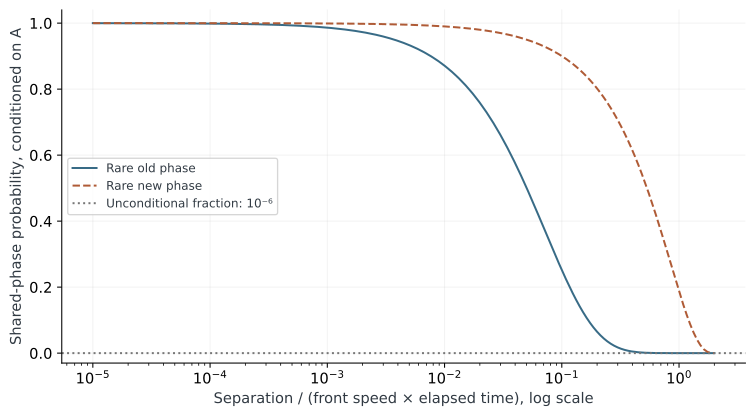
Globally rare, locally shared
Analytic flat-space Poisson-front geometry. Each curve conditions on A occupying the phase with marginal fraction 10⁻⁶. Monte Carlo validates cone overlap, not alien-life probabilities.Inputs, units and provenance · PNG · SVG
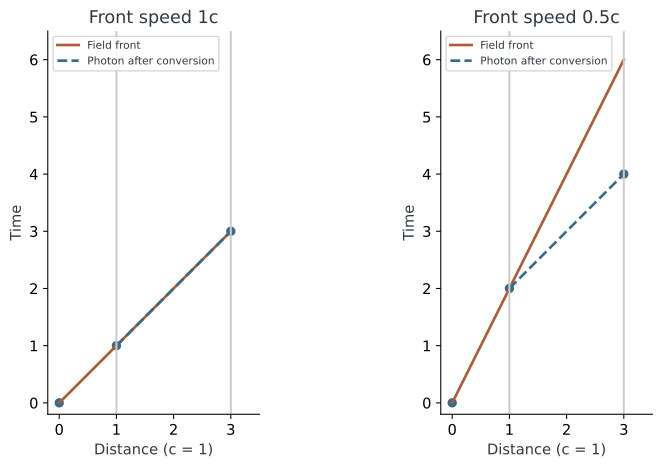
Which changed sources can we see?
Kinematic spacetime control, with c=1 and equal axis units. In the collinear light-speed case the photon and direct front arrive together. A stipulated slower front can be preceded by the photon.Inputs, units and provenance · PNG · SVG
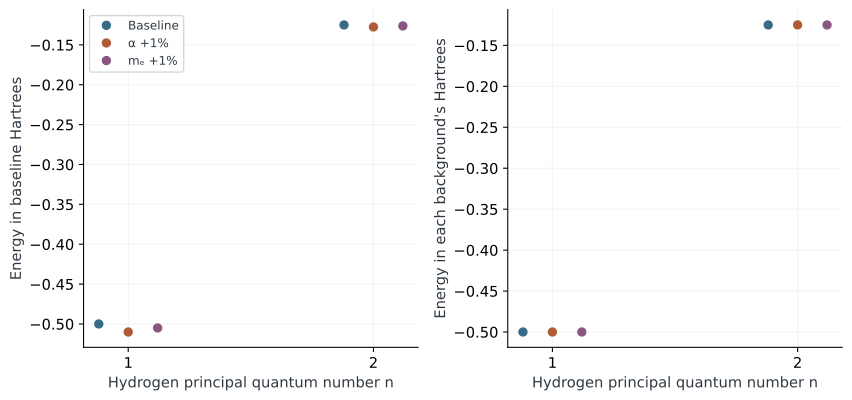
A changed scale can preserve the structure
Independent hydrogen eigensolves. Changing α or electron mass changes energies in reference units; the energies collapse in each background's Hartree units. Markers are offset horizontally for legibility.Inputs, units and provenance · PNG · SVG